A spine-zapping implant helped 3 people with a muscle-wasting disease walk better

Advertisement

Advertise with us

WASHINGTON (AP) — Three people with a muscle-destroying disease destined to worsen got a little stronger – able to stand and walk more easily – when an implanted device zapped their spinal cord.

Read this article for free:


or

Already have an account? Log in here »

To continue reading, please subscribe:

Subscribe and receive a limited-edition Free Press branded hat or tote.

Digital Subscription

One year of digital access for only $205*

  • Enjoy unlimited reading on winnipegfreepress.com
  • Read the E-Edition, our digital replica newspaper
  • Access News Break, our award-winning app
  • Play interactive puzzles

*First annual payment billed as $205.00 + GST for one year. This annual subscription will automatically renew at $233.00 + GST every 52 weeks (10% off the regular annual price of $259.35). Offer available to new and qualified returning subscribers only. Cancel any time.

To continue reading, please subscribe:

Add Free Press access to your Brandon Sun subscription for only an additional

$1 for the first 4 weeks*

  • Enjoy unlimited reading on winnipegfreepress.com
  • Read the E-Edition, our digital replica newspaper
  • Access News Break, our award-winning app
  • Play interactive puzzles
Start now

*Your next Brandon Sun subscription payment will increase by $1.00 and you will be charged $17.95 plus GST for four weeks. After four weeks, your payment will increase to $24.95 plus GST every four weeks.

Hey there, time traveller!
This article was published 05/02/2025 (612 days ago), so information in it may no longer be current.

WASHINGTON (AP) — Three people with a muscle-destroying disease destined to worsen got a little stronger – able to stand and walk more easily – when an implanted device zapped their spinal cord.

On Wednesday, researchers reported what they called the first evidence that a spine-stimulating implant already being tested for paralysis might also aid neurodegenerative diseases like spinal muscle atrophy – by restoring some muscle function, at least temporarily.

“These people were definitely not expecting an improvement,” said Marco Capogrosso, an assistant professor at the University of Pittsburgh who led the research. Yet over the month-long pilot study, “they were getting better and better.”

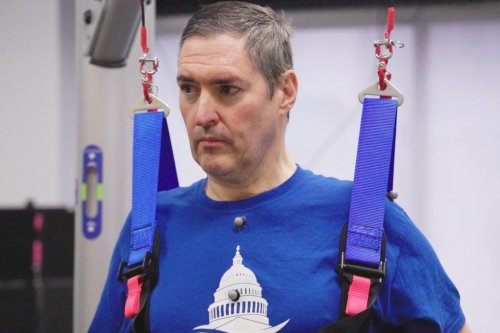
This image from video provided by UPMC and University of Pittsburgh Health Sciences shows Doug McCullough, who has spinal muscular atrophy, during tests of experimental spinal cord stimulation to improve muscle function in Pittsburgh, on March 14, 2023. (UPMC, University of Pittsburgh Health Sciences via AP)

Spinal muscle atrophy or SMA is a genetic disease that gradually destroys motor neurons, nerve cells in the spinal cord that control muscles. That leads muscles to waste away, especially in the legs, hips and shoulders and sometimes those involved with breathing and swallowing. There is no cure. A gene therapy can save the lives of very young children with a severe form of the disease, and there are some medicines to slow worsening in older patients.

Stimulating the spinal cord with low levels of electricity has long been used to treat chronic pain but Capogrosso’s team also has tested it to help people paralyzed from strokes or spinal cord injury move their limbs unaided. While turned on, it zaps circuits of dormant nerves downstream of the injury to activate muscles.

Then Capogrosso wondered if that same technology might help SMA in a similar way — by revving up related sensory nerves so they wake up damaged muscle cells, helping them move to combat wasting.

The Pitt researchers implanted electrodes over the lower spinal cord of three adults with SMA and tested their muscle strength, fatigue, range of motion and changes in gait and walking distance when the device was firing and when it was turned off.

It didn’t restore normal movement but with just a few hours of spinal stimulation a week, all quickly saw improvements in muscle strength and function, researchers reported in the journal Nature Medicine.

“With a progressive disease you never get any better,” said study participant Doug McCullough, 57, of Franklin Park, New Jersey. “Either you’re staying stable or getting worse. So having any improvement is just a really surreal and very exciting benefit.”

All three participants significantly increased how far they could walk in six minutes, and one who initially couldn’t stand from a kneeling position could by the study’s end, Capogrosso said. And McCullough’s gait changed so that each step was about three times longer.

“They get less fatigued so they can walk for longer,” Capogrosso said. “Even a person this many years into the disease can improve.”

Intriguingly, researchers found the improvements didn’t disappear as soon as the stimulator was switched off, though they did fade as participants were tracked after the study ended.

McCullough said even when the stimulator was turned off, some nights his legs “would just feel supercharged.”

While he understood that the device had to be removed at the study’s end, he was disappointed. He said there were some lingering benefits at his six-week checkup, but none after six months.

Neuroscientist Susan Harkema, who led pioneering studies of stimulation for spinal cord injuries while at the University of Louisville, cautioned the new study is small and short but called it an important proof of concept. She said it’s logical to test the technique against a list of muscle-degenerating diseases.

“Human spinal circuitry is very sophisticated – it’s not just a bunch of reflexes controlled by the brain,” said Harkema, now with the Kessler Foundation, a rehabilitation research nonprofit. “This is a very solid study, an important contribution to move forward.”

At Pitt, Capogrosso said some small but longer studies are getting underway.

___

The Associated Press Health and Science Department receives support from the Howard Hughes Medical Institute’s Science and Educational Media Group and the Robert Wood Johnson Foundation. The AP is solely responsible for all content.


Report Error Submit a Tip

More Stories

Sex offender who changed name sent back to prison

Dean Pritchard 7 minute read Preview

Sex offender who changed name sent back to prison

Dean Pritchard 7 minute read Wednesday, Oct. 7, 2026

The father of a boy repeatedly abused by convicted sex predator Ryan Knight said he believes his son would have been kept safe had there been a law in place preventing sex offenders from legally changing their name.

Read
Wednesday, Oct. 7, 2026

See silver lining to your impossible crush

Maureen Scurfield 4 minute read Yesterday at 2:01 AM CDT

DEAR MISS LONELYHEARTS: I’m in love with my sister’s boyfriend, and neither one of them knows it. They’re both grad students and came back home from the province where they are studying to write and spend the summer in Manitoba.

Thankfully, they’ve gone back home because it was becoming too much for me to bear. My sister’s guy is perfect for me, but she already owns him and I’m too young to fight her for him.

Still, the two of them don’t realize the depth of my feelings. I don’t know how to behave when they get cosy around me and I feel so jealous I want to scream. I’m not sure what to do next.

This week I got an email from my artsy-fartsy sister with an invitation to come visit them in December and go to some fun plays and parties with them and their friends. They even promised my Christmas present from them will be my plane ticket.

Consequences of verdict on City Football Group satellites primed to be even more damaging

Jerrad Peters 5 minute read Preview

Consequences of verdict on City Football Group satellites primed to be even more damaging

Jerrad Peters 5 minute read 4:44 PM CDT

There is a map of the world on which City Football Group shades its influence in blue.

As an illustration, it is not so different from those maps that show the Roman Empire’s territory — mostly around the Mediterranean, coloured red in history textbooks — or on which the extent of the British Empire — also in red — takes up about a fifth of the page.

The visual effect is not an accident.

This map, published on City Football Group’s official website, is introduced by a preamble that declares the holding company to be “the world’s leading private owner and operator of football clubs — with total or partial ownership of 12 worldwide.”

Read
4:44 PM CDT

A spine-zapping implant helped 3 people with a muscle-wasting disease walk better

Lauran Neergaard, The Associated Press 4 minute read Preview

A spine-zapping implant helped 3 people with a muscle-wasting disease walk better

Lauran Neergaard, The Associated Press 4 minute read Wednesday, Feb. 5, 2025

WASHINGTON (AP) — Three people with a muscle-destroying disease destined to worsen got a little stronger – able to stand and walk more easily – when an implanted device zapped their spinal cord.

On Wednesday, researchers reported what they called the first evidence that a spine-stimulating implant already being tested for paralysis might also aid neurodegenerative diseases like spinal muscle atrophy – by restoring some muscle function, at least temporarily.

“These people were definitely not expecting an improvement,” said Marco Capogrosso, an assistant professor at the University of Pittsburgh who led the research. Yet over the month-long pilot study, “they were getting better and better.”

Spinal muscle atrophy or SMA is a genetic disease that gradually destroys motor neurons, nerve cells in the spinal cord that control muscles. That leads muscles to waste away, especially in the legs, hips and shoulders and sometimes those involved with breathing and swallowing. There is no cure. A gene therapy can save the lives of very young children with a severe form of the disease, and there are some medicines to slow worsening in older patients.

Read
Wednesday, Feb. 5, 2025

Police on scene at Fairmont hotel construction site

1 minute read Updated: 12:19 AM CDT

At least three police cars were present at the under-construction Fairmont Winnipeg Thursday evening.

The nature of the response was unclear, but officers were guiding traffic outside of the construction zone at 2 Lombard Place while the response was underway. At 6:50 p.m., traffic was flowing normally.

Security on site provided no information on the response, but an individual working behind site fencing told the Free Press there’d be no comment from anyone on site as to why police were on scene at this time.

An SUV with a Government of Manitoba logo on its side was also present alongside personnel from Manitoba Workplace Safety and Health. However, it’s unknown if it’s connected to the police response.

PCs renew calls for CFS inquiry

Carol Sanders 6 minute read Preview

PCs renew calls for CFS inquiry

Carol Sanders 6 minute read Updated: Yesterday at 7:54 PM CDT

The Progressive Conservatives renewed calls to put Manitoba’s child and welfare system under the microscope Thursday, tabling a motion that urged the province to appoint a commissioner to lead a public inquiry.

Families critic Jodie Byram’s opposition day motion, which was ultimately defeated by the NDP majority, reiterated demands for an inquiry into the systemic failures of Child and Family Services, more than 20 years after the death of Phoenix Sinclair first prompted demands for answers.

“We have seen far too many children die under the care of CFS, and we need to determine where the gaps are in the system in order to make the system a safer place for children,” Byram told reporters before the motion was defeated in the legislature.

Families Minister Nahanni Fontaine said in an interview that her department, CFS agencies and authorities are “doing good work” and won’t call an inquiry.

Read
Updated: Yesterday at 7:54 PM CDT