‘A wake-up call’: Report urges agri-food export diversification amid tariff threat

Advertisement

Advertise with us

TORONTO - The Canadian agriculture industry needs to expand its international exports to hold its own against U.S. tariffs and global competitors, according to a new report from RBC.

Read this article for free:


or

Already have an account? Log in here »

To continue reading, please subscribe:

Subscribe and receive a limited-edition Free Press branded hat or tote.

Digital Subscription

One year of digital access for only $205*

  • Enjoy unlimited reading on winnipegfreepress.com
  • Read the E-Edition, our digital replica newspaper
  • Access News Break, our award-winning app
  • Play interactive puzzles

*First annual payment billed as $205.00 + GST for one year. This annual subscription will automatically renew at $233.00 + GST every 52 weeks (10% off the regular annual price of $259.35). Offer available to new and qualified returning subscribers only. Cancel any time.

To continue reading, please subscribe:

Add Free Press access to your Brandon Sun subscription for only an additional

$1 for the first 4 weeks*

  • Enjoy unlimited reading on winnipegfreepress.com
  • Read the E-Edition, our digital replica newspaper
  • Access News Break, our award-winning app
  • Play interactive puzzles
Start now

*Your next Brandon Sun subscription payment will increase by $1.00 and you will be charged $17.95 plus GST for four weeks. After four weeks, your payment will increase to $24.95 plus GST every four weeks.

Hey there, time traveller!
This article was published 25/02/2025 (566 days ago), so information in it may no longer be current.

TORONTO – The Canadian agriculture industry needs to expand its international exports to hold its own against U.S. tariffs and global competitors, according to a new report from RBC.

Amid the looming tariff threat, the report says Canada’s agriculture and agri-food sector is vulnerable as more than 60 per cent of its exports go to the U.S.

It argues Canada has become too reliant on the U.S. for those exports, and over the years has become a dominant supplier for American grocery stores.
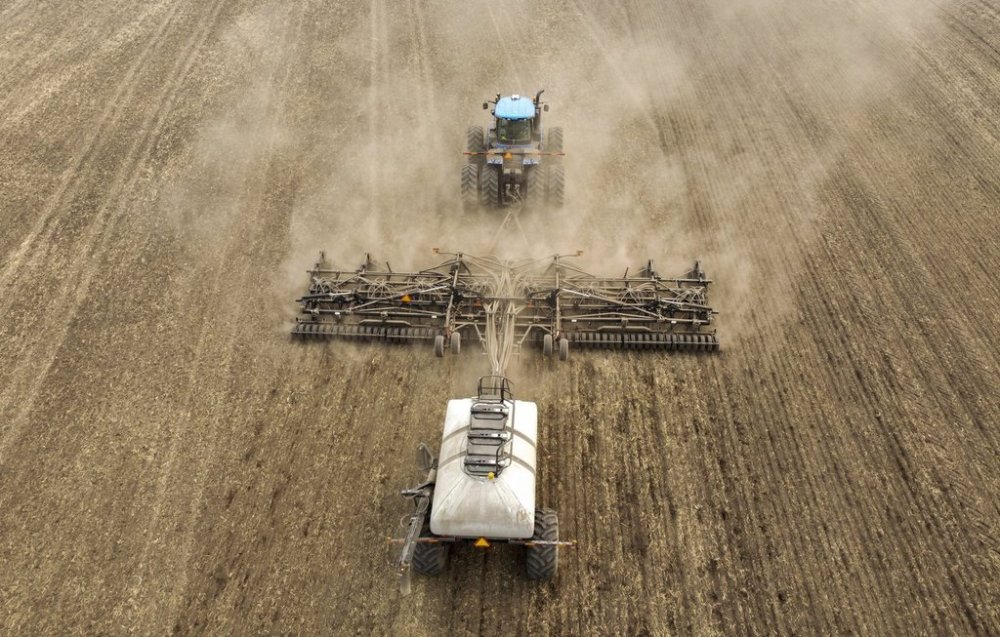
David Reid drives a seeding rig as he plants a canola crop on the family's farm near Cremona, Alta., Tuesday, May 16, 2023. THE CANADIAN PRESS/Jeff McIntosh

For instance, about 96 per cent of Canada’s canola oil went to the U.S. in 2024, while Canada also supplies the vast majority of potash for American farmers.

As a result of the growing relationship, Canada’s agri-food manufacturing sector quietly became the country’s largest source of manufacturing, the report said. Both countries have benefitted from their strong trading relationship.

But these advantages are now in jeopardy.

Tariffs on agriculture and agri-food products will make Canada a less desirable trading partner to the U.S. relative to other low-cost producers such as China and the Netherlands, the report said.

“Food and beverage manufacturing may also struggle to maintain investment levels, as one of its biggest selling features has been its preferential access to the world’s largest market.”

On the global stage, Canada is falling behind, with rivals like Brazil and Australia gaining market share in key markets, the report said. That means there are opportunities for diversification.

The report argues that Canada should start by taking advantage of its existing free-trade agreements, which provide access to more than two-thirds of the global economy. The next step is taking advantage of new growth markets, including in Southeast and South Asia.

India is another clear opportunity, the report said, in particular for plant-based proteins, where Canada can excel with its production of peas, lentils and soybeans.

But with the right measures, the report says Canada can increase its global share of agri-food exports, adding $44 billion in export value for the sector by 2035.

“To regain market share, Canada needs to focus on innovation, investment, export-oriented infrastructure, digital infrastructure, and overseas agri-food promotion,” the report said.

The report recommends that Canada invest in innovation in the agri-food sector, as well as fix internet and cellphone access in rural areas so farmers are able to adopt the latest generation of technology.

It also recommends investing in Canada’s export infrastructure to improve turnaround times at ports, as well as marketing Canadian products more effectively on the world stage.

The report envisions Canada making big strides in growing key industries such as the greenhouse sector, aquaculture and beef.

“Moving from short-term reactionary tactics to strategic growth, Canada can use the U.S. tariff threats as a wake-up call to leverage agriculture and agri-food as a driving force for trade diversification while building Canadian self-sufficiency.”

This report by The Canadian Press was first published Feb. 25, 2025.

Report Error Submit a Tip

More Stories

Port of Churchill expansion could chase belugas away, U of M researcher says

Nicole Buffie 4 minute read Preview

Port of Churchill expansion could chase belugas away, U of M researcher says

Nicole Buffie 4 minute read Yesterday at 9:07 AM CDT

As plans to expand the Port of Churchill into a four-season trade corridor gathers momentum, a University of Manitoba researcher has published a report on what ship traffic could mean for the beluga whales that gather in the Churchill River estuary each summer.

Veronica Coppolaro said more vessels in the waterways bring a risk that belugas will stop using the estuary for migration, which would impact the ecological landscape, tourism and communities that rely on the animals for food and cultural purposes.

“There are studies showing that (noises) change the way they swim, they change the way (the whales) are vocalizing, they change their main activity, and so this (expansion) can have consequences at different levels,” she said.

The Churchill river estuary is a marine habitat where the Churchill River empties into Hudson Bay. During the summer months belugas gather in the area to feed and give birth.

Read
Yesterday at 9:07 AM CDT

Bombers exact revenge in Banjo Bowl, lose Collaros to injury

Taylor Allen 6 minute read Preview

Bombers exact revenge in Banjo Bowl, lose Collaros to injury

Taylor Allen 6 minute read Saturday, Sep. 12, 2026

Redha Kramdi downplayed the significance of his return for the Winnipeg Blue Bombers.

“I don’t think I have that big of an impact,” said Kramdi on Tuesday, who watched the club go 2-4 while he was sidelined with a cast on his left hand.

It sounded silly at the time, and it’s even sillier now considering how exceptional the 29-year-old safety from Montreal was in Saturday’s 22nd edition of the Banjo Bowl.

Kramdi caused two turnovers — a forced fumble and an interception — to lead the Bombers to a 19-6 victory over the Saskatchewan Roughriders in front of a sell-out crowd at Princess Auto Stadium.

Read
Saturday, Sep. 12, 2026

Menstruation, consent move up in sex-ed lesson plan

Maggie Macintosh 5 minute read Preview

Menstruation, consent move up in sex-ed lesson plan

Maggie Macintosh 5 minute read 6:00 AM CDT

Manitoba’s newest curriculum introduces the menstrual cycle earlier and repeatedly calls for explicit lessons on how students can give, seek, and decline to provide their consent.

The education department has released its sweeping proposal to overhaul how exercise, nutrition and sexuality are taught between kindergarten and Grade 12.

Grade 5 has long served as a key turning point for “the talk,” said J Fiedler, a sexual and reproductive health educator who provided input on the new curriculum.

“There’s no ‘the talk’ anymore. Now, there’s continuations of multiple ‘talks,’ which can hopefully reduce stress for students and stigma that people experience talking about sexuality.”

Read
6:00 AM CDT

Pokemon thieves clear out collectibles shop

Scott Billeck 5 minute read Preview

Pokemon thieves clear out collectibles shop

Scott Billeck 5 minute read Friday, Sep. 11, 2026

Terri Settle loved watching children walk into her collectibles shop to hunt for their favourite Pokemon cards.

After the latest break in stripped her shelves of much of the inventory, she’s not sure she’ll get to see it again.

Thieves broke into Terri’s Trinkets and Toys on Tuesday evening, punching through a grate and then the store’s bathroom wall to reach the storefront.

They made off with about $6,000 worth of merchandise, including all of the store’s Pokemon cards — about 7,000 of them — along with toys, Lego, jewelry, video games, a debit machine and personal laptop. They even took her vacuum cleaner.

Read
Friday, Sep. 11, 2026

‘Didn’t realize how close I was’ to getting hit, pedestrian says

Scott Billeck 5 minute read Preview

‘Didn’t realize how close I was’ to getting hit, pedestrian says

Scott Billeck 5 minute read Updated: 3:18 PM CDT

A West Broadway pedestrian says it was like a scene straight out of the movies as he narrowly avoided being plowed into during a midday police pursuit.

Adam Orbanski was crossing Langside Street along Broadway Friday and had just made it to the curb when a vehicle slammed into another metres away from him.

“It’s pretty crazy,” Orbanski said Monday after viewing security footage of the incident captured by a nearby business. “I didn’t realize how close I was, I guess, until my friend sent me the security footage. I’m lucky to be alive.”

Orbanski said he was walking home from work when he began to hear sirens. As he crossed Langside, he could see one vehicle approaching him quickly.

Read
Updated: 3:18 PM CDT

Finding fulfilment as canines’ companion

AV Kitching 9 minute read Preview

Finding fulfilment as canines’ companion

AV Kitching 9 minute read 6:00 AM CDT

Tim Campbell loves dogs. He loves them so much that as soon he retired from his job at Panasonic Canada in early 2024 he began volunteering in earnest at the Winnipeg Humane Society (WHS).

He’d started his voluntary career five years prior with another local dog rescue organization. The work was rewarding, he says but the call-outs were unpredictable.

He was looking for a voluntary role which had a bit more structure to it, something he could build a routine around, while spending time with the animals he truly adores.

“In the summer, I’m there two mornings a week, and when the weather turns a little colder, I’m there anywhere from three to four mornings, depending on what’s going on,” Campbell, 59, explains.

Read
6:00 AM CDT