A stroke survivor speaks again with the help of an experimental brain-computer implant

Advertisement

Advertise with us

Scientists have developed a device that can translate thoughts about speech into spoken words in real time.

Read this article for free:


or

Already have an account? Log in here »

To continue reading, please subscribe:

Subscribe and receive a limited-edition Free Press branded hat or tote.

Digital Subscription

One year of digital access for only $205*

  • Enjoy unlimited reading on winnipegfreepress.com
  • Read the E-Edition, our digital replica newspaper
  • Access News Break, our award-winning app
  • Play interactive puzzles

*First annual payment billed as $205.00 + GST for one year. This annual subscription will automatically renew at $233.00 + GST every 52 weeks (10% off the regular annual price of $259.35). Offer available to new and qualified returning subscribers only. Cancel any time.

To continue reading, please subscribe:

Add Free Press access to your Brandon Sun subscription for only an additional

$1 for the first 4 weeks*

  • Enjoy unlimited reading on winnipegfreepress.com
  • Read the E-Edition, our digital replica newspaper
  • Access News Break, our award-winning app
  • Play interactive puzzles
Start now

*Your next Brandon Sun subscription payment will increase by $1.00 and you will be charged $17.95 plus GST for four weeks. After four weeks, your payment will increase to $24.95 plus GST every four weeks.

Hey there, time traveller!
This article was published 31/03/2025 (503 days ago), so information in it may no longer be current.

Scientists have developed a device that can translate thoughts about speech into spoken words in real time.

Although it’s still experimental, they hope the brain-computer interface could someday help give voice to those unable to speak.

A new study described testing the device on a 47-year-old woman with quadriplegia who couldn’t speak for 18 years after a stroke. Doctors implanted it in her brain during surgery as part of a clinical trial.
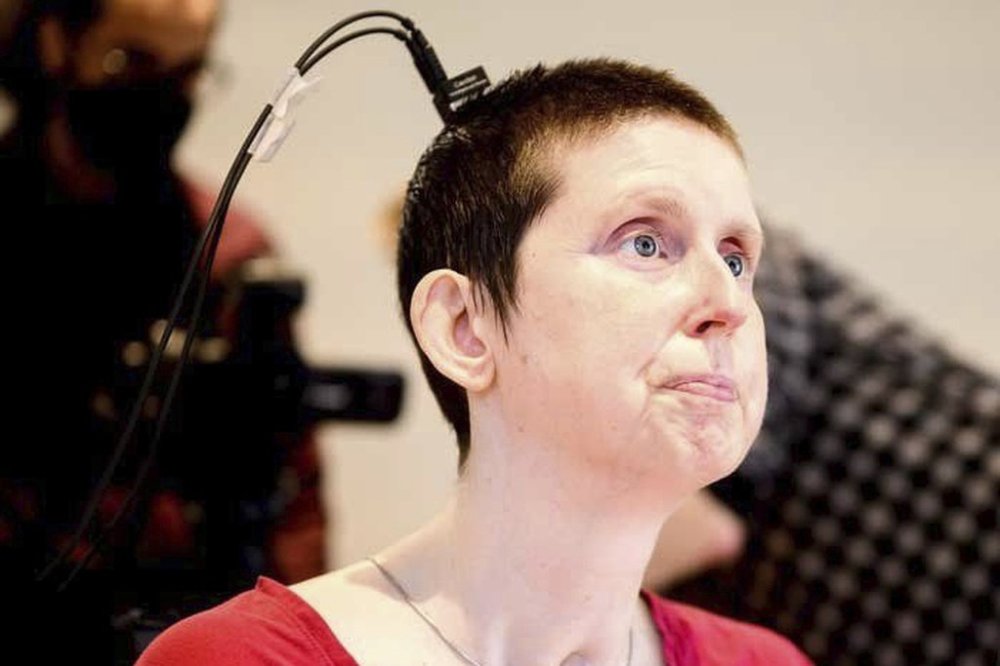
This photo provided by researchers at UCSF and UC Berkeley shows Ann, a participant in a study on speech neuroprostheses, in California in 2023. (Noah Berger/UCSF, UC Berkeley via AP)

It “converts her intent to speak into fluent sentences,” said Gopala Anumanchipalli, a co-author of the study published Monday in the journal Nature Neuroscience.

Other brain-computer interfaces, or BCIs, for speech typically have a slight delay between thoughts of sentences and computerized verbalization. Such delays can disrupt the natural flow of conversation, potentially leading to miscommunication and frustration, researchers said.

This is “a pretty big advance in our field,” said Jonathan Brumberg of the Speech and Applied Neuroscience Lab at the University of Kansas, who was not part of the study.

A team in California recorded the woman’s brain activity using electrodes while she spoke sentences silently in her brain. The scientists used a synthesizer they built using her voice before her injury to create a speech sound that she would have spoken. They trained an AI model that translates neural activity into units of sound.

It works similarly to existing systems used to transcribe meetings or phone calls in real time, said Anumanchipalli, of the University of California, Berkeley.

The implant itself sits on the speech center of the brain so that it’s listening in, and those signals are translated to pieces of speech that make up sentences. It’s a “streaming approach,” Anumanchipalli said, with each 80-millisecond chunk of speech – about half a syllable – sent into a recorder.

“It’s not waiting for a sentence to finish,” Anumanchipalli said. “It’s processing it on the fly.”

Decoding speech that quickly has the potential to keep up with the fast pace of natural speech, said Brumberg. The use of voice samples, he added, “would be a significant advance in the naturalness of speech.”

Though the work was partially funded by the National Institutes of Health, Anumanchipalli said it wasn’t affected by recent NIH research cuts. More research is needed before the technology is ready for wide use, but with “sustained investments,” it could be available to patients within a decade, he said.

___

The Associated Press Health and Science Department receives support from the Howard Hughes Medical Institute’s Science and Educational Media Group and the Robert Wood Johnson Foundation. The AP is solely responsible for all content.

Report Error Submit a Tip

More Stories

Trailblazing Western Scrap Metals heavy-equipment operator relishes role at massive crane’s control

David Sanderson 7 minute read Preview

Trailblazing Western Scrap Metals heavy-equipment operator relishes role at massive crane’s control

David Sanderson 7 minute read Friday, Aug. 14, 2026

Less than five per cent of heavy-equipment operators in the country are women but that number is trending upward, according to a study conducted by trade magazine Crane & Hoist Canada.

It was reported that in Ontario roughly eight per cent of jobs in the transport and heavy-equipment field are currently held by women. Furthermore, in 2024 almost 20 per cent of graduates at an Edmonton-based heavy-equipment operator training school were female, the article stated.

That brings us to Harmony Guspodarchuk, the first female crane operator in the 70-year history of Western Scrap Metals, a family-owned business at 18 Sutherland Ave.

Three years ago, Guspodarchuk literally stepped into the driver’s seat of a 27,500-kilogram, Liebherr C 924 Heavy Lift Litronic crane. The 29-year-old hasn’t looked back much since.

Read
Friday, Aug. 14, 2026

Oliveira shines in win over Redblacks, Collaros rocked again

Taylor Allen 5 minute read Preview

Oliveira shines in win over Redblacks, Collaros rocked again

Taylor Allen 5 minute read Yesterday at 8:57 PM CDT

It wasn’t a stellar performance by any stretch.

But at this point, the Winnipeg Blue Bombers will take a win no matter what it looks like.

The Blue and Gold outlasted the winless Ottawa Redblacks 33-21 on a rainy Friday night at Princess Auto Stadium to improve to 5-4.

“It’s great to finally get a win at home for our fans and to go out and play a better game is very encouraging,” said right guard Patrick Neufeld.

Read
Yesterday at 8:57 PM CDT

Could renewed interest in strategically critical rare earth elements finally make sub-sector profitable?

Joel Schlesinger 6 minute read Preview

Could renewed interest in strategically critical rare earth elements finally make sub-sector profitable?

Joel Schlesinger 6 minute read Yesterday at 3:00 AM CDT

Rare earth elements are among the most critical of mined resources for modern economies.

They’re essential in manufacturing specialized magnets used in a host of technologies from wind turbines and electric vehicles to hard drives, smartphones, television screens, and fibre optics. Most notably, however, rare earth minerals are increasingly vital to the defence industry.

These 17 elements — closely related chemically and usually found all together in mineral deposits — have indeed been growing in geopolitical importance as the United States, Canada and other Western nations recognize their dependence on production from China.

It is the world’s largest producer and processor of rare earths, including the most in-demand elements neodymium and praseodymium used to manufacture very light and powerful magnets for an array of technologies, including the most advanced weapons of modern warfare.

Read
Yesterday at 3:00 AM CDT

Development turning long-vacant gas station in Selkirk into commercial hub

By Tiago Resko 2 minute read Preview

Development turning long-vacant gas station in Selkirk into commercial hub

By Tiago Resko 2 minute read Thursday, Aug. 13, 2026

A plot of land that has sat vacant in Selkirk for 30 years is being redeveloped to host new businesses in the heart of the city.

The former gas station site on Main Street — between Rosser and Pacific avenues — will be turned into a commercial hub that will be home to six local businesses, and will be a big stepping stone for economic growth in Selkirk, Mayor Larry Johannson said Thursday.

“For decades this site has been a reminder of what once was. Today, it represents what is possible when investors see the potential of our community and choose to be a part of its future,” he said in a news release announcing the project and Thursday’s groundbreaking.

“This development reflects confidence in Selkirk, our economy and the direction we are heading.”

Read
Thursday, Aug. 13, 2026

WRHA directs three care homes to accommodate surge of hospital patients

Malak Abas 5 minute read Preview

WRHA directs three care homes to accommodate surge of hospital patients

Malak Abas 5 minute read Friday, Aug. 14, 2026

The Winnipeg Regional Health Authority has directed three long-term care centres to make space for hospital patients, citing “exceptionally high demand for care across the health-care system.”

Read
Friday, Aug. 14, 2026

A stroke survivor speaks again with the help of an experimental brain-computer implant

Laura Ungar, The Associated Press 3 minute read Preview

A stroke survivor speaks again with the help of an experimental brain-computer implant

Laura Ungar, The Associated Press 3 minute read Monday, Mar. 31, 2025

Scientists have developed a device that can translate thoughts about speech into spoken words in real time.

Although it’s still experimental, they hope the brain-computer interface could someday help give voice to those unable to speak.

A new study described testing the device on a 47-year-old woman with quadriplegia who couldn’t speak for 18 years after a stroke. Doctors implanted it in her brain during surgery as part of a clinical trial.

It “converts her intent to speak into fluent sentences,” said Gopala Anumanchipalli, a co-author of the study published Monday in the journal Nature Neuroscience.

Read
Monday, Mar. 31, 2025