As US abruptly ends support, Liberia faces empty health clinics and unplanned pregnancies
Advertisement
Read this article for free:
or
Already have an account? Log in here »
To continue reading, please subscribe:

Digital Subscription
One year of digital access for only $205*
- Enjoy unlimited reading on winnipegfreepress.com
- Read the E-Edition, our digital replica newspaper
- Access News Break, our award-winning app
- Play interactive puzzles
*First annual payment billed as $205.00 + GST for one year. This annual subscription will automatically renew at $233.00 + GST every 52 weeks (10% off the regular annual price of $259.35). Offer available to new and qualified returning subscribers only. Cancel any time.
To continue reading, please subscribe:
Add Free Press access to your Brandon Sun subscription for only an additional
$1 for the first 4 weeks*
- Enjoy unlimited reading on winnipegfreepress.com
- Read the E-Edition, our digital replica newspaper
- Access News Break, our award-winning app
- Play interactive puzzles
*Your next Brandon Sun subscription payment will increase by $1.00 and you will be charged $17.95 plus GST for four weeks. After four weeks, your payment will increase to $24.95 plus GST every four weeks.
Read unlimited articles for free today:
or
Already have an account? Log in here »
Hey there, time traveller!
This article was published 08/07/2025 (463 days ago), so information in it may no longer be current.
SARWORLOR, Liberia (AP) — Five months ago, Roseline Phay, a 32-year-old farmer from the West African nation of Liberia, set off on a quest to find contraceptives.
Phay and her partner have two daughters, and they barely make ends meet. Determined not to have more children, she went to a health worker in her village, but contraception pills, implants and condoms had run out. Phay trekked for hours on red clay roads to the nearest clinic, but they had no contraceptives either.
She did not know it, but her mission was doomed from the beginning. Just weeks before, U.S. President Donald Trump abruptly suspended most foreign aid through the U.S. Agency for International Development, which paid for medications in Liberia’s public clinics.
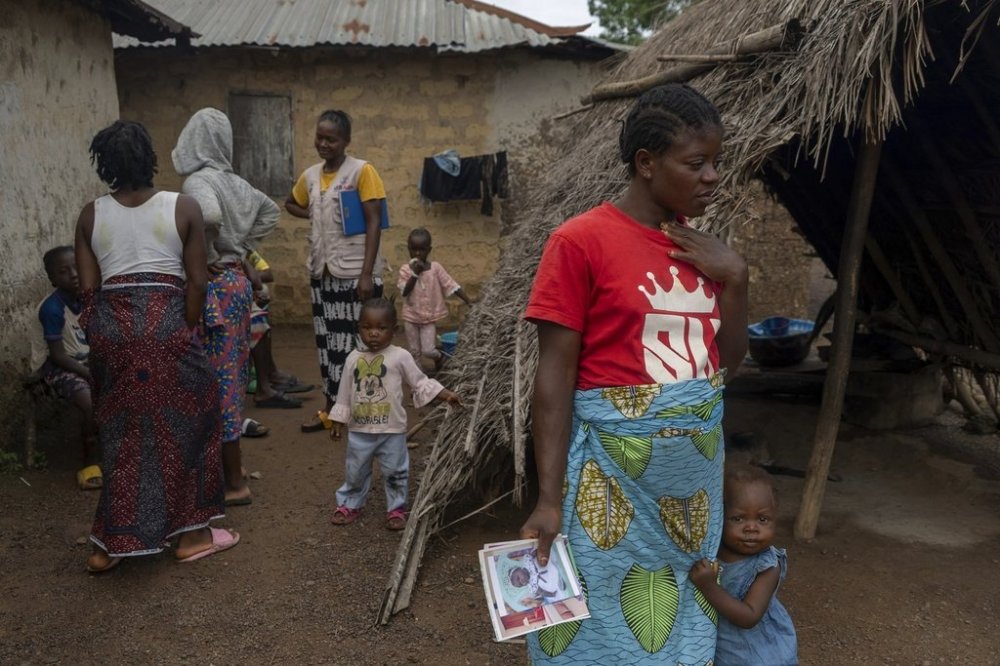
Tenacious and outspoken, Phay repeated the trip four times. Then she got pregnant.
“I’m suffering,” she said, with daughter Pauline crying in her arms. “I have this little child on my back, and the other child in my stomach is suffering.” She must continue farming throughout her pregnancy, she said, or “I will not eat.”
After she got pregnant she had to wean Pauline off breastfeeding, she said, and the girl became so badly malnourished that she almost died. The U.S. cuts left no therapeutic food to give her, and she is still ill.
Phay is among millions across Africa who have seen their lives upended after the U.S. aid cuts. In Liberia, the American support made up almost 2.6% of the gross national income, the highest percentage anywhere in the world, according to the Center for Global Development.
“The impact of USAID in Liberia cannot be overstated,” said Richlue O. Burphy, who worked for USAID projects for over a decade and manages the National Lottery, a government body. “Everywhere you go, you see the USAID (signs). And almost all the government institutions … had some kind of USAID partnership.”
A feeling of betrayal
The sense of betrayal runs deep in Liberia, established in the early 1800s with the aim of relocating freed slaves and free-born Black people from the United States. The political system is modeled on that of the U.S., along with its flag. Liberians often refer to the U.S. as their “big brother.”
Liberia was one of the first countries to receive USAID support, starting in 1961. Its officials thought they would be spared from Trump’s cuts because of the countries’ close relationship.
Following civil wars and an Ebola epidemic, Liberia’s survival has depended largely on foreign aid, mainly from the U.S. and the World Bank. Despite abundant natural wealth, six out of 10 Liberians live in poverty, according to the World Bank, and Liberia is among the world’s 10 poorest nations.
The aid cuts pose “a serious challenge,” especially for the healthcare system, Deputy Finance Minister Dehpue Y. Zuo, responsible for drafting the development budget, told The Associated Press. To make sure the system stays afloat, he said, “we have to take a dramatic switch to see where we will be cutting funding for other areas.”
Liberia received an average of $527.6 million in aid annually between 2014 and 2023, according to the finance ministry. This year, Liberia was supposed to receive $443 million, but the total estimated impact of the cuts is $290 million — essentially what hadn’t been disbursed yet.
USAID funding built schools and health clinics, provided training for teachers and doctors and gave scholarships for study in the U.S. It supported small-scale farmers and paid for school meals.
But most of the U.S. funding went to Liberia’s health system, making up 48% of its budget. It funded malaria control, maternal health programs, HIV/AIDS treatment and community health programs. It financed hundreds of health projects run by aid groups.
Now in Bong county, where Phay lives, medicine shelves in health clinics are almost empty. The USAID-funded ambulance cannot function because there is no money for fuel. Hospitals are running out of hand sanitizer and gloves. Training for medical staff has stopped, and community health workers have not been paid in months.
An opening for China
Moses K. Banyan, head of the nearby CB Dunbar Hospital, described the U.S. cuts as “beyond a shock.” He worried about the future, especially now that Bong county has begun to see a handful of mpox cases spread from neighboring Sierra Leone.
Warning of the cuts could have helped in finding options, he said. “But it’s like you were sleeping, you woke up and you were told: ‘Hey, leave this house.’”
The withdrawal of U.S. support is an opportunity for others, especially China, experts and officials said. Chinese companies have been operating Liberia’s gold mines, building roads and training aid workers. Chinese beer is sold alongside local brands. Many Liberians who would have sent children to universities in the U.S. are now choosing China.
Last month, China opened a cardiology wing in the capital’s main hospital, which is named after John F. Kennedy but was commonly referred to as “Just For Killing” because of its scarce resources, even before the U.S. cuts.
“There are gaps to be filled, and that cannot be covered by the government of Liberia,” said Zuo, the deputy finance minister. “We are open door to the rest of the world, including the United States.”
In Phay’s village of Sarworlor, community health worker Alice Togbah still wears her USAID vest though she hasn’t been paid in months. She has no more malaria medication for children. She is running out of cough medicine and diarrhea treatment.
A 4-year-old resident, Promise, got malaria a few days ago. Her mother, Grace Morris, obtained only a limited number of malaria tablets at the nearest clinic because of the U.S. cuts. Now they are finished, and the child still feels ill.
“Children die from malaria here,” she said. Last year, her neighbor’s son died because he did not get medication on time.
Morris and other women also seek contraceptives. Liberia in recent years made strides in bringing down teenage pregnancy rates and maternal mortality rates.
For women in traditional, conservative communities, access to contraceptives meant reclaiming some control over their lives.
“If … my man touches me, I cannot say no because I need to satisfy him,” Phay said. “But if I have no medicine, I will get pregnant.”
Her 9-year-old daughter, also named Promise, is living in the capital, Monrovia, with her aunt. Phay wants her to finish school and have a different life from hers.
“I am begging, if you people have the medicine, you people need to help us,” she said. “I don’t want her to suffer like me.”
___
For more on Africa and development: https://apnews.com/hub/africa-pulse
The Associated Press receives financial support for global health and development coverage in Africa from the Gates Foundation. The AP is solely responsible for all content. Find AP’s standards for working with philanthropies, a list of supporters and funded coverage areas at AP.org.