Stocking up How to coax the best from stocks and sauces to give your fine cuisine a good foundation
Read this article for free:
or
Already have an account? Log in here »
To continue reading, please subscribe:

Digital Subscription
One year of digital access for only $205*
- Enjoy unlimited reading on winnipegfreepress.com
- Read the E-Edition, our digital replica newspaper
- Access News Break, our award-winning app
- Play interactive puzzles
*First annual payment billed as $205.00 + GST for one year. This annual subscription will automatically renew at $233.00 + GST every 52 weeks (10% off the regular annual price of $259.35). Offer available to new and qualified returning subscribers only. Cancel any time.
To continue reading, please subscribe:
Add Free Press access to your Brandon Sun subscription for only an additional
$1 for the first 4 weeks*
- Enjoy unlimited reading on winnipegfreepress.com
- Read the E-Edition, our digital replica newspaper
- Access News Break, our award-winning app
- Play interactive puzzles
*Your next Brandon Sun subscription payment will increase by $1.00 and you will be charged $17.95 plus GST for four weeks. After four weeks, your payment will increase to $24.95 plus GST every four weeks.
Read unlimited articles for free today:
or
Already have an account? Log in here »
Hey there, time traveller!
This article was published 22/07/2025 (448 days ago), so information in it may no longer be current.
Homemade is a series that celebrates home cooking in Manitoba. Find more stories, ideas and share your recipes at wfp.to/homemade
In today’s Homemade Cooking School lesson, chef Mandy Wingert walks us through the basics of stocks and sauces — essential culinary components designed to enhance the flavour, moisture and texture of a dish.
“It’s like the foundation of your house. If you don’t have a good stock, you’re going to be playing catch-up trying to make things taste better,” says Wingert, a culinary and baking instructor at Red River College Polytechnic.
Originally from Saskatchewan, she grew up in a family of cooks and knew from an early age she wanted to pursue a career in food.
Wingert moved to Prince Edward Island to complete her Red Seal training in cooking and baking at the Culinary Institute of Canada at Holland College, where she competed in the Culinary Olympics.
She worked at the Fat Duck, a three-Michelin Star restaurant in England, and elsewhere in the Maritimes before joining RRC Polytech’s faculty in January 2024.
It’s been a varied and flavourful career — just like a good sauce.
Stocks and broths
MIKAELA MACKENZIE / FREE PRESS Chef and Red River College Polytech instructor Mandy Wingert.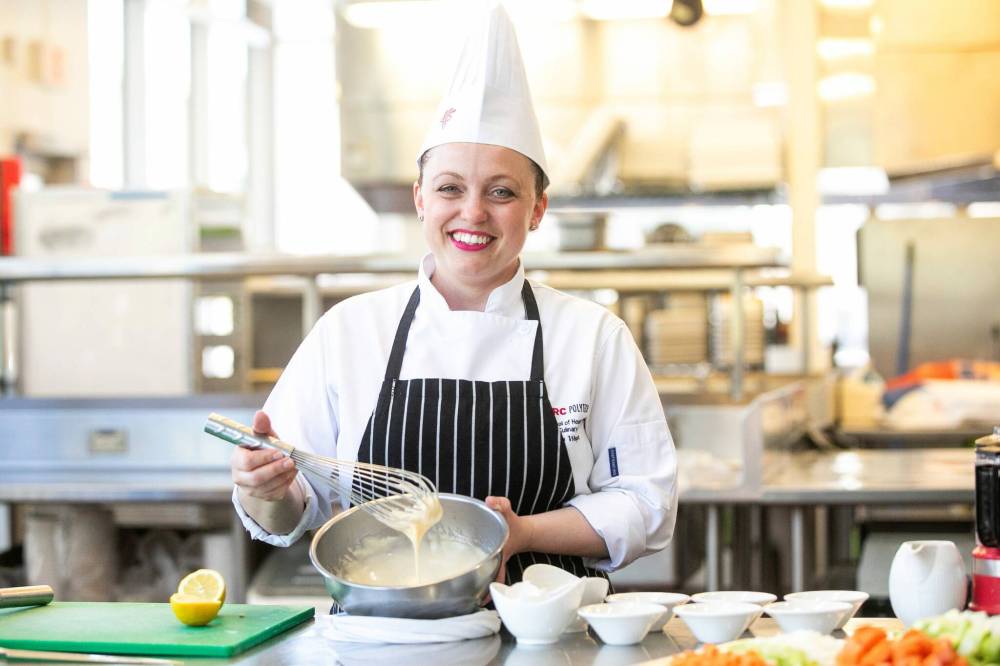
While stock and broth are both made from a long-simmered combination of water, vegetables and, often, animal products, these foundational liquids are siblings not synonyms.
Stock: Liquid made from bones and vegetables
Broth: Liquid made from meat and vegetables
Both liquids can be used interchangeably as the base for soups and sauces, but broth tends to be a more expensive ingredient owing to the meat component.
Making broth or stock is a good way to reduce food waste in the kitchen. Keep bones and vegetable scraps in the freezer for later use.
“You’re taking a leftover or something you wouldn’t otherwise use and making a usable product out of it, but stock is also not a compost bin,” Wingert says.
Avoid using vegetables that will make your stock cloudy, such as peppers, or bitter, such as leafy greens. Carrots, celery and onions (a mixture that, when diced, is also known as mirepoix) are standard additions, along with herbs and other aromatics.
Tip: Roast the bones in the oven first for a darker stock with a richer flavour — a great base for gravy.
Add everything to a large pot and cover with water, bring to a boil and let it simmer for three to four hours. Skim frequently to remove the impurities released by the bones during cooking, which will make for a nice clear stock.
The final result should be thick and jiggly when cooled.
“A good stock will set up like Jell-O,” Wingert says.
Stock and broth can be frozen in small containers or ice cube trays and added to dishes or sauces as needed.
Sauces
MIKAELA MACKENZIE / FREE PRESS Different thickening agents used in sauces include (counter-clockwise from left) white roux, blond roux, brown roux and beurre manié.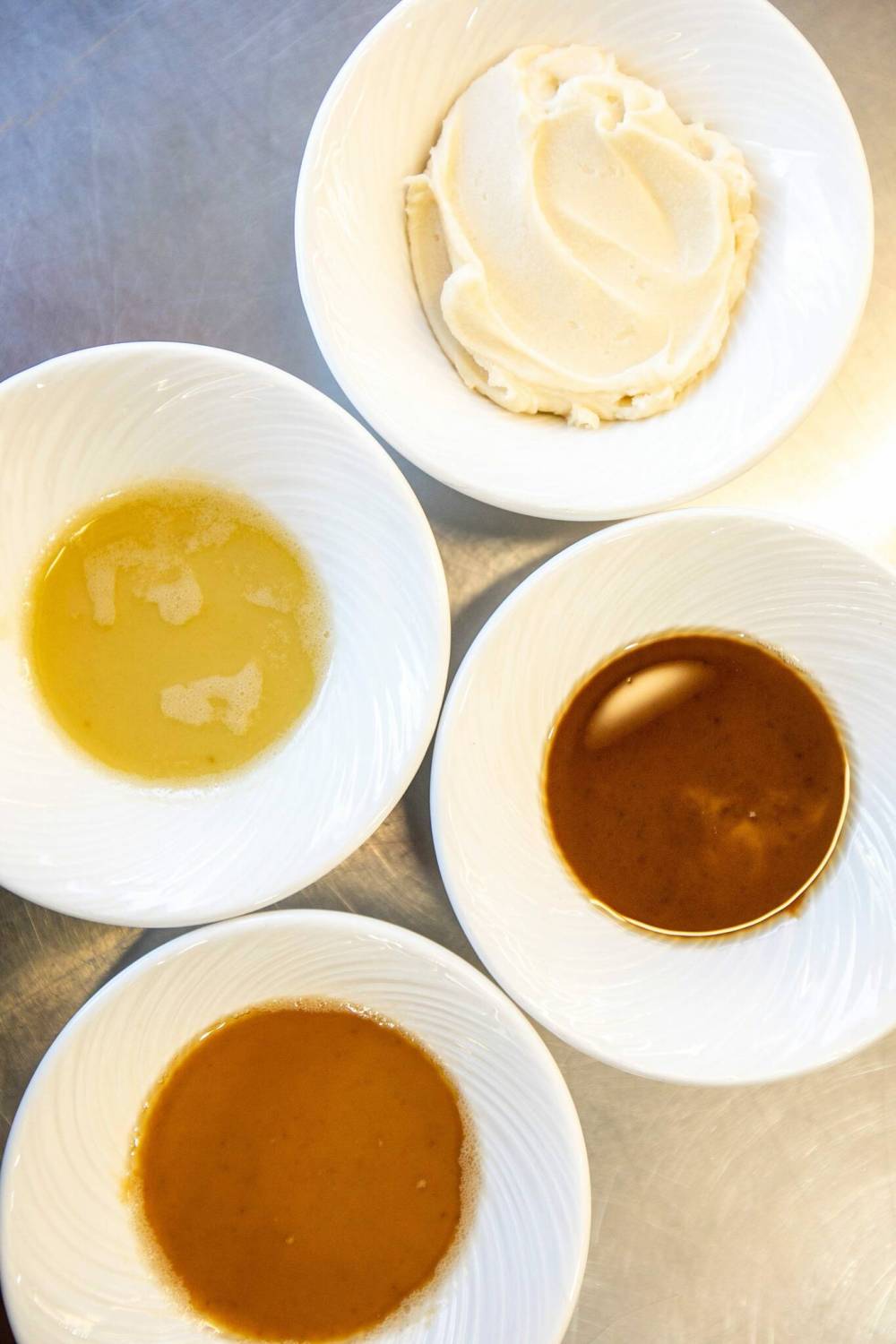
In classical French cooking, there are five “Mother Sauces” on which all other sauces are based. Most start with a roux, a thickening agent made with equal parts flour and fat (butter, oil or animal fat) cooked until the desired colour is achieved.
Béchamel: A thick cream sauce made from white roux and milk
Velouté: A light creamy sauce made from blond roux and light stock
Espagnole: A rich, dark brown sauce made from brown roux and dark stock
Tomato: A tomato sauce made from roux and stock
Hollandaise: A creamy sauce made from emulsified butter and egg yolks
To make a white roux, heat the fat in a saucepan over medium-low heat and add flour, stirring constantly until the mixture is smooth, pale and beginning to smell nutty. Continue cooking (and stirring) for a blond or brown roux, each of which has progressively more colour and flavour. Liquid is then slowly added to the roux to form a sauce.
“If I add it all at once, it’s going to lump together, so I have to build it in steps so that it slowly heats up,” Wingert says.
Cornstarch is a gluten-free option for thickening sauces, but it must be added correctly. First, make a slurry by stirring cold water into cornstarch. Then, add the slurry to a hot, simmering sauce towards the end of cooking.
A beurre manié — a paste made of equal parts soft butter and flour — can make sauces thick and glossy. Stick the paste in the middle of a whisk and stir it into a nearly finished sauce or soup, Wingert says.
Liquid ingredients can also be reduced by simmering until most of the water has evaporated to create a sauce with a more concentrated flavour.
Sauces are generally made separately and added to a dish before serving, but can also be made from braising liquids or pan drippings, as is often the case with gravy. Just add a thickening agent, such as flour, stock and desired seasonings.
MIKAELA MACKENZIE / FREE PRESS Egg yolks act as an emulsifier in mayonnaise.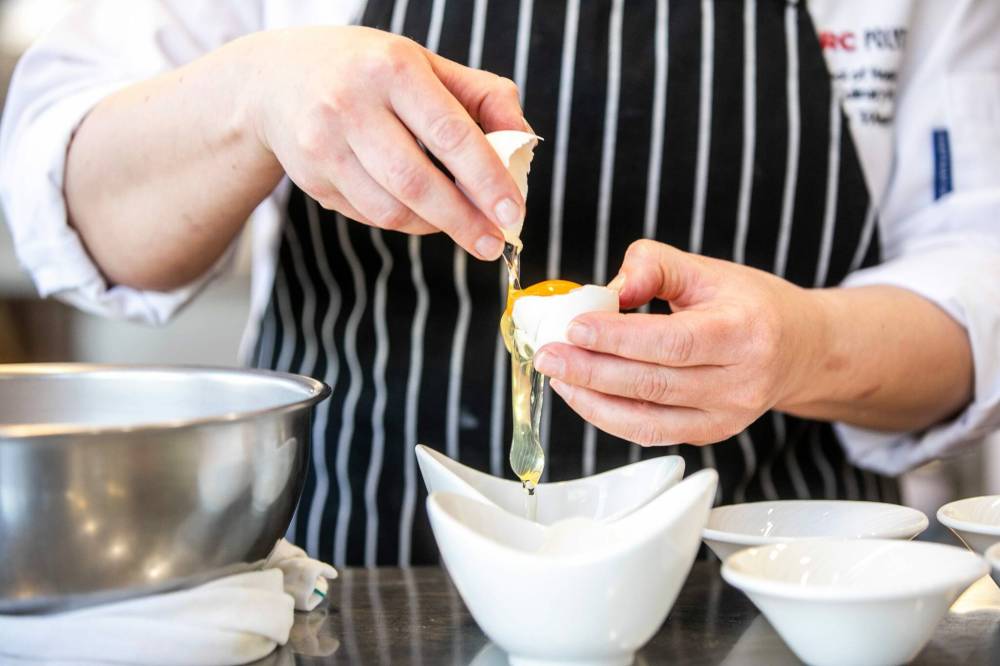
Mayonnaise
2 egg yolks
7.5 ml (1 1/2 tsp) white vinegar
7.5 ml (1 1/2 tsp) water
2.5 ml (1/2 tsp) salt
2.5 ml (1/2 tsp) dry mustard
Pinch cayenne
425 ml (1 3/4 cups) neutral oil
5 ml (1 tsp) lemon juice
Whisk the egg yolks and dry mustard for 1 to 2 minutes.
Mix vinegar and water together and add 5 ml (1 tsp) to the egg yolks.
Slowly drizzle in the oil while whisking as the mixture begins to emulsify and thicken.
Continue to whisk while adding the remaining vinegar and water, cayenne, lemon juice and salt. Taste and adjust the seasoning if needed.
— Mandy Wingert
More on emulsification
Many sauces rely on emulsification: the near-magical process of combining two ingredients that don’t naturally mix, such as oil and water, to create a stable solution.
Emulsifications need emulsifying ingredients to form a bond.
MIKAELA MACKENZIE / FREE PRESS Add oil slowly while whisking to make an emulsion.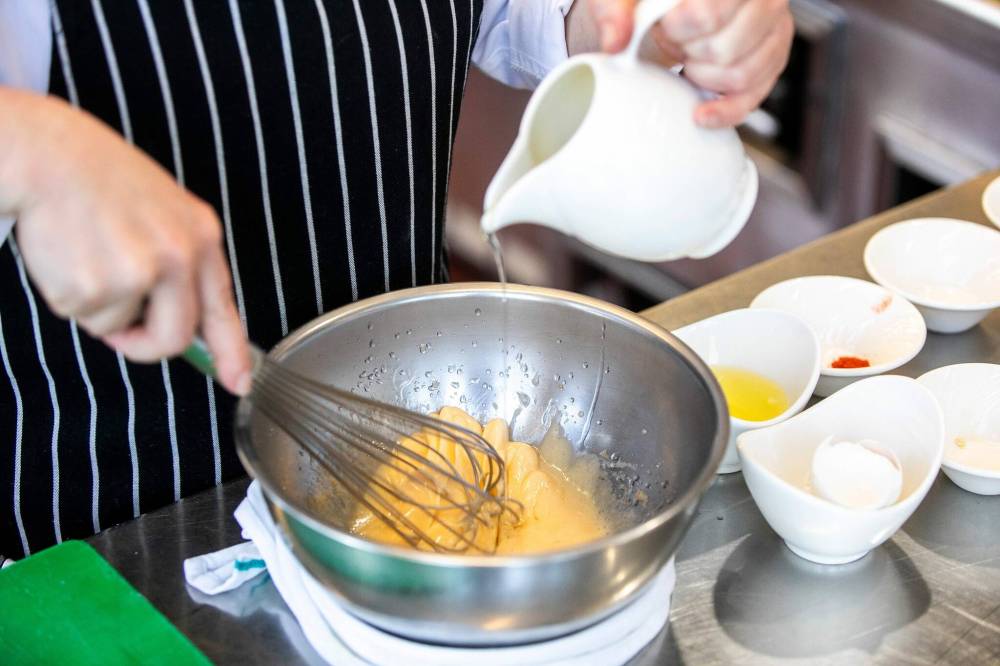
Common emulsifiers include egg yolks, butter, mustard and honey — all of which contain particles with an equal attraction to fat and water, thus helping hold everything in suspension together.
Most salad dressings and vinaigrettes are temporary emulsions that separate over time, but can be reconstituted by shaking or mixing. Thicker sauces, such as mayonnaise, are more permanent emulsions.
“Mayonnaise is basically like a cold hollandaise sauce,” Wingert says.
MIKAELA MACKENZIE / FREE PRESS Mayonnaise is an example of a permanent emulsion.
To make mayonnaise, oil is slowly added to egg yolks and other ingredients while whisking vigorously (visit wfp.to/mayonnaise to watch a video of Wingert demonstrating the process).
“If I dumped all the oil in at the same time, it’s just going to split. With all emulsifications, salad dressings, anything, you have to very slowly add your oil,” she says.
If your mayo or hollandaise does split, add another egg yolk and continue whisking.
Mayonnaise can be used on its own or as an emulsifier for other dressings and dips. It’s also the base for aioli, which is made from mayo, garlic, lemon juice and whatever other ingredients strike your fancy.
Tools and tips
To make stock or broth, you’ll need a large pot, a spoon for skimming and a strainer to separate the cooked liquid from the bones and veg.
Use a shallow pan or pot, depending on the quantity of sauce you’re making.
Whisks or whips, as they’re sometimes called, come in many shapes and sizes. Piano whisks with thin wires and a bulbous head are the most versatile; while French whisks have thicker wires and a narrower profile, making them useful for thicker sauces.

If hand-whisking, wrap a damp towel around the bottom of your bowl to keep it steady on the counter. A food processor can be used to create emulsions; drizzle oil slowly through the opening in the lid while the machine is running.
Working slowly and steadily is the key to making top-notch stocks and sauces, as is building in flavour.
“Don’t rush your sauce. If you want a good sauce, use a stock — and there’s nothing wrong with using stock from the grocery store,” Wingert says.
In next month’s Homemade Cooking School, we discuss everything eggs.
eva.wasney@winnipegfreepress.com

Eva Wasney covers environmental issues in Manitoba for The Narwhal in partnership with the Winnipeg Free Press. Read more about Eva.
Every piece of reporting Eva produces is reviewed by an editing team before it is posted online or published in print — part of the Free Press‘s tradition, since 1872, of producing reliable independent journalism. Read more about Free Press’s history and mandate, and learn how our newsroom operates.
Our newsroom depends on a growing audience of readers to power our journalism. If you are not a paid reader, please consider becoming a subscriber.
Our newsroom depends on its audience of readers to power our journalism. Thank you for your support.
Related Articles
Side shows: These culinary supporting roles earn the Thanksgiving spotlight