Science and local sleuthing identify a 250-year-old shipwreck on a Scottish island

Advertisement

Advertise with us

LONDON (AP) — When a schoolboy going for a run found the ribs of a wooden ship poking through the dunes of a remote Scottish beach, it sparked a hunt by archaeologists, scientists and local historians to uncover its story.

Read this article for free:


or

Already have an account? Log in here »

To continue reading, please subscribe:

Subscribe and receive a limited-edition Free Press branded hat or tote.

Digital Subscription

One year of digital access for only $205*

  • Enjoy unlimited reading on winnipegfreepress.com
  • Read the E-Edition, our digital replica newspaper
  • Access News Break, our award-winning app
  • Play interactive puzzles

*First annual payment billed as $205.00 + GST for one year. This annual subscription will automatically renew at $233.00 + GST every 52 weeks (10% off the regular annual price of $259.35). Offer available to new and qualified returning subscribers only. Cancel any time.

To continue reading, please subscribe:

Add Free Press access to your Brandon Sun subscription for only an additional

$1 for the first 4 weeks*

  • Enjoy unlimited reading on winnipegfreepress.com
  • Read the E-Edition, our digital replica newspaper
  • Access News Break, our award-winning app
  • Play interactive puzzles
Start now

*Your next Brandon Sun subscription payment will increase by $1.00 and you will be charged $17.95 plus GST for four weeks. After four weeks, your payment will increase to $24.95 plus GST every four weeks.

Hey there, time traveller!
This article was published 22/07/2025 (407 days ago), so information in it may no longer be current.

LONDON (AP) — When a schoolboy going for a run found the ribs of a wooden ship poking through the dunes of a remote Scottish beach, it sparked a hunt by archaeologists, scientists and local historians to uncover its story.

Through a mix of high-tech science and community research, they have an answer. Researchers announced Wednesday that the vessel is very likely the Earl of Chatham, an 18th-century warship that saw action in the American War of Independence before a second life hunting whales in the Arctic — and then a stormy demise.

“I would regard it as a lucky ship, which is a strange thing to say about a ship that’s wrecked,” said Ben Saunders, senior marine archaeologist at Wessex Archaeology, a charity that helped community researchers conduct the investigation.
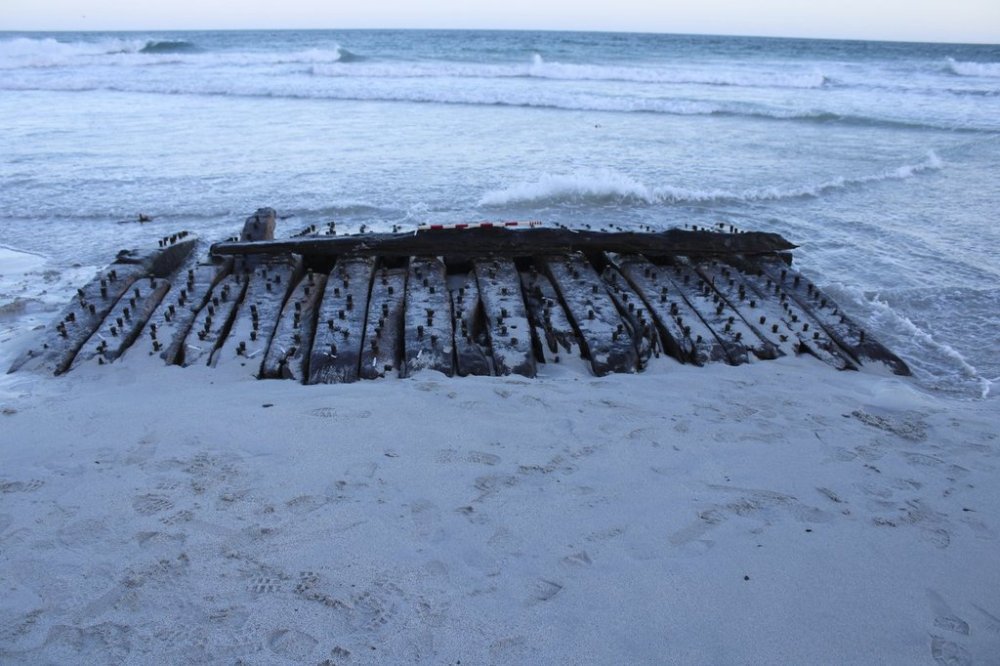
In this image provided by Wessex Archaeology, the Sanday Wreck is seen on the shores of Sanday on Orkney, Feb. 2024. (Wessex Archaeology via AP)

“I think if it had been found in many other places, it wouldn’t necessarily have had that community drive, that desire to recover and study that material, and also the community spirit to do it,” Saunders said.

Uncovered after 250 years

The wreck was discovered in February 2024 after a storm swept away sand covering it on Sanday, one of the rugged Orkney Islands that lie off Scotland’s northern tip.

It excited interest on the island of 500 people, whose history is bound up with the sea and its dangers. Around 270 shipwrecks have been recorded around the 20-square-mile (50-square-kilometer) island since the 15th century.

Local farmers used their tractors and trailers to haul the 12 tons of oak timbers off the beach, before local researchers set to work trying to identify it.

“That was really good fun, and it was such a good feeling about the community – everybody pulling together to get it back,” said Sylvia Thorne, one of the island’s community researchers. “Quite a few people are really getting interested in it and becoming experts.”

Dendrochronology — the science of dating wood from tree rings — showed the timber came from southern England in the middle of the 18th century. That was one bit of luck, Saunders said, because it coincides with “the point where British bureaucracy’s really starting to kick off” and detailed records were being kept.

“And so we can then start to look at the archive evidence that we have for the wrecks in Orkney,” Saunders said. “It becomes a process of elimination.

“You remove ones that are Northern European as opposed to British, you remove wrecks that are too small or operating out of the north of England and you really are down to two or three … and Earl of Chatham is the last one left.”

Wars and whaling

Further research found that before it was the Earl of Chatham, the ship was HMS Hind, a 24-gun Royal Navy frigate built in Chichester on England’s south coast in 1749.

Its military career saw it play a part in the expansion — and contraction — of the British Empire. It helped Britain wrest control of Canada from France during the sieges of Louisbourg and Quebec in the 1750s, and in the 1770s served as a convoy escort during Britain’s failed effort to hold onto its American colonies.

Sold off by the navy in 1784 and renamed, the vessel became a whaling ship, hunting the huge mammals in the Arctic waters off Greenland.

Whale oil was an essential fuel of the Industrial Revolution, used to lubricate machinery, soften fabric and light city streets. Saunders said that in 1787 there were 120 London-based whaling ships in the Greenland Sea, the Earl of Chatham among them.

A year later, while heading out to the whaling ground, it was wrecked in bad weather off Sanday. All 56 crew members survived — more evidence, Saunders says, that this was a vessel blessed with luck.

Community effort

The ship’s timbers are being preserved in a freshwater tank at the Sanday Heritage Centre while plans are discussed to put it on permanent display.

Saunders said that the project is a model of community involvement in archaeology.

“The community have been so keen, have been so desirous to be involved and to find out things to learn, and they’re so proud of it. It’s down to them it was discovered, it’s down to them it was recovered and it’s been stabilized and been protected,” he said.

For locals, it’s a link to the island’s maritime past — and future. Finding long-buried wrecks could become more common as climate change alters the wind patterns around Britain and reshapes the coastline.

“One of the biggest things I’ve got out of this project is realizing how much the past in Sanday is just constantly with you — either visible or just under the surface,” said Ruth Peace, another community researcher.


Report Error Submit a Tip

More Stories

Jockey wisecrack a hurtful low blow

Maureen Scurfield 4 minute read 2:00 AM CDT

DEAR MISS LONELYHEARTS: I ran into my boyfriend from Grade 9 at the horse races recently. He’s still really short. I said, “You’re so small you could be a great jockey!” He said, ”And you still talk before you think!”

Ouch! I was just stating what was true. If he doesn’t like being compared to a jockey, he should stay away from the racetrack, where people will mistake him for one, don’t you think?

— Hurt Feelings, St. James

Dear Hurt Feelings: It’s important not to make cracks about personal traits people are sensitive about.

Man who killed truck passenger handed new 12-year sentence

Erik Pindera 4 minute read Preview

Man who killed truck passenger handed new 12-year sentence

Erik Pindera 4 minute read 2:00 AM CDT

Manitoba’s highest court has given a man who shot at a passing truck and killed a 20-year-old woman a 12-year prison sentence for manslaughter.

William Ryerson Thomas Comber, now in his mid 20s, was found guilty of second-degree murder by a jury in December 2022 for the killing of Hailey Dugay on Nov. 17, 2018. Comber was later sentenced to life in prison with no chance of parole for 12 years.

Dugay died after the truck she was travelling in was struck by gunfire late at night on a gravel road near Fraserwood, 90 kilometres north of Winnipeg.

The Court of Appeal struck down Comber’s murder conviction earlier this year and ruled he was instead guilty of the lesser offence of manslaughter.

Read
2:00 AM CDT

Chefs gather in St. Boniface to see whose version of jollof is best

Eva Wasney 4 minute read Preview

Chefs gather in St. Boniface to see whose version of jollof is best

Eva Wasney 4 minute read Yesterday at 5:30 PM CDT

Chef Alex Bockarie is bringing an age-old African culinary battle to Winnipeg.

On Saturday, five local chefs hailing from Senegal, Liberia, Sierra Leone, Ghana and Nigeria will go head-to-head to determine who makes the best jollof — a rice dish simmered in a savoury tomato-based stew.

“Jollof rice originated from Senegal but it has spread throughout West Africa and every country has its own method of cooking it,” Bockarie says. “It’s a long-standing fight; even among the communities here in Winnipeg, everybody’s always saying that Sierra Leone’s (jollof) is the best, Ghana’s is the best, Nigeria’s is the best.

“It’s a friendly competition; friendly, but very serious too.”

Read
Yesterday at 5:30 PM CDT

Social problems cannot be simply swept away

Editorial 4 minute read Preview

Social problems cannot be simply swept away

Editorial 4 minute read 2:00 AM CDT

In the battle to alleviate homelessness, mental health issues and drug addiction, we just can’t seem to get the order of our response right.

The city dismantles homeless encampments before there are enough safe, permanent places for people to live.

The Winnipeg Police Service conducts an intensive sweep to combat open drug use on Main Street, without arranging support from social service agencies to help the people they are rousting.

Is it any surprise that the acute problems being experienced by residents, businesses and workers on Main Street are beginning to manifest in adjacent neighbourhoods? That’s what happens when you try to solve a problem by moving it, not addressing it head-on.

Read
2:00 AM CDT

Province accused of meddling in Dynacare contract dispute as strike deadline looms

Carol Sanders 5 minute read Preview

Province accused of meddling in Dynacare contract dispute as strike deadline looms

Carol Sanders 5 minute read Yesterday at 4:30 PM CDT

The union for hundreds of Dynacare lab employees in Manitoba has accused the provincial government of interfering in contract talks ahead of next week’s strike deadline.

The Manitoba Association of Health Care Professionals, which bargains on behalf of 350 lab workers at two dozen Dynacare outlets in Winnipeg, Brandon, and surrounding communities, said Tuesday that the labour board has been asked to review the need for an essential services agreement.

Dynacare and the union agreed in March that Dynacare services are not deemed essential under provincial law, and do not need to continue if a strike is held, MAHCP president Jason Linklater said Tuesday. The union, whose collective agreement with the private company expired March 31, said the NDP government was informed the two sides had agreed no essential services agreement was needed.

After contract negotiations broke down, and a strike deadline of 6 a.m. Sept. 8 was set, physicians and health-care advocates warned that patient care will suffer if the strike goes ahead because Dynacare provides nearly all medical lab services in Manitoba.

Read
Yesterday at 4:30 PM CDT

Rare and tough to notice, sarcomas may lurk in the body

Jen Zoratti 12 minute read Preview

Rare and tough to notice, sarcomas may lurk in the body

Jen Zoratti 12 minute read Monday, Aug. 31, 2026

Last summer, Michelle Finley was going about a normal day.

She had just dropped her car off at a garage and was walking back to her office building downtown when, suddenly, she was stopped in her tracks by a searing cramp on the bottom of her right foot.

“It was so painful it took my breath away,” says Finley, now 52. “I stopped and held on to the side of a building for a second — like, it was bringing tears to my eyes.”

Finley thought she had a really bad case of plantar fasciitis. Nine months later she would lose her foot to sarcoma.

Read
Monday, Aug. 31, 2026