Peru seizes record 4-ton mercury shipment in fight against illegal gold mining

Advertisement

Advertise with us

BOGOTA, Colombia (AP) — Peruvian customs officials have seized a record-breaking shipment of illegal mercury, exposing a cross-border smuggling network that is fueling one of the Amazon’s most destructive criminal economies: illicit gold mining.

Read this article for free:


or

Already have an account? Log in here »

To continue reading, please subscribe:

Subscribe and receive a limited-edition Free Press branded hat or tote.

Digital Subscription

One year of digital access for only $205*

  • Enjoy unlimited reading on winnipegfreepress.com
  • Read the E-Edition, our digital replica newspaper
  • Access News Break, our award-winning app
  • Play interactive puzzles

*First annual payment billed as $205.00 + GST for one year. This annual subscription will automatically renew at $233.00 + GST every 52 weeks (10% off the regular annual price of $259.35). Offer available to new and qualified returning subscribers only. Cancel any time.

To continue reading, please subscribe:

Add Free Press access to your Brandon Sun subscription for only an additional

$1 for the first 4 weeks*

  • Enjoy unlimited reading on winnipegfreepress.com
  • Read the E-Edition, our digital replica newspaper
  • Access News Break, our award-winning app
  • Play interactive puzzles
Start now

*Your next Brandon Sun subscription payment will increase by $1.00 and you will be charged $17.95 plus GST for four weeks. After four weeks, your payment will increase to $24.95 plus GST every four weeks.

Hey there, time traveller!
This article was published 24/07/2025 (423 days ago), so information in it may no longer be current.

BOGOTA, Colombia (AP) — Peruvian customs officials have seized a record-breaking shipment of illegal mercury, exposing a cross-border smuggling network that is fueling one of the Amazon’s most destructive criminal economies: illicit gold mining.

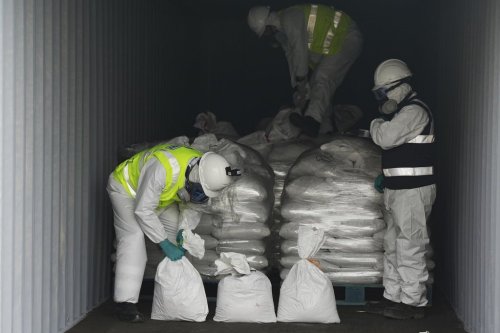
The 4-ton haul — the largest mercury seizure ever made in an Amazon country and one of the world’s largest — was discovered in June at the port of Callao, hidden inside gravel-filled bags on a cargo ship bound for Bolivia. Though labeled as crushed stone, the shipment was flagged by customs agents based on international intelligence sharing.

“This crushed stone was laced with mercury,” said Jorge Gallo Alvarado, head of customs enforcement at SUNAT, Peru’s tax and customs agency. “It’s a restricted substance because it’s used in illegal alluvial mining.”

Customs workers carry bags of mercury hidden in gravel-filled bags in Lima, Peru, Wednesday, July 16, 2025. (AP Photo/Guadalupe Pardo)

The container, which originated in Mexico, was singled out for inspection by SUNAT’s risk analysis team. U.S. specialists later confirmed the presence of mercury embedded in the gravel — a tactic increasingly used to avoid detection at ports.

The seized goods are valued at roughly $500,000, SUNAT said.

High-value illicit trade

Authorities say the bust marks a turning point in efforts to dismantle the supply chains behind the Amazon’s illicit gold trade. Mercury, a powerful neurotoxin banned or tightly restricted in many countries, remains essential to the process used by illegal miners across the rainforest to extract gold from river sediment.

The method is simple but dangerous: miners mix mercury with gold particles to form an amalgam, then burn it off, releasing toxic vapor into the air. The leftover mercury often flows into rivers, where it transforms into methylmercury — its most dangerous form — and builds up in fish and aquatic life.

“This is a very important seizure,” said Luis Fernandez, a research professor and mercury expert at Wake Forest University in North Carolina, who traveled to Lima to assess the find.

“We don’t often see mercury seizures at this scale, especially not in transit through formal customs points,” he said.

Fernandez estimated the mercury could have been used to produce roughly 1,600 kilograms (3,527 pounds) of gold — worth more than $172 million at current prices.

“This isn’t subsistence mining,” he said. “It’s organized, high-value illicit trade with serious environmental and public health consequences.”

A ‘gold-mercury-drug trifecta’

In Peru’s Madre de Dios region, an epicenter of illegal mining, mercury contamination has been detected in drinking water, fish and even breast milk. Long-term exposure to methylmercury can cause irreversible damage to the brain and nervous system, particularly in children and pregnant women. Indigenous and riverine communities that rely on fish for food are especially vulnerable.

Peruvian authorities say much of the mercury entering the country is smuggled from Mexico, where it’s mined in central states such as Querétaro. Prices have surged in recent years due to booming global demand for gold, reaching as high as $330 per kilogram of mercury — and more than $3,500 per ounce of gold — earlier this year.

Some of the mercury seized in June is believed to have originated in small, artisanal mines inside a UNESCO ‑protected biosphere reserve.

While the Environmental Investigation Agency, a nonprofit watchdog that investigates environmental crime, has documented that at least 30 tons of mercury have been trafficked annually from Mexico to countries like Peru and Colombia by a single criminal network, the real volume is likely higher. Soaring gold prices and a 400% markup on mercury in the Amazon compared to Mexico have made smuggling increasingly lucrative. Seizures and monitoring suggest flows rose to an estimated 56 tons in 2024, with further increases expected this year. Colombia remains one of the highest per capita emitters of mercury worldwide, with total annual releases reaching up to 150 tons, much of it tied to illegal gold mining.

EIA’s latest investigation, released in tandem with Peru’s announcement, describes a growing “gold-mercury-drug trifecta” linking illegal mining to transnational crime and environmental degradation. The group’s investigators documented how organized criminal groups — including Mexico’s Jalisco New Generation Cartel — are now involved in mercury mining and trafficking.

“Until mercury mines are no longer in operation, traffickers will leave no stone unturned to smuggle the metal,” the report states.

Growing calls to close mercury mines

Traffickers often disguise mercury shipments with false paperwork and front companies, allowing them to slip through customs. Once across the border, the metal is sold to illegal mining camps — often in protected forests or Indigenous territories — where it becomes almost impossible to trace.

In Colombia, security sources say armed groups such as the National Liberation Army and the Gulf Clan play a central role in the mercury-for-gold trade. Similar dynamics have been reported in Brazil and Bolivia, where enforcement is weak and black-market demand is high.

Although Peru ratified the Minamata Convention on Mercury in 2013, enforcement has struggled to keep up with the pace and adaptability of trafficking networks.

“These networks are agile,” Fernandez said. “As gold prices rise, they adapt quickly. Customs authorities need tools, training, and resources to keep pace.”

Adam Dolezal, extractive industries campaigner at EIA, said the seizure shows what is possible when customs systems are properly resourced and coordinated — but warned that enforcement alone won’t stop the trade.

“Unless mercury production is shut down at the source, this toxic trade will continue,” Dolezal said.

Calls are growing to close remaining mercury mines in Mexico and reform global controls on the metal. The issue is expected to take center stage at the upcoming Conference of the Parties to the Minamata Convention later this year, where advocates hope to eliminate legal loopholes that allow mercury to be traded for small-scale mining.

____

Follow Steven Grattan on Instagram: @steven.grattan

____

The Associated Press’ climate and environmental coverage receives financial support from multiple private foundations. AP is solely responsible for all content. Find AP’s standards for working with philanthropies, a list of supporters and funded coverage areas at AP.org.
Report Error Submit a Tip

More Stories

A life’s story: activist, educator, organizer knew the true meaning of community

Janine LeGal 7 minute read Preview

A life’s story: activist, educator, organizer knew the true meaning of community

Janine LeGal 7 minute read Yesterday at 3:00 AM CDT

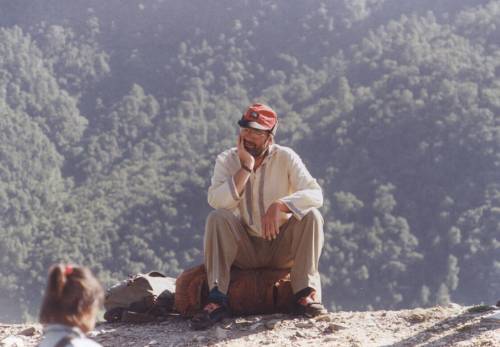
Somewhere between a love for sharing stories and a love of community connections, Michael (Mike) Maunder lived his life. Giving voice to people and neighbourhoods was a passion for the natural-born community organizer.

An author, teacher and principal, Maunder lived in a one-bedroom apartment in West Broadway and devoted himself to community development, education and neighbourhood renewal.

He maintained a connection with Augustine United Church, whose commitment to social justice he appreciated, volunteered at the Sandy-Saulteaux Spiritual Centre, and found comfort in a Buddhist prayer community.

Maunder died on July 15 at the age of 80.

Read
Yesterday at 3:00 AM CDT

Cabernet Sauvignon star of wine festival

Ben Sigurdson 5 minute read Preview

Cabernet Sauvignon star of wine festival

Ben Sigurdson 5 minute read Yesterday at 3:00 AM CDT

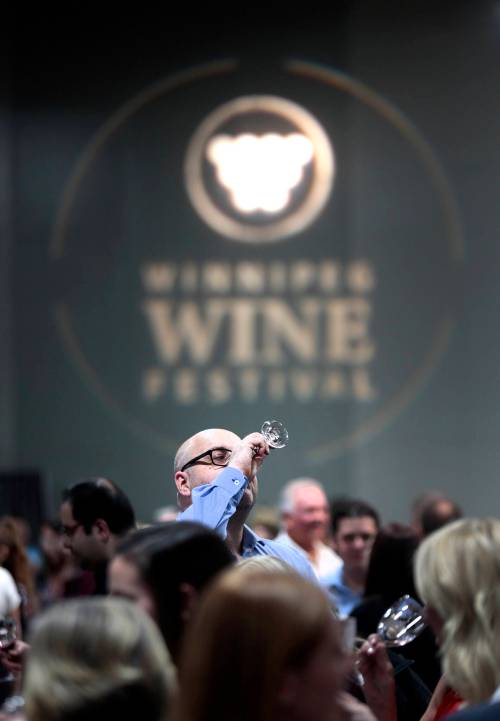
The Winnipeg Wine Festival will celebrate the king of red wine grapes next weekend — the theme of this year’s festival, which takes place Sept. 25 and 26 at the RBC Convention Centre, is Cabernet Sauvignon.

Cab Sauv, as it’s also known, is the world’s most widely planted wine grape of any colour, first coming to prominence in the 1800s in France’s Bordeaux region, where the grape is still popular. Rather than single-variety wines, Bordeaux reds tend to be blends, with those coming from the left bank of the Gironde estuary being Cabernet-dominant, while right-bank wines are Merlot-dominant, with Cabernet Sauvignon playing a supporting role. Cabernet and Merlot work well together and many other countries have followed suit in blending the two.

A team at University of California Davis put Cabernet Sauvignon through a DNA test in 1996 and discovered its parent grapes are Cabernet Franc and Sauvignon Blanc — it’s likely that at some point the two varieties, planted next to each other in some vineyard, crossed and mutated and became the grape we know today. (Someone growing grapes in the 19th century must have had an inkling of what was up, as the grape has been called Cabernet Sauvignon since long before the DNA test.)

Flavour-wise, most Cabernet Sauvignon wines are big and bold, with a core of deep dark berry flavours, some graphite and spice notes and relatively bright acidity. It’s a grape that is well-suited to barrel aging, with most examples seeing at least some time in wood.

Read
Yesterday at 3:00 AM CDT

Peru seizes record 4-ton mercury shipment in fight against illegal gold mining

Steven Grattan, The Associated Press 6 minute read Preview

Peru seizes record 4-ton mercury shipment in fight against illegal gold mining

Steven Grattan, The Associated Press 6 minute read Thursday, Jul. 24, 2025

BOGOTA, Colombia (AP) — Peruvian customs officials have seized a record-breaking shipment of illegal mercury, exposing a cross-border smuggling network that is fueling one of the Amazon’s most destructive criminal economies: illicit gold mining.

The 4-ton haul — the largest mercury seizure ever made in an Amazon country and one of the world's largest — was discovered in June at the port of Callao, hidden inside gravel-filled bags on a cargo ship bound for Bolivia. Though labeled as crushed stone, the shipment was flagged by customs agents based on international intelligence sharing.

“This crushed stone was laced with mercury,” said Jorge Gallo Alvarado, head of customs enforcement at SUNAT, Peru’s tax and customs agency. “It’s a restricted substance because it’s used in illegal alluvial mining.”

The container, which originated in Mexico, was singled out for inspection by SUNAT’s risk analysis team. U.S. specialists later confirmed the presence of mercury embedded in the gravel — a tactic increasingly used to avoid detection at ports.

Read
Thursday, Jul. 24, 2025

Family account spiced with magic realism, geopolitical intrigue and a ghost story

Reviewed by Zilla Jones 4 minute read Preview

Family account spiced with magic realism, geopolitical intrigue and a ghost story

Reviewed by Zilla Jones 4 minute read Yesterday at 2:01 AM CDT

Tom Lin’s second novel Babylon, South Dakota moves beyond a historical account of an immigrant family’s struggle, delightfully blending and bending genres.

Lin is a Chinese-born novelist whose family emigrated to the U.S. when he was four years old. His debut novel, The Thousand Crimes of Ming Tsu, won the 2022 Andrew Carnegie Medal for Excellence in Fiction, making him the youngest ever recipient of that award. He earned a PhD in English from the University of California Davis and is currently an assistant professor of English and creative writing at the University of Iowa.

Babylon, South Dakota takes place in an unspecified time period that can be understood to be during the Mao era — likely the 1950s or ’60s. A young Chinese couple, the Hsuis, immigrate to the rural community that gives the book its title. They take the names Saul and Mei and settle on a 160-acre homestead left to them by a distant relative.

Saul’s dream is to breed and sell chrysanthemums from seeds he brought from China, while Mei wants to raise livestock. They speak no English, know nothing of life in the United States, are unprepared for the harshness of winter and the isolation of the farm and bring nothing with them except some gold, which Mei hides around the house for emergencies. Their only link to the outside world is a discarded and marginally functioning TV set, which Saul rescues and rigs up.

Read
Yesterday at 2:01 AM CDT

Gillingham in lead with decided voters

Nicole Buffie 6 minute read Preview

Gillingham in lead with decided voters

Nicole Buffie 6 minute read Friday, Sep. 18, 2026

A cloud of uncertainty is hanging over Winnipeg as October’s municipal election nears.

Three months after a poll showed more than 40 per cent of Winnipeggers wanted to see someone other than current mayor Scott Gillingham elected, a new Abacus Data poll indicates more than half of Winnipeg voters are undecided heading into next month’s civic election.

Of decided voters, 55 per cent favour Gillingham compared to 23 per cent for former councillor and provincial cabinet minister Kevin Klein and 11 per cent for funeral director Mike Vogiatzakis.

Of all respondents, just over 50 per cent said they were unsure while 13 per cent said they will not vote.

Read
Friday, Sep. 18, 2026

Elmwood–East Kildonan candidate promises to tackle ‘inefficiency’ in government

Gabrielle Piché 3 minute read Preview

Elmwood–East Kildonan candidate promises to tackle ‘inefficiency’ in government

Gabrielle Piché 3 minute read Yesterday at 6:17 PM CDT

The former assistant of late Elmwood–East Kildonan councillor Jason Schreyer is again running for the seat.

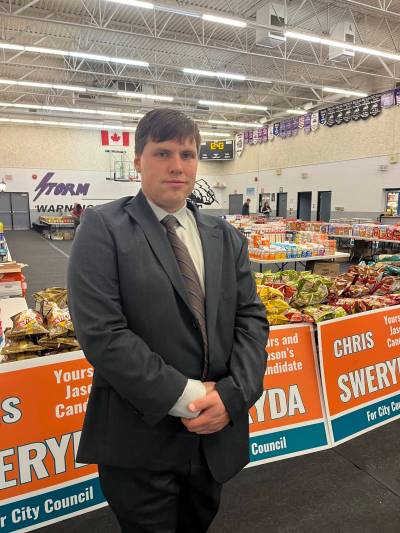
Chris Sweryda officially launched his campaign Saturday. He did so with the backdrop of a grocery program he runs, where food is sold near-cost out of St. Gerard School’s gym.

Rows of cereal, pasta sauce and chips filled tables ahead of the program’s afternoon opening. Sweryda created the pop-up with Schreyer months ahead of the former councillor’s April 2025 death.

The program sees roughly 500 people each day it’s open (which is every other week on Saturday), Sweryda said.

Read
Yesterday at 6:17 PM CDT