New draft of global plastic pollution treaty wouldn’t limit plastic production

Advertisement

Advertise with us

GENEVA (AP) — Negotiators working on a treaty to address global plastic pollution discussed a new draft of the text Wednesday that wouldn't limit plastic production or address chemicals used in plastic products.

Read this article for free:


or

Already have an account? Log in here »

To continue reading, please subscribe:

Subscribe and receive a limited-edition Free Press branded hat or tote.

Digital Subscription

One year of digital access for only $205*

  • Enjoy unlimited reading on winnipegfreepress.com
  • Read the E-Edition, our digital replica newspaper
  • Access News Break, our award-winning app
  • Play interactive puzzles

*First annual payment billed as $205.00 + GST for one year. This annual subscription will automatically renew at $233.00 + GST every 52 weeks (10% off the regular annual price of $259.35). Offer available to new and qualified returning subscribers only. Cancel any time.

To continue reading, please subscribe:

Add Free Press access to your Brandon Sun subscription for only an additional

$1 for the first 4 weeks*

  • Enjoy unlimited reading on winnipegfreepress.com
  • Read the E-Edition, our digital replica newspaper
  • Access News Break, our award-winning app
  • Play interactive puzzles
Start now

*Your next Brandon Sun subscription payment will increase by $1.00 and you will be charged $17.95 plus GST for four weeks. After four weeks, your payment will increase to $24.95 plus GST every four weeks.

Hey there, time traveller!
This article was published 13/08/2025 (412 days ago), so information in it may no longer be current.

GENEVA (AP) — Negotiators working on a treaty to address global plastic pollution discussed a new draft of the text Wednesday that wouldn’t limit plastic production or address chemicals used in plastic products.

The biggest issue of the talks has been whether the treaty should impose caps on producing new plastic or focus instead on things like better design, recycling and reuse. About 100 countries want to limit production as well as tackle cleanup and recycling. Many have said it’s essential to address toxic chemicals.

Powerful oil and gas-producing nations and the plastics industry oppose production limits. They want a treaty focused on better waste management and reuse.
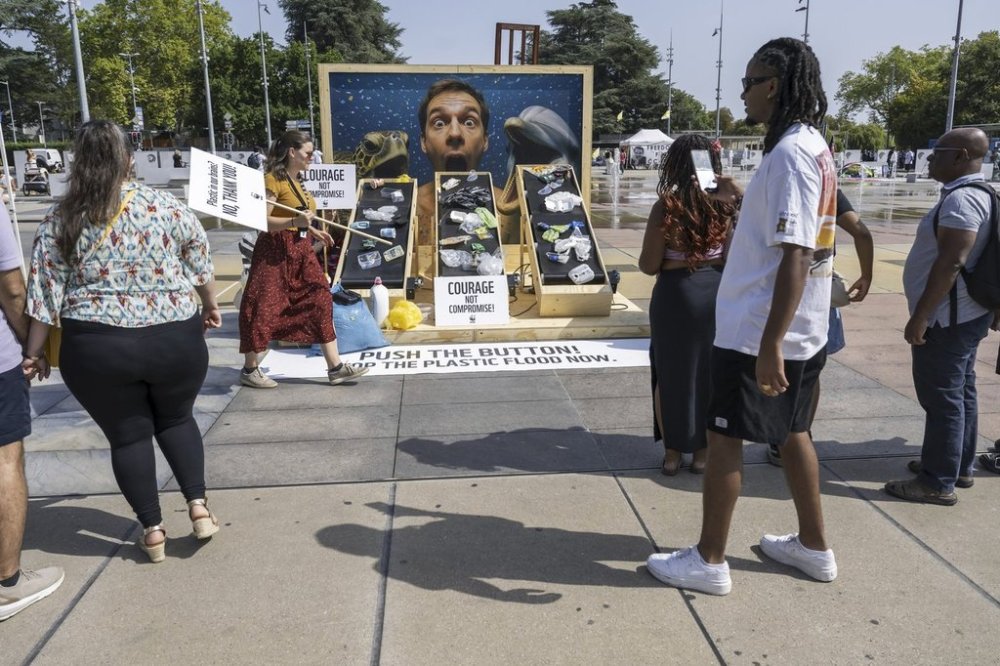
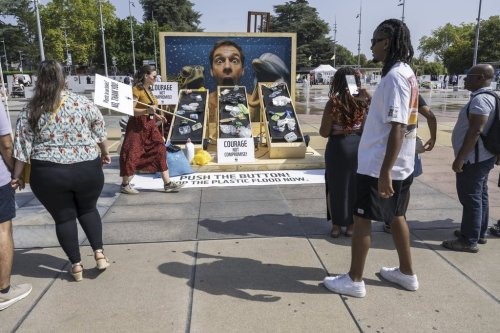
People observe a demonstration by the World Wildlife Fund against plastic waste during the ongoing plastics treaty negotiations in front of the United Nations office in Geneva, Switzerland, Wednesday, Aug. 13, 2025. (Martial Trezzini/Keystone via AP)

Countries with very divergent views expressed disappointment with the draft. It could change significantly and a new version is expected Thursday, the last scheduled day of the negotiations.

When they convened Wednesday night, Colombia’s delegation said that the text was entirely unacceptable, because it was unbalanced, and lacked the ambition and global obligations needed to end plastic pollution. The delegation said that it wouldn’t accept the wording as the basis for negotiations.

The head of Panama’s delegation to the talks, Juan Carlos Monterrey Gómez, stood up and cheered. Many delegations made statements to agree, including Mexico, Chile, Ghana, Canada, Norway, the United Kingdom, the European Union and the group of small island developing states.

“Let me be clear — this is not acceptable for future generations,” said Erin Silsbe, representing Canada.

Oil- and gas-producing nations raised other concerns, with Saudi Arabia, Kuwait, Qatar and others saying that the draft doesn’t have the scope they want to set the parameters of the treaty or precise definitions.

The United States said that six articles cross red lines, but didn’t say how.

India’s delegation, on the other hand, said that the draft is a “good enough starting point.”

The draft contains one mention of plastic production in the preamble, reaffirming the importance of promoting sustainable production and consumption of plastics. It doesn’t contain an article on production from a previous draft. There is no mention of chemicals.
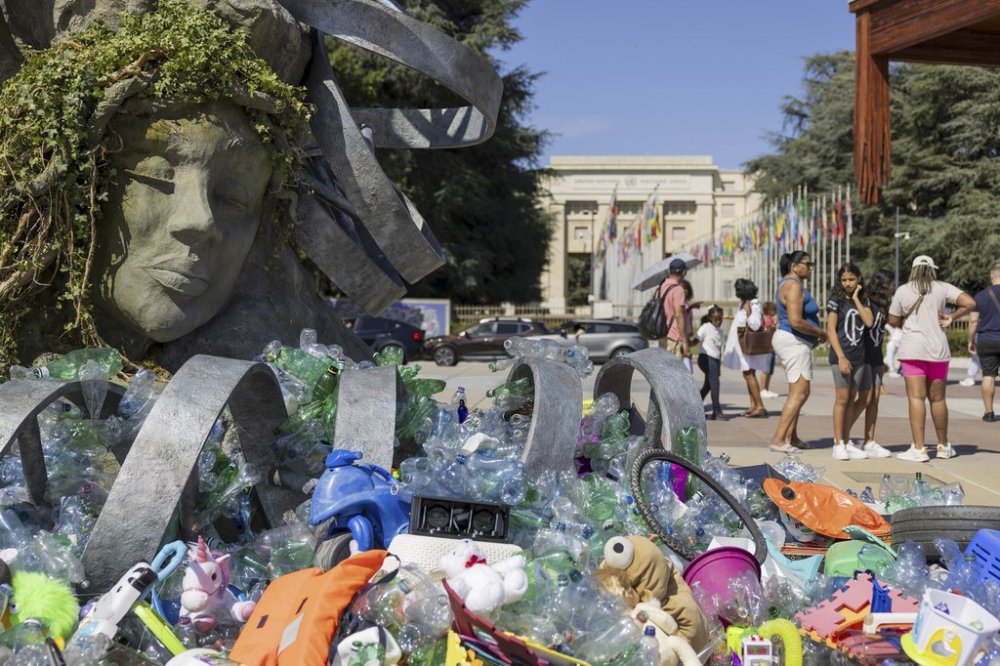
Plastic items are seen next to an artwork by Canadian artist and activist Benjamin Von Wong, titled 'The Thinker's Burden', a 6-meter-tall sculptural remix of Rodin's iconic Thinker, created especially for the Plastics Treaty negotiations, on Place des Nations in front of the European headquarters of the United Nations in Geneva, Switzerland, Monday, Aug. 4, 2025 before the second segment of the fifth session of the Intergovernmental Negotiating Committee on Plastic Pollution (INC-5.2). (Salvatore Di Nolfi/Keystone via AP)

The new provisions seek to reduce the number of problematic plastic products that often enter the environment and are difficult to recycle and promote the redesign of plastic products, so that they can be recycled and reused. Parties to the treaty would improve their waste management.

Luis Vayas Valdivieso, the chair of the negotiating committee, wrote the draft based on the views expressed by nations over the course of the negotiations. He told them that he did it to move them closer to a legally-binding instrument, and they can shape and improve it, as well as add and delete wording.

With little time left, he said, it’s time to build bridges, not dig in over red lines.

___

The Associated Press’ climate and environmental coverage receives financial support from multiple private foundations. AP is solely responsible for all content. Find AP’s standards for working with philanthropies, a list of supporters and funded coverage areas at AP.org.
Report Error Submit a Tip

More Stories

Kinew adds cabinet portfolio to focus on first responders

Carol Sanders and Nicole Buffie 5 minute read Preview

Kinew adds cabinet portfolio to focus on first responders

Carol Sanders and Nicole Buffie 5 minute read Updated: Yesterday at 6:40 PM CDT

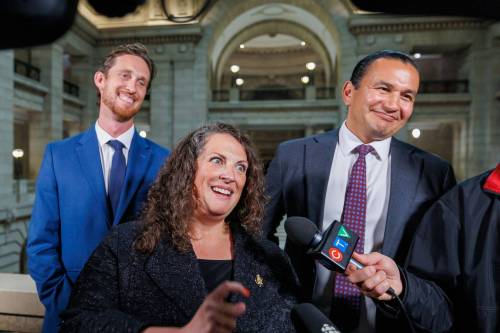
Premier Wab Kinew shuffled his cabinet Monday and created a new ministerial position that will oversee first responders in the province.

Kinew appointed David Pankratz, the MLA for Waverley, as minister responsible for first responder initiatives.

Tuxedo MLA Carla Compton was appointed minister responsible for accessibility, taking over the role from Families Minister Nahanni Fontaine.

The new ministers were sworn in at a ceremony at the legislature Monday afternoon.

Read
Updated: Yesterday at 6:40 PM CDT

Canada resorting to its tried and true playbook

Niigaan Sinclair 5 minute read Preview

Canada resorting to its tried and true playbook

Niigaan Sinclair 5 minute read Yesterday at 6:00 AM CDT

In 1846, Britain faced an emergency influenced by the Irish famine, so leaders repealed the country’s “Corn Laws” and restrictions on imported food and grain, transitioning to a system of free trade.

This created a crisis in the then Province of Canada, which had relied on British “preferential” status to prop up its agricultural and resource industries.

As a result, Canada looked south for new markets and eventually negotiated a free trade agreement with the United States.

This required land to be acquired and converted for industrial use quickly, so Canada quickly dispatched Commissioner William Robinson to negotiate with Indigenous communities along Lake Huron and Lake Superior for land.

Read
Yesterday at 6:00 AM CDT

AI, animals and us

Jordan Laidlaw 5 minute read 2:00 AM CDT

It is now perhaps axiomatic to declare that artificial intelligence will revolutionize the world, as researchers and industry insiders are projecting the novel technology to become the greatest technological breakthrough in human history.

There has been a flurry of discussion in both our local and international contexts — and with good cause. We must remain steadfast to ensure our youth, local workforces, and environment are not negatively impacted by this burgeoning technology.

I wish to accentuate, however, a somewhat neglected area of public discussion around AI developments. Specifically, we urgently need to re-evaluate the ethos of humanity, particularly cognizant of the emergence of this digitally superintelligent species.

If artificial superintelligence (ASI) is ultimately achieved, leading academics theorize that these digital agents will be sentient, conscious, and astronomically more intelligent and powerful than us. In fact, numerous scholars believe AI to already possess some level of consciousness in its current iteration. This position is held by eminent evolutionary biologist Richard Dawkins, for example.

New draft of global plastic pollution treaty wouldn’t limit plastic production

Jennifer Mcdermott, The Associated Press 4 minute read Preview

New draft of global plastic pollution treaty wouldn’t limit plastic production

Jennifer Mcdermott, The Associated Press 4 minute read Wednesday, Aug. 13, 2025

GENEVA (AP) — Negotiators working on a treaty to address global plastic pollution discussed a new draft of the text Wednesday that wouldn't limit plastic production or address chemicals used in plastic products.

The biggest issue of the talks has been whether the treaty should impose caps on producing new plastic or focus instead on things like better design, recycling and reuse. About 100 countries want to limit production as well as tackle cleanup and recycling. Many have said it’s essential to address toxic chemicals.

Powerful oil and gas-producing nations and the plastics industry oppose production limits. They want a treaty focused on better waste management and reuse.

Countries with very divergent views expressed disappointment with the draft. It could change significantly and a new version is expected Thursday, the last scheduled day of the negotiations.

Read
Wednesday, Aug. 13, 2025

What’s open, what’s closed, what’s up in Winnipeg on National Day of Truth and Reconciliation Sept. 30, 2026

Free Press staff 4 minute read Preview

What’s open, what’s closed, what’s up in Winnipeg on National Day of Truth and Reconciliation Sept. 30, 2026

Free Press staff 4 minute read Sunday, Sep. 27, 2026

The National Day of Truth and Reconciliation, or Orange Shirt Day, as it's known in Manitoba, happens Sept. 30 with many commemorative community events scheduled.

Read
Sunday, Sep. 27, 2026

Today’s horoscope

Georgia Nicols 4 minute read Preview

Today’s horoscope

Georgia Nicols 4 minute read 2:00 AM CDT

MOON ALERT: Avoid shopping (except food and gas) and important decisions after 6 p.m. The moon is in Taurus.

ARIES (March 21-April 19)

You might find you identify with your possessions more than usual. In fact, this could be why you might be tempted to be a bit extravagant or go overboard buying something. This same sense of largesse might creep into your financial negotiations. Be aware of this.

TAURUS (April 20-May 20)

Read
2:00 AM CDT