On the money
Works by Indigenous innovator Daphne Odjig will circulate through Canada

Advertisement
Read this article for free:
or
Already have an account? Log in here »
To continue reading, please subscribe:

Digital Subscription
One year of digital access for only $205*
- Enjoy unlimited reading on winnipegfreepress.com
- Read the E-Edition, our digital replica newspaper
- Access News Break, our award-winning app
- Play interactive puzzles
*First annual payment billed as $205.00 + GST for one year. This annual subscription will automatically renew at $233.00 + GST every 52 weeks (10% off the regular annual price of $259.35). Offer available to new and qualified returning subscribers only. Cancel any time.
To continue reading, please subscribe:
Add Free Press access to your Brandon Sun subscription for only an additional
$1 for the first 4 weeks*
- Enjoy unlimited reading on winnipegfreepress.com
- Read the E-Edition, our digital replica newspaper
- Access News Break, our award-winning app
- Play interactive puzzles
*Your next Brandon Sun subscription payment will increase by $1.00 and you will be charged $17.95 plus GST for four weeks. After four weeks, your payment will increase to $24.95 plus GST every four weeks.
Read unlimited articles for free today:
or
Already have an account? Log in here »
Hey there, time traveller!
This article was published 05/09/2025 (362 days ago), so information in it may no longer be current.
Three million $2 coins bearing artwork by Daphne Odjig will soon circulate through the country.
Odjig, who died in 2016, was one of the country’s most notable artists and a key innovator of the Woodlands style, an Indigenous art movement that emerged in the latter half of the 20th century. Her celebrated career took flight while living in Manitoba.
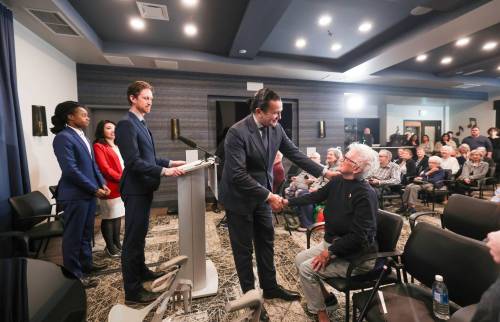
The Royal Canadian Mint unveiled the commemorative coin at a media conference at the Manitoba Museum on Thursday, marking the first Canadian circulation coin to feature a female visual artist.
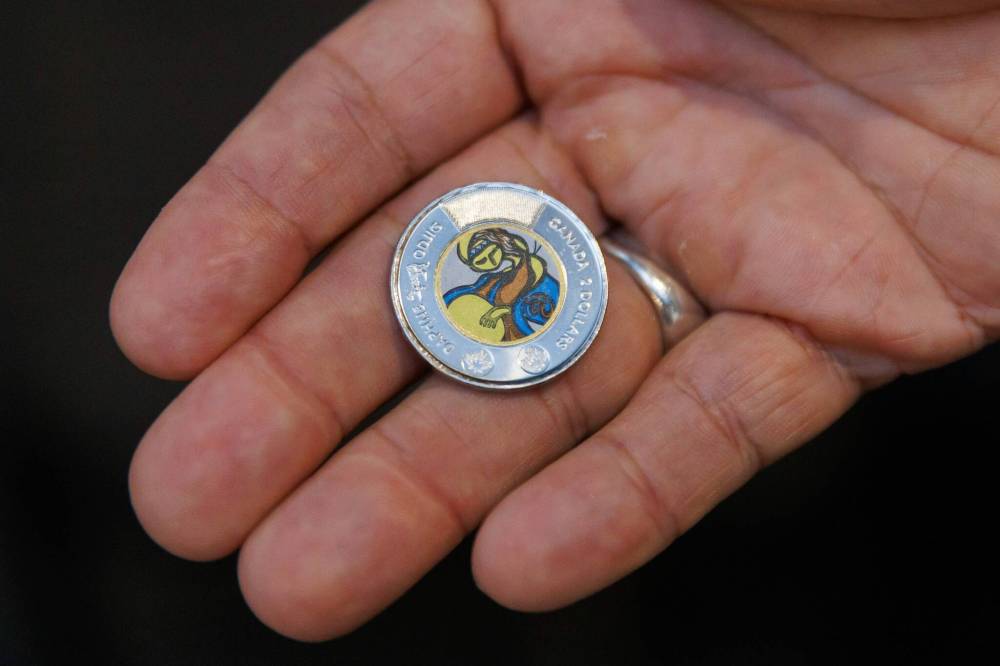
The toonie comes in coloured and uncoloured varieties.
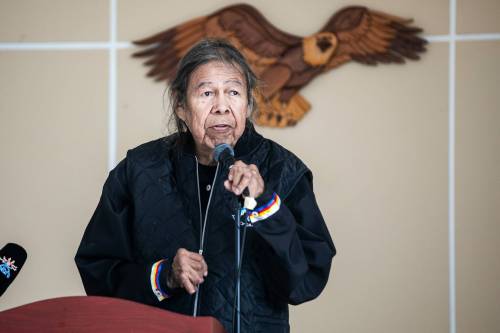
“This is a province and city that played a pivotal role in my mother’s development as an artist. I think she spent 10 years here,” said her son Stan Somerville, owner of Odjig Arts, at the conference.
“She was much, much more than an amazing artist. She was to many people an advocate, a trailblazer, an icon and, to many of us, a warrior.”
Odjig was born in Wiikwemkoong Unceded Territory (Manitoulin Island, Ontario) in 1919. A bout of rheumatic fever, forcing her to leave school at age 13, played an unlikely role in fostering a famous legacy. It meant she could absorb the training and traditional Potawatomi stories of her grandfather Jonas, a stone carver, at a time when traditional cultural practices were illegal in Canada.
By the mid-1960s, she had moved to northern Manitoba, where her painting began to assume its striking signatures. Legends and allegories were rendered with a boldly contemporary style, the first signs of what many considered a shift in the Canadian art world led by Indigenous artists.
While her work in this period was associated with Norval Morrisseau, with Odjig considered a “grandmother” figure of the Woodland style and Morrisseau a grandfather.
Apparently, they worked unbeknown to one another at first.
In this period, the European modernist heritage — which demanded a turn from tradition and representation towards experimentation and abstraction — loomed large in North America.
MIKE DEAL / FREE PRESS
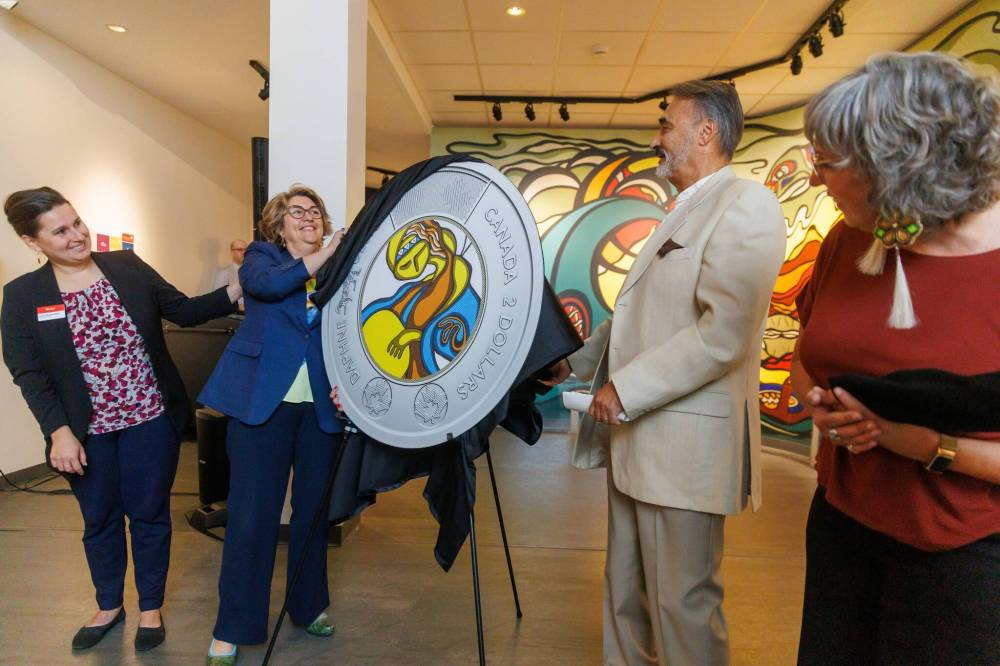
An enlarged replica showcasing the art printed on the coin is unveiled by (from left) Dorota Blumczynska CEO of the Manitoba Museum, Marie Lemay CEO of the Royal Canadian Mint, Stan Somerville, the son of artist Daphne Odjig, and Ginette Lavack, MP for St. Boniface-St. Vital and Parliamentary Secretary to the Minister of Indigenous Services.
Bonnie Devine — Anishinaabe visual artist, curator and friend of Odjig — says Odjig cut through the dilemmas this seemed to impose on Indigenous artists.
“She is the only one that I would call a genius. Daphne was a genius in the way that she integrated and synthesized so many different influences to create something completely new,” she says, highlighting such influences on Odjig as cubism, colour field painting and traditional Anishinaabe painting.
“I was scared to knock on the door. I was an artist, also Anishinaabe, also struggling to find how to be real in Canada. But she opened the door and beckoned me in and from that moment on, I felt her warmth and I felt her strength.”
Devine has elsewhere described how Odjig’s work in the 1980s assumed a personal turn, saying, “She began to exhibit work that didn’t necessarily speak about either her ‘Indianness’ or the history of her people, but about her feelings as a human being.”
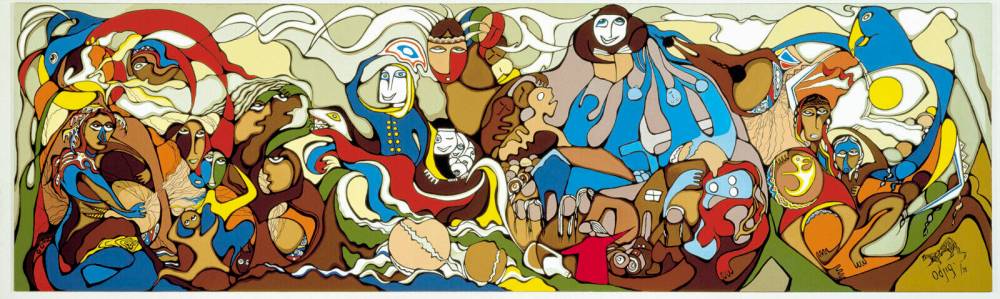
Odjig’s two-dollar coin features two works from just before that period. The colourized version has a cropped version of The Folk Singer (1977) at its centre, while the outer rim features an extract from her monumental The Indian in Transition (1978).
Considered a masterpiece, the painting may loosely bring to mind Picasso’s sprawling tableaus, though is iconic Odjig.
Odjig ran an art gallery in Winnipeg for many years, a hub for what became the Professional Native Indian Artists Incorporation – better known as the “Indian Group of Seven” – of which she was the driving force.
For her impact as an artist and organizer, she received the Order of Canada, the Governor General’s Award as well as five honorary doctorates.
MIKE DEAL / FREE PRESS
The toonie features elements of two artistic works by Odjig.
At the conference, Somerville ended his speech with a quote by Odjig reflecting on her own legacy.
“If my work as an artist has somehow helped to open doors between our people and the non-Native community, then I am glad,” he recited tearfully.
“I am even more deeply pleased if it has helped to encourage the young people that have followed our generation to express their pride in our heritage more openly, more joyfully than I would have ever dared to think possible.”
conrad.sweatman@freepress.mb.ca
Conrad Sweatman is an arts reporter and feature writer. Before joining the Free Press full-time in 2024, he worked in the U.K. and Canadian cultural sectors, freelanced for outlets including The Walrus, VICE and Prairie Fire. Read more about Conrad.
Our newsroom depends on a growing audience of readers to power our journalism. If you are not a paid reader, please consider becoming a subscriber.
Our newsroom depends on its audience of readers to power our journalism. Thank you for your support.
Conrad Sweatman is an arts reporter and feature writer. Before joining the Free Press full-time in 2024, he worked in the U.K. and Canadian cultural sectors, freelanced for outlets including The Walrus, VICE and Prairie Fire. Read more about Conrad.
Our newsroom depends on a growing audience of readers to power our journalism. If you are not a paid reader, please consider becoming a subscriber.
Our newsroom depends on its audience of readers to power our journalism. Thank you for your support.
Advertisement Advertise With Us
Advertisement Advertise With Us