Harvesting conversation and curiosity from BreakOut West

Advertisement
Read this article for free:
or
Already have an account? Log in here »
To continue reading, please subscribe:

Digital Subscription
One year of digital access for only $205*
- Enjoy unlimited reading on winnipegfreepress.com
- Read the E-Edition, our digital replica newspaper
- Access News Break, our award-winning app
- Play interactive puzzles
*First annual payment billed as $205.00 + GST for one year. This annual subscription will automatically renew at $233.00 + GST every 52 weeks (10% off the regular annual price of $259.35). Offer available to new and qualified returning subscribers only. Cancel any time.
To continue reading, please subscribe:
Add Free Press access to your Brandon Sun subscription for only an additional
$1 for the first 4 weeks*
- Enjoy unlimited reading on winnipegfreepress.com
- Read the E-Edition, our digital replica newspaper
- Access News Break, our award-winning app
- Play interactive puzzles
*Your next Brandon Sun subscription payment will increase by $1.00 and you will be charged $17.95 plus GST for four weeks. After four weeks, your payment will increase to $24.95 plus GST every four weeks.
Read unlimited articles for free today:
or
Already have an account? Log in here »
Hey there, time traveller!
This article was published 03/10/2025 (352 days ago), so information in it may no longer be current.
BreakOut West has long been about shoring up Northern and Western Canada in a music industry that feels Montreal- and Toronto-centric.
But discussions at this year’s conference, which Winnipeg hosted last week for the first time in over a decade, also reflected pressing challenges for the Canadian music sector as a whole.
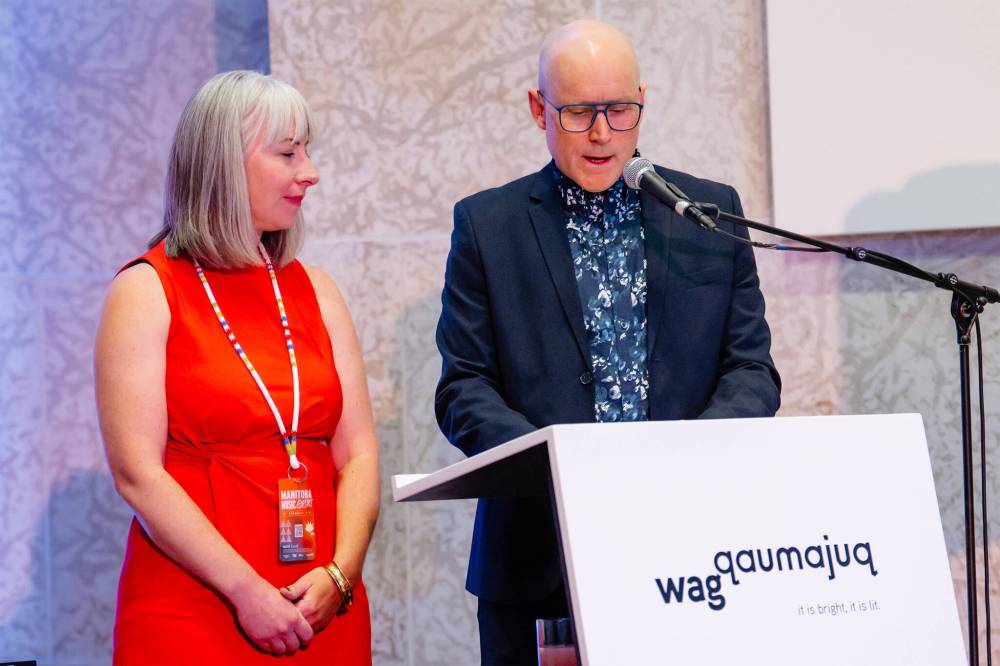
“There are some very real concerns right now about support for funding in the music industry,” says Manitoba Music’s executive director Vanessa Kuzina, who co-chaired the host organizing committee for BreakOut West 2025 with Manitoba Film and Music’s director of music programs Stephen Carroll.

SUPPLIED
Chixdiggit, at the Park Theatre, were among the Prairie acts showcased at BreakOut West.
Heightened trade and political tensions with the United States help incite protectionism and “nation-building” initiatives in other areas of Western and Northern Canada’s economy and public infrastructure.
Yet arts professionals often perceive this shuffle as sidelining the cultural sector — with frozen or tepid government increases, for instance, for key funding sources for musicians such as FACTOR (Foundation Assisting Canadian Talent on Recordings) and the Canada Council for the Arts.
“We can’t talk about saving and maintaining our cultural sovereignty, and then trade away all the pieces that maintain it,” Kuzina says.
She also highlights concerns that if major streaming platforms such as Spotify succeed in their legal offensives against Bill C-11, the revenue that bill requires them to contribute to FACTOR could be slashed.
Canadian speakers and delegates at BreakOut West waxed philosophical and strategized about these and other timely challenges in discussions relating to everything from touring, streaming and grant revenue to mental health and sobriety that spilled over into venues and bars in the evening.
Still, the mood was largely buoyant at the tightly organized conference, which in many ways was a show of artistic force for its host province.
Locals took home hardware in 12 categories of the conference’s award component, the Western Canadian Music Awards.
Meanwhile, more than a dozen hometown acts — in genres ranging from AfroBeats and hip-hop to the folky Canadiana for which the Prairies are so well known — strutted their stuff for national and international music industry decision-makers.
Notable were the number of agents, festival organizers, label executives, music marketers, trade officers and music business professionals from non-American foreign markets, including Mexico, Colombia, Germany, Sweden and Asia, present at this year’s event.
Even if it may not be a big winner in Canada’s new era of “elbows up” policies, Western Canada’s music sector is obviously thinking like other Canadian exporters — looking to diversify its foreign markets, without giving up on commercial opportunities and partnerships to the south.
Kuzina says this shift isn’t just about the effects of tariffs, but also heightened travel barriers and safety concerns for artists, especially queer musicians and musicians of colour, touring to the U.S.
It seems that for Carroll — who for years toured and performed as a member of one of Winnipeg’s most successful (and now inactive) bands, the Weakerthans — this shift in thinking is overdue.
“The U.S. has always been a bit of an impenetrable fortress of a market for many Canadians, and the increased problems with processing times and general bureaucratic requirements of the work visas are driving people to look for other markets which maybe are more accessible,” he says — issues, he adds, that long pre-exist this era of Trumpian nationalism.
BreakOut West had an especially strong delegation from Mexico and Germany, the former based on relationships forged more recently with help from Manitoba Music, the latter based on longstanding, and seemingly unlikely, ties between Hamburg and Winnipeg’s punk and folk scenes.
At “Hamburg and Winnipeg: A Love Story,” Carroll shared the stage with three veteran heavy-hitters from Germany’s punk scene — Thees Uhlmann, Danny Simons and Marcus Wiebusch — all now associated with Hamburg’s prestigious Grand Hotel van Cleef label and festival.
SUPPLIED
Vanessa Kuzina (left) and Stephen Carroll
The scrappy, anti-authoritarian spirit of Hamburg’s punk scene in the 1990s made it a natural comrade to Winnipeg’s music scene, where punk fans and bands with DIY and anarchist leanings such as Propagandhi congregated around the Royal Albert, Wellington’s and Mondragon.
Germany later embraced Winnipeg indie rock band the Weakerthans; its lead singer John K. Samson is still something of celebrity in the country’s underground music scene.
Carroll — a member of hardcore act Painted Thin before joining the Weakerthans — swapped memories with the German panelists about contracts drafted by hand with markers, clashing with Nazi skinheads and crashing at punk squats while on tour.
“In fact, we went to Germany before we went to the States. There was food on the table at night after the show, there were cases of beer. It felt very lavish, even though there were dirty mattresses sometimes and we’d get infections!” Carroll said onstage.
From this hothouse grew not just enduring musical friendships between Canuck and Kraut punks, but a vaunted international touring network that continues to bear fruit.
“The most success we’ve really had anywhere was Germany and I would say Danny (Simons) did a really good part of putting that together,” said Andrew Sannie, whose hip-hop ensemble the Lytics has toured Germany and Europe multiple times.

Other Winnipeg acts associated with Grand Hotel van Cleef include Imaginary Cities and Amos the Kid, who tours Germany in November.
BreakOut West’s festival portion concluded Saturday evening, when numerous Canadian acts — including Winnipeggers Slow Leaves, Tommyphyll, Cec, Dill the Giant, Virgo Rising and Boniface — performed for thousands of Winnipeggers parading the downtown during Nuit Blanche.
“Winnipeg really shone during BreakOut West,” Kuzina says.
“We know how special it is, but being able to actually demonstrate it, to have people go like, ‘Winnipeg’s incredible, when can I get back?’ I think that’s the piece that I’m really taking away.”
conrad.sweatman@freepress.mb.ca
Conrad Sweatman is an arts reporter and feature writer. Before joining the Free Press full-time in 2024, he worked in the U.K. and Canadian cultural sectors and freelanced for outlets including The Walrus, VICE and Prairie Fire. Read more about Conrad.
Our newsroom depends on a growing audience of readers to power our journalism. If you are not a paid reader, please consider becoming a subscriber.
Our newsroom depends on its audience of readers to power our journalism. Thank you for your support.
Conrad Sweatman is an arts reporter and feature writer. Before joining the Free Press full-time in 2024, he worked in the U.K. and Canadian cultural sectors and freelanced for outlets including The Walrus, VICE and Prairie Fire. Read more about Conrad.
Our newsroom depends on a growing audience of readers to power our journalism. If you are not a paid reader, please consider becoming a subscriber.
Our newsroom depends on its audience of readers to power our journalism. Thank you for your support.
Advertisement Advertise With Us
Advertisement Advertise With Us
History
Updated on Friday, October 3, 2025 9:50 AM CDT: Corrects that Stephen Carroll is Manitoba Film and Music's director of music programs