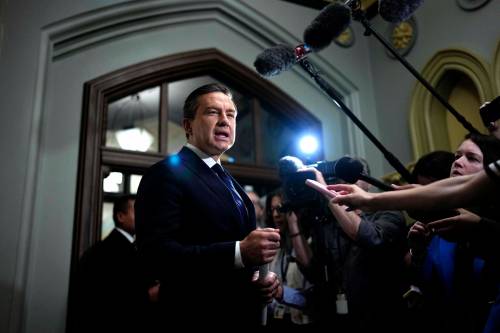
Tech leader John Ruffolo hopeful Canada will take digital sovereignty seriously

Advertisement

Advertise with us

TORONTO - The trade war has awoken Canada to the need to protect its digital sovereignty and for the first time in awhile, John Ruffolo is optimistic the country will finally do something about it. 

Read this article for free:


or

Already have an account? Log in here »

To continue reading, please subscribe:

Subscribe and receive a limited-edition Free Press branded hat or tote.

Digital Subscription

One year of digital access for only $205*

  • Enjoy unlimited reading on winnipegfreepress.com
  • Read the E-Edition, our digital replica newspaper
  • Access News Break, our award-winning app
  • Play interactive puzzles

*First annual payment billed as $205.00 + GST for one year. This annual subscription will automatically renew at $233.00 + GST every 52 weeks (10% off the regular annual price of $259.35). Offer available to new and qualified returning subscribers only. Cancel any time.

To continue reading, please subscribe:

Add Free Press access to your Brandon Sun subscription for only an additional

$1 for the first 4 weeks*

  • Enjoy unlimited reading on winnipegfreepress.com
  • Read the E-Edition, our digital replica newspaper
  • Access News Break, our award-winning app
  • Play interactive puzzles
Start now

*Your next Brandon Sun subscription payment will increase by $1.00 and you will be charged $17.95 plus GST for four weeks. After four weeks, your payment will increase to $24.95 plus GST every four weeks.

Hey there, time traveller!
This article was published 08/10/2025 (304 days ago), so information in it may no longer be current.

TORONTO – The trade war has awoken Canada to the need to protect its digital sovereignty and for the first time in awhile, John Ruffolo is optimistic the country will finally do something about it. 

“I was losing hope over the last couple of years because I was wondering whether we would ever get there,” said the founder of Maverix Private Equity and OMERS Ventures on stage at the Elevate tech conference on Wednesday.

“What I’ve noticed today is the political leaders, the business leaders, everyone is starting to sing the same song, so the message is being delivered.”
A man uses a computer keyboard in Toronto in a Sunday, Oct. 9, 2023 photo illustration. THE CANADIAN PRESS/Graeme Roy

The unity is a byproduct of U.S. President Donald Trump’s antagonism toward Canada. Since the start of the year, Trump has been lashing out against his country’s one-time biggest ally with tariffs and threats to take over its northern neighbor. 

The aggression has every sector of Canada’s economy scrambling to protect itself, lest it be Trump’s next target.

The tech sector sees sovereignty as one of its best solutions.

“At its core, Canadian sovereignty means our ability to define our own future without foreign influence, to drive our agendas and our ambitions. That’s the foundation,” said Debbie Gamble, chief strategy and marketing officer at Interac Corp., who joined Ruffolo on stage.

“From there though, the conversation must extend into the digital world. Digital sovereignty asks who owns and controls the infrastructure, who owns the data, and who defines the rules for the emerging digital economy.”

Ruffolo said it’s been an important concept he was hoping would gain support for years, especially after the U.S. introduced the Cloud Act.

The 2018 legislation allows the U.S. to access data anywhere in the world as long as it is held in servers maintained by an American firm. If the country seeks the data, it doesn’t even need to inform the companies whose info is being accessed, he said.

“When I saw that, read that, I was extremely troubled,” Ruffolo said.

Others weren’t nearly as concerned. He recalled them saying, “That’s theoretical. Is that going to really happen?”

Recent events, like the trade war and Elon Musk threatening to turn off Starlink internet access to the Ukrainian military, have convinced Ruffolo it could.

“If Canada is not playing ball with the United States from a trade negotiation perspective it is not so hard to assume that maybe Trump says, ‘You know what? Just shut Starlink down for an hour and let the Canadians quake in their boots,’” Ruffolo said.

John Ruffolo, right, the founder of Maverix Private Equity and OMERS Ventures, used an appearance at the Elevate tech conference in Toronto on Wednesday, October 8, 2025 to talk about digital sovereignty.
 THE CANADIAN PRESS/Handout - Elevate
- Ferguson Media Collective 
(Mandatory Credit)
John Ruffolo, right, the founder of Maverix Private Equity and OMERS Ventures, used an appearance at the Elevate tech conference in Toronto on Wednesday, October 8, 2025 to talk about digital sovereignty. THE CANADIAN PRESS/Handout - Elevate - Ferguson Media Collective (Mandatory Credit)

“That is possible. Not saying it’s going to happen but that’s what sovereignty means.”

If Canada wants to protect itself from everything that can happen when a nation’s tech ecosystem is too reliant on a neighbour, Ruffolo said it needs to find ways to keep capital in the country. 

That could mean pension funds and banks investing in homegrown businesses and governments and companies buying from other domestic firms.

“It doesn’t mean that you do not invest globally, but every country in the world is starting to ringfence their own capital, including the United States, so we need that capital,” he said.

The country also needs to support its own businesses, which would help give them more access to customers and markets.

“The United States is a great example. They are proud to say buy American and yet we were scared to say buy Canada,” he said. “Right now, we need to be supporting our own companies in our own backyard and be proud about doing that.”

If the country doesn’t find ways to support itself, he said it risks being a branch plant economy to the U.S. or elsewhere.

This report by The Canadian Press was first published Oct. 8, 2025.

Report Error Submit a Tip

More Stories

Israel: the new political divide?

David McLaughlin 5 minute read Preview

Israel: the new political divide?

David McLaughlin 5 minute read 2:01 AM CDT

Abdul won and Avi is thrilled.

Federal NDP Leader Avi Lewis emerged from electoral hiding to tell us how it is “exhilarating to witness” a “wave of progressive populism” in the United States. He was referring to the upset winner of Tuesday’s heavily-watched Michigan Senate primary race, Abdul El-Sayed, who barely prevailed over his establishment opponent for the Democratic nomination.

Premier Wab Kinew’s favourite New Democrat (after himself) steadfastly hesitates to take a risk and run for a House of Commons seat in a byelection to kickstart Canada’s version of progressive populism. No hesitation, though, in Lewis immediately basking in the reflected glory of those international comrades and fellow travellers who do.

Writing about the state of Canada’s New Democrats feels like a hate crime — you hate wasting your time — and this is no exception. A better story is what’s driving this modest but undeniable political movement in U.S. politics and whether it might gain traction here in Canada.

Read
2:01 AM CDT

Champion curler Meleschuk never lost his passion for the game

Joshua Frey-Sam 9 minute read Preview

Champion curler Meleschuk never lost his passion for the game

Joshua Frey-Sam 9 minute read 3:00 AM CDT

At the height of his curling career, Orest Meleschuk balanced ferocity and finesse like almost no one else.

The Winnipeg product was a fierce competitor skilful enough to thread a rock through a window and find the button.

Known as “The Big O,” he curled competitively for over six decades, finding success at the local, provincial, national and global level, and his longevity on the pebble was notable before lengthy careers became the norm.

Meleschuk is still tied with his good friend John Usackis for the most appearances in the Manitoba men’s provincial playdowns, at 30.

Read
3:00 AM CDT

Lac du Bonnet slowly healing from devastating fire

Nicole Buffie 6 minute read Preview

Lac du Bonnet slowly healing from devastating fire

Nicole Buffie 6 minute read Yesterday at 6:32 PM CDT

LAC DU BONNET — Fifteen months after devastating wildfires ripped through Lac du Bonnet, claiming two lives and destroying more than a dozen homes, residents are trying their best to build back better.

Along the winding gravel path that is Wendigo Road outside Lac du Bonnet, new timber peeks through patches of charred forest. Homes and cottages are beginning to take shape after fire raced through the neighbourhood at record speed and levelled at least 18 homes on the road.

Table saws and nail guns ring in the distance while Brian Curtis plots out where his new cottage will go. Curtis bought his previous cottage 19 years ago and had recently levelled the foundation.

He and his wife, Pam, had been thinking about long-term renovations when the May 13, 2025 fire swept away all their work and memories.

Read
Yesterday at 6:32 PM CDT

Poilievre’s lips moving, but Canadians aren’t interested in what he’s saying

Tom Brodbeck 5 minute read Preview

Poilievre’s lips moving, but Canadians aren’t interested in what he’s saying

Tom Brodbeck 5 minute read Thursday, Aug. 6, 2026

Pierre Poilievre’s biggest political challenge right now isn’t Prime Minister Mark Carney’s popularity.

It’s the fact that he still seems to be campaigning against a political landscape that no longer exists.

More than a year after the 2025 federal election, the Conservative leader is still relying on the same message, the same themes and the same attacks that defined his party’s campaign before voters went to the polls.

And Canadians appear to be tuning it out.

Read
Thursday, Aug. 6, 2026

Winnipeggers hoping for shorter waits in rural ERs delay care for all, Selkirk nurse says

Nicole Buffie 5 minute read Preview

Winnipeggers hoping for shorter waits in rural ERs delay care for all, Selkirk nurse says

Nicole Buffie 5 minute read Thursday, Aug. 6, 2026

Nurses and union leaders say Winnipeggers — who are frustrated with wait times at city hospitals — head to rural emergency rooms instead, but the facilities don’t have enough staff to meet the extra demand.

As a result, patients in the Selkirk Regional Health Centre emergency department have waited up to 18 hours during peak times, said one nurse who works there.

The nurse, who spoke to the Free Press on the condition of anonymity, said in recent years they have noted more Winnipeg patients who’ve driven the 25 kilometres north to Selkirk’s ER, believing the wait for treatment would be shorter than in the three emergency departments inside the Perimeter.

“They’re all trying to access health care, right? And everybody deserves health care. And I feel bad, because people have to come out here thinking that the wait times are less,” the nurse said. “I can’t blame people for wanting to seek care, and they’re desperate to see someone.”

Read
Thursday, Aug. 6, 2026

Watching while we work

Tory McNally 7 minute read Preview

Watching while we work

Tory McNally 7 minute read 2:01 AM CDT

For many employees, the idea that their employer might be tracking how long they spend at their keyboard, how often they move their mouse, or whether they are actively working throughout the day feels unsettling. For many employers, however, workplace surveillance is increasingly viewed as another management tool, particularly as hybrid and remote work become more common. The recent news that TD plans to monitor certain employees’ activity during the workday has reignited a conversation that has been quietly growing for several years: where is the line between legitimate oversight and excessive monitoring?

The reality is that workplace surveillance is nothing new. Employers have long monitored attendance, reviewed security camera footage, tracked company vehicles using GPS, audited expense reports, and reviewed internet usage on company-owned devices. What has changed is the sophistication of the technology. Today’s software can record login times, monitor application usage, track keystrokes, capture screenshots, analyze email activity, and even generate reports ranking employees based on their perceived productivity.

This naturally raises an important question. Does increased surveillance actually make people work harder?

The answer is not nearly as straightforward as many organizations hope.

Read
2:01 AM CDT