Hubble Space Telescope spies dusty debris from two cosmic collisions

Advertisement

Advertise with us

NEW YORK (AP) — NASA's Hubble Space Telescope got a rare look at the aftermath of two cosmic collisions — and helped scientists solve a decades-old mystery.

Read this article for free:


or

Already have an account? Log in here »

To continue reading, please subscribe:

Subscribe and receive a limited-edition Free Press branded hat or tote.

Digital Subscription

One year of digital access for only $205*

  • Enjoy unlimited reading on winnipegfreepress.com
  • Read the E-Edition, our digital replica newspaper
  • Access News Break, our award-winning app
  • Play interactive puzzles

*First annual payment billed as $205.00 + GST for one year. This annual subscription will automatically renew at $233.00 + GST every 52 weeks (10% off the regular annual price of $259.35). Offer available to new and qualified returning subscribers only. Cancel any time.

To continue reading, please subscribe:

Add Free Press access to your Brandon Sun subscription for only an additional

$1 for the first 4 weeks*

  • Enjoy unlimited reading on winnipegfreepress.com
  • Read the E-Edition, our digital replica newspaper
  • Access News Break, our award-winning app
  • Play interactive puzzles
Start now

*Your next Brandon Sun subscription payment will increase by $1.00 and you will be charged $17.95 plus GST for four weeks. After four weeks, your payment will increase to $24.95 plus GST every four weeks.

Hey there, time traveller!
This article was published 18/12/2025 (236 days ago), so information in it may no longer be current.

NEW YORK (AP) — NASA’s Hubble Space Telescope got a rare look at the aftermath of two cosmic collisions — and helped scientists solve a decades-old mystery.

Many years ago, scientists saw a dense, bright spot near a young star called Fomalhaut. They thought it could be a planet and continued to track it.

But in 2023, Hubble’s pictures revealed something strange. The bright spot had vanished — and a new one had appeared — a sign that it wasn’t a planet after all.
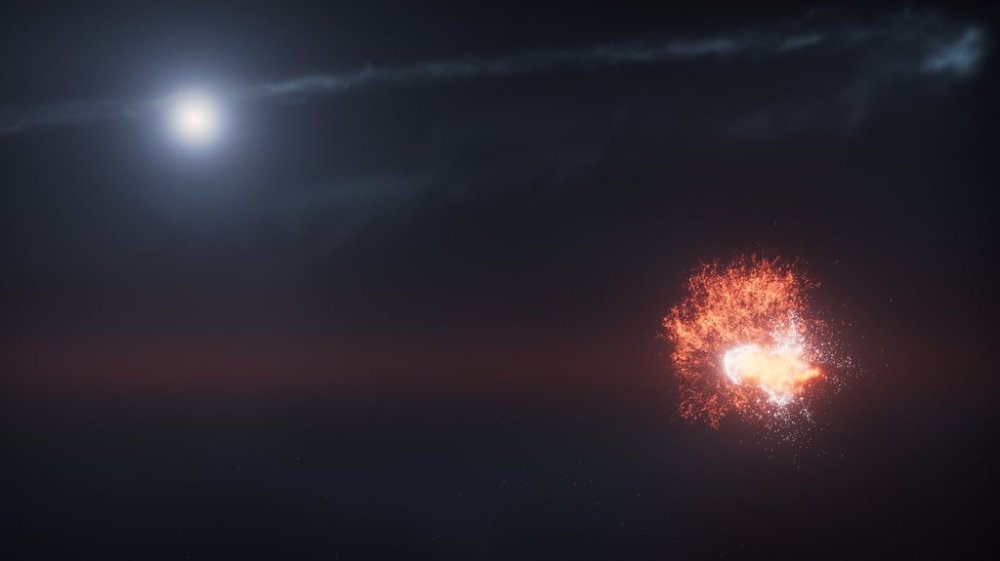
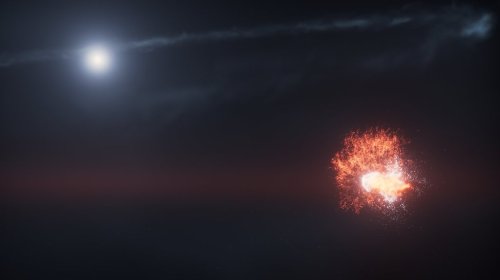
This illustration provided by NASA in December 2025 depicts the aftermath of a collision between two massive space rocks orbiting the star Fomalhaut. (NASA, ESA, STScI, Ralf Crawford, Space Telescope Science Institute via AP)

Scientists had stumbled on the dusty debris from two cosmic crashes. Massive space rocks slammed together to create clouds of dust that were thick enough to masquerade as planets. Over time, the remains spread out and eventually disappeared altogether.

Scientists think the space rocks involved in the collision were at least 37 miles (60 kilometers) wide. It’s rare to capture such clashes on camera, especially since theories suggest they only happen in the same vicinity about once every 100,000 years.

It’s “highly unexpected” that this area “has now exhibited two, unique, massive collisions inside 20 years,” said Joshua Lovell with the Harvard-Smithsonian Center for Astrophysics in an email. He had no role in the study, which was published Thursday in the journal Science.

The new observations could just be a lucky find. Or, they could mean that such smashups happen more often than scientists thought. It’ll take more data to know for sure.

Collisions of large space rocks are essential to how planets like ours form and what they’re made of. Studying them is “like taking a toddler picture of our solar system,” said astrophysicist Meredith MacGregor with Johns Hopkins University, who was not involved with the study.

Researchers plan to track the new dust cloud in the coming years to see how it changes and eventually disintegrates.

The star near the collision site is in our cosmic neighborhood, just 25 light years from Earth. A light year is nearly 6 trillion miles.

By keeping an eye on it, scientists are “catching these violent explosions in real time,” said study author Paul Kalas with the University of California, Berkeley.

___

The Associated Press Health and Science Department receives support from the Howard Hughes Medical Institute’s Department of Science Education and the Robert Wood Johnson Foundation. The AP is solely responsible for all content.

Report Error Submit a Tip

More Stories

Hydro’s planned $3B gas turbines purchase misguided, bad for environment, critics say

Malak Abas 6 minute read Preview

Hydro’s planned $3B gas turbines purchase misguided, bad for environment, critics say

Malak Abas 6 minute read Updated: Yesterday at 7:19 PM CDT

Despite defending a $3-billion gas turbine purchase as the most reliable power source in freezing temperatures, Manitoba Hydro’s gas turbines in Brandon have had outages during three of the 10 highest usage times over the past five winters — a sign that the Crown corporation’s long-term power plan needs re-evaluation, environmental groups say.

Read
Updated: Yesterday at 7:19 PM CDT

The right plan for reliable energy

Hal Turner 5 minute read Preview

The right plan for reliable energy

Hal Turner 5 minute read 2:00 AM CDT

Manitoba Hydro’s long-term energy plan is before the Public Utilities Board for public hearings. Debate is healthy, but not when critics ignore the facts.

Read
2:00 AM CDT

Hubble Space Telescope spies dusty debris from two cosmic collisions

Adithi Ramakrishnan, The Associated Press 3 minute read Preview

Hubble Space Telescope spies dusty debris from two cosmic collisions

Adithi Ramakrishnan, The Associated Press 3 minute read Thursday, Dec. 18, 2025

NEW YORK (AP) — NASA's Hubble Space Telescope got a rare look at the aftermath of two cosmic collisions — and helped scientists solve a decades-old mystery.

Many years ago, scientists saw a dense, bright spot near a young star called Fomalhaut. They thought it could be a planet and continued to track it.

But in 2023, Hubble's pictures revealed something strange. The bright spot had vanished — and a new one had appeared — a sign that it wasn't a planet after all.

Scientists had stumbled on the dusty debris from two cosmic crashes. Massive space rocks slammed together to create clouds of dust that were thick enough to masquerade as planets. Over time, the remains spread out and eventually disappeared altogether.

Read
Thursday, Dec. 18, 2025

Letters, August 10

7 minute read Preview

Letters, August 10

7 minute read Yesterday at 3:00 AM CDT

Horrors. Is Donald Trump correct? I think so. The bans on U.S. liquor are discriminatory. How could they be anything else? Provinces don’t ban alcohol from any other country.

Read
Yesterday at 3:00 AM CDT

Arcade bar to open in former downtown Keg

Gabrielle Piché 4 minute read Preview

Arcade bar to open in former downtown Keg

Gabrielle Piché 4 minute read Yesterday at 4:33 PM CDT

Smash burgers and Skee-Ball will replace steaks as the former downtown Keg transforms into an arcade bar.

Read
Yesterday at 4:33 PM CDT

‘Exciting news’ on rail relocation coming

Carol Sanders 5 minute read Preview

‘Exciting news’ on rail relocation coming

Carol Sanders 5 minute read 2:00 AM CDT

Premier Wab Kinew is expected to make an announcement concerning long-awaited Winnipeg rail relocation later this week.

Former federal transport minister and Manitoba MP Lloyd Axworthy, who Kinew tasked in October 2024 with leading a two-year rail relocation feasibility study, confirmed there would be an announcement Wednesday.

“We’ve had this rail study group which I’ve chaired and we’ve been responsible for developing recommendations,” Axworthy said Monday.

The longtime champion for Winnipeg rail relocation, who is vacationing at his cottage on Lake Winnipeg, deferred to the premier’s office for information, but confirmed he will attend Wednesday’s news conference.

Read
2:00 AM CDT