

Hydro’s planned $3B gas turbines purchase misguided, bad for environment, critics say

Advertisement
Read this article for free:
or
Already have an account? Log in here »
To continue reading, please subscribe:

Digital Subscription
One year of digital access for only $205*
- Enjoy unlimited reading on winnipegfreepress.com
- Read the E-Edition, our digital replica newspaper
- Access News Break, our award-winning app
- Play interactive puzzles
*First annual payment billed as $205.00 + GST for one year. This annual subscription will automatically renew at $233.00 + GST every 52 weeks (10% off the regular annual price of $259.35). Offer available to new and qualified returning subscribers only. Cancel any time.
To continue reading, please subscribe:
Add Free Press access to your Brandon Sun subscription for only an additional
$1 for the first 4 weeks*
- Enjoy unlimited reading on winnipegfreepress.com
- Read the E-Edition, our digital replica newspaper
- Access News Break, our award-winning app
- Play interactive puzzles
*Your next Brandon Sun subscription payment will increase by $1.00 and you will be charged $17.95 plus GST for four weeks. After four weeks, your payment will increase to $24.95 plus GST every four weeks.
Read unlimited articles for free today:
or
Already have an account? Log in here »
Despite defending a $3-billion gas turbine purchase as the most reliable power source in freezing temperatures, Manitoba Hydro’s gas turbines in Brandon have had outages during three of the 10 highest usage times over the past five winters — a sign that the Crown corporation’s long-term power plan needs re-evaluation, environmental groups say.
The utility admitted it had to reduce output of its two gas turbines at its Brandon generating station on Jan. 7 and Dec. 20 in 2022, and Jan. 22-23 of this year, during an ongoing Public Utilities Board hearing.
The outages happened during high load periods, when demands for energy in Manitoba were especially high.
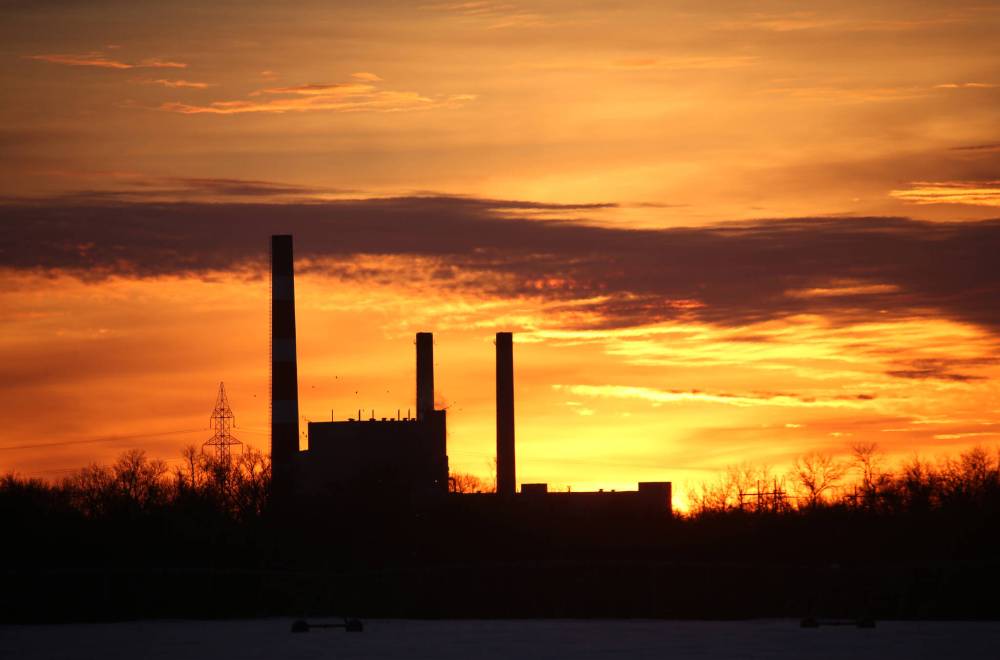
Manitoba Hydro has had to reduce output of its two gas turbines at its Brandon generating station on more than one occasion during times of peak energy usage. (Matt Goerzen/The Brandon Sun files)
The Jan. 22-23 outage occurred during a peak load of 5,096 megawatts, Hydro’s second-highest load period ever.
“There definitely are times here where it couldn’t run, but there are reasons for that.”
Manitoba Hydro is currently undergoing a six-week series of public hearings conducted by the PUB, an independent regulator, that will scrutinize its 10-year plan for the future of power in the province, including its decision to spend $3 billion on three new 250-megawatt gas-combustion turbines in Brandon by 2030 to meet increasing power needs.
Hydro vice-president of operations Dave Bowen acknowledged the outages during the hearing, but said they were a consequence of several issues, including staffing and maintenance.
He said that after previously believing the Brandon station would be de-commissioned, Hydro “didn’t invest in critical things to keep Brandon reliable.”
“There definitely are times here where it couldn’t run, but there are reasons for that, which (are) part of the maintenance and the sustainment (monies) that (were) not spent on that facility,” Bowen said in a transcript of the PUB hearing held in Winnipeg.
Manitoba Hydro has projected a shortfall of up to 600 megawatts in firm electricity capacity by the end of 2030. Their 10-year plan calls for about 1,760 megawatts, largely from the new turbines and Indigenous-led wind farms, by 2035, along with about 860 megawatts of energy-saving measures.
During the same hearing, Cheryl Sanclemente, Hydro’s director of energy markets, noted the utility will import energy during peak periods.
Bowen said Hydro is working on “making sure those issues will not persist for these units and for the future units that we install.”
During an earlier hearing date, he defended the purchase of the three turbines, saying it was “the one resource that has a reliable energy and capacity to supply Manitoba during a multiday or week cold snap.”
The Manitoba-based Climate Action Team disagrees. The organization has been critical of Hydro’s decision to purchase the turbines, pointing to the cost and impact on greenhouse-gas emissions.
CAT policy manager James Wilt said reliability has been Hydro’s central argument since the turbines were first announced last year, but there is already proof they won’t hold up to Manitoba’s energy needs on the coldest days of the year.
“The fact that this happened three out of 10 times during what are, really, record peak events fundamentally contradicts Hydro’s argument about the reliability of gas as a resource,” Wilt said Monday.
He pointed to several gas plant outages elsewhere, including a major outage in Alberta in 2024 that resulted in a “firm load shed” — a last-resort measure when power is intentionally cut during critical shortages — as a possible worst-case scenario for Manitoba.
“This is a real concern, given that we’ve seen report after report throughout North America showing that gas plants are failing at a higher rate than expected, and leaving ratepayers on the hook for either imports or having to deal with loss of electricity during these sorts of rolling blackouts,” he said.
Hydro spokesman Peter Chura said the gas turbines currently operating in Brandon are over 20 years old and have an “overall start-up reliability” of 91 per cent.
“The three turbines proposed as part of our development plan will, of course, be new equipment and are expected to build on that record of reliability,” Chura said in an email.
“Combustion turbines will ensure a dependable source of power when needed during peak demand and emergencies.”
He said Hydro had studied other options extensively and found them insufficient.
Quentin Robinson, with environmental group Sustainable Brandon, said the urgency of climate change is too severe to delay possible alternatives that could be more environmentally friendly, such as battery storage.
“How long can we wait for another (plan) that will give us alternatives?”
“With Brandon flooded once again this year, and with the wildfires and the smoke in the air, that question just becomes more and more pressing — can we wait? How long can we wait for another (plan) that will give us alternatives?” he said.
The hearing included comments from seven interveners, including other environmental and First Nations groups.
Both Wilt and Robinson said they’d like to see the like to see a re-evaluation of the reliability of gas power as a widely used resource, especially in times of extreme temperatures.

“Above all, Hydro is staking its argument, and the case for this $3 billion gas plant, on near-perfect reliability, and based on this disclosure, that doesn’t seem to be accurate, and it’s not something that Hydro has so far been really pushed on or held to account on,” Wilt said.
Premier Wab Kinew has lauded the $3-billion project as potentially transformative to Manitoba’s economy.
A spokesperson for Adrien Sala, the minister responsible for Hydro, initially declined to comment Monday because the hearing is underway.
After the story was published online, the spokesperson issued a statement, attributed to Sala, that was non-responsive to the issue.
malak.abas@freepress.mb.ca
Malak Abas is a city reporter at the Free Press. Born and raised in Winnipeg’s North End, she led the campus paper at the University of Manitoba before joining the Free Press in 2020. Read more about Malak.
Every piece of reporting Malak produces is reviewed by an editing team before it is posted online or published in print — part of the Free Press‘s tradition, since 1872, of producing reliable independent journalism. Read more about Free Press’s history and mandate, and learn how our newsroom operates.
Our newsroom depends on a growing audience of readers to power our journalism. If you are not a paid reader, please consider becoming a subscriber.
Our newsroom depends on its audience of readers to power our journalism. Thank you for your support.
Malak Abas is a city reporter at the Free Press. Born and raised in Winnipeg’s North End, she led the campus paper at the University of Manitoba before joining the Free Press in 2020. Read more about Malak.
Every piece of reporting Malak produces is reviewed by an editing team before it is posted online or published in print — part of the Free Press‘s tradition, since 1872, of producing reliable independent journalism. Read more about Free Press’s history and mandate, and learn how our newsroom operates.
Our newsroom depends on a growing audience of readers to power our journalism. If you are not a paid reader, please consider becoming a subscriber.
Our newsroom depends on its audience of readers to power our journalism. Thank you for your support.
Related Articles
Manitoba Hydro’s $3 billion fossil fuel bet


Advertisement Advertise With Us
Advertisement Advertise With Us
History
Updated on Monday, August 10, 2026 7:19 PM CDT: Adds quotet