

Forging a future with AI
Premier uses software to make homemade Ojibwa translator; cautiously optimistic about technology’s benefits

Advertisement
Read this article for free:
or
Already have an account? Log in here »
To continue reading, please subscribe:

Digital Subscription
One year of digital access for only $205*
- Enjoy unlimited reading on winnipegfreepress.com
- Read the E-Edition, our digital replica newspaper
- Access News Break, our award-winning app
- Play interactive puzzles
*First annual payment billed as $205.00 + GST for one year. This annual subscription will automatically renew at $233.00 + GST every 52 weeks (10% off the regular annual price of $259.35). Offer available to new and qualified returning subscribers only. Cancel any time.
To continue reading, please subscribe:
Add Free Press access to your Brandon Sun subscription for only an additional
$1 for the first 4 weeks*
- Enjoy unlimited reading on winnipegfreepress.com
- Read the E-Edition, our digital replica newspaper
- Access News Break, our award-winning app
- Play interactive puzzles
*Your next Brandon Sun subscription payment will increase by $1.00 and you will be charged $17.95 plus GST for four weeks. After four weeks, your payment will increase to $24.95 plus GST every four weeks.
Read unlimited articles for free today:
or
Already have an account? Log in here »
Hey there, time traveller!
This article was published 22/12/2025 (271 days ago), so information in it may no longer be current.
The tabs open on Premier Wab Kinew’s laptop will all but certainly surprise the average Manitoban.
Google Gemini, Claude by Anthropic and other artificial-intelligence powered assistants can be found coding on his behalf, even when his computer appears to be asleep.
Following a year-end interview with the Free Press, Kinew revealed he had been multitasking — with the help of large language models — the whole time.
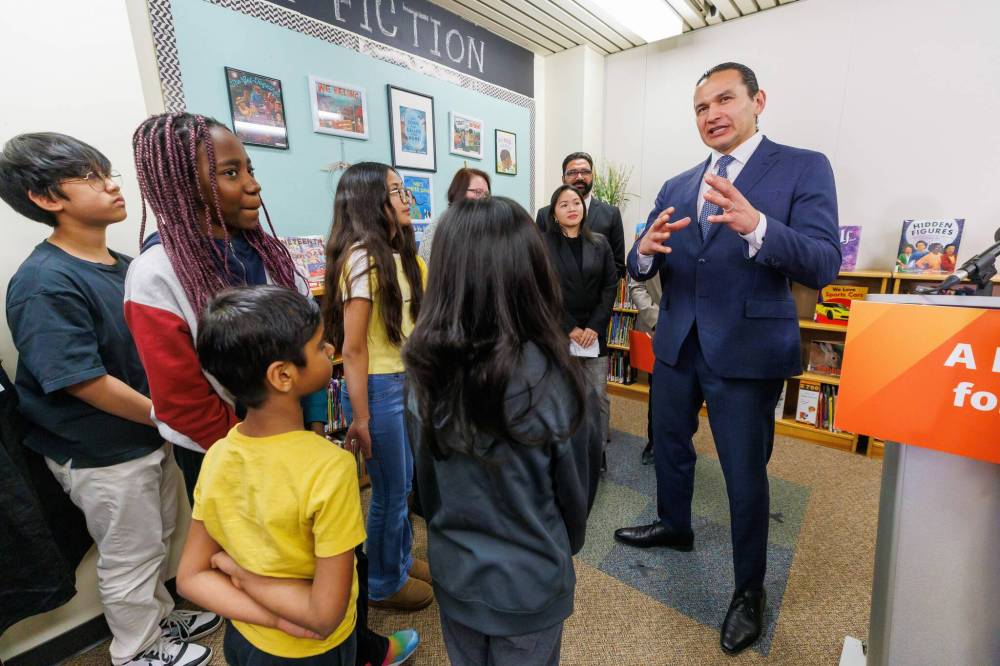
“I’m building an automatic translator for the Ojibwa language,” he said in his office Thursday during an interview that culminated with an impromptu monologue about AI.
Upon completion, Kinew’s homemade software will be able to translate written paragraphs into Anishinaabemowin.
The NDP leader said he’s doing his part to digitize the endangered dialect, which his Onigaming First Nation ancestors learned and passed on through oral storytelling, and assist government-employed interpreters.
Kinew, who made history in 2023 when he became the province’s first First Nations premier, speaks English, French and Anishinaabemowin fluently.
This new passion project is rooted in his drive to both keep the mother tongue of his ancestors alive and familiarize himself with the transformative technology.
“A worker with AI, from now on, is going to be like a person with a power tool versus somebody with just a screwdriver,” he said.
Looking ahead to 2026, his 44th birthday — Dec. 31 — and the second half of his first term, Manitoba’s 25th premier has been busying himself with trying to better understand how AI could help or hinder the province he governs.
The civil service adopted an internal policy on generative AI in May.
This tech is being used within the bureaucracy for research, analysis and automating administrative work. The province’s tool of choice? A made-in-America product: Microsoft Copilot — although a government spokesperson said the province is testing options “from other suppliers.”
Local data experts have warned the province’s competitiveness, business dynamism and sovereignty are all being threatened by the data-driven and AI economy.
“If we do not own and control the facilities, networks, and compute capacity where this data resides, the benefits will flow outward,” Manitoba’s Innovation and Productivity Taskforce, chaired by Jim Balsillie, said in an October report prepared for the province.
“The antidote is sovereign strategic investment and governance.”
“If we do not own and control the facilities, networks, and compute capacity where this data resides, the benefits will flow outward.”
The future of Manitoba’s AI workforce, ecosystem and the kinds of infrastructure required to power it are top of mind for Kinew.
One of the things he’s most excited about in the new year is a summit that will gather teachers to discuss AI.
Hundreds of teachers from the kindergarten-to-Grade 12 and post-secondary sectors are scheduled to meet Jan. 16 for a conference put on by Manitoba Education.
Sinead Bovell, a Canadian futurist who founded tech education company WAYE, will serve as the keynote speaker.
As far as Kinew is concerned, the province has a responsibility to prepare young people for an AI-powered future so they are competitive in the job market.
At the same time, the father of three is aware of the ethical and environmental impacts of accessing this rapidly-evolving technology.
Existing AI tools, including models running on his laptop to understand, generate, translate and summarize human language, are “probably the most powerful educational tools that we’ve invented until now,” he said.
“But they are also being deployed by massive, massive companies that are effectively (spying on us).”
Manitoba ethicist Arthur Schafer has spoken at length about the negative impact that surveillance capitalism can have on one’s creativity and personal development.
Schafer’s thoughts on the subject gives the premier pause, both as a dad and elected official, he said, adding that the major AI companies are based in the U.S.
Within a year of taking office, the NDP government introduced an outright ban on cellphones in elementary schools. High schoolers are, as of September 2024, no longer supposed to have personal devices out during instructional periods.
There are exemptions for accessibility and teacher-approved tasks.
Given he’s generally opposed to removing technology from any equation, the premier said he had to be convinced to crack down on screentime in schools.
But a decade of backlash against U.S.-based social media giants and growing concern about children and youth attention spans ultimately proved impossible to ignore, Kinew said.
Compliance has been varied, owing to individual educators’ philosophies and classroom management.
“We’re at the cusp of a similar decision point on AI,” Kinew said, adding that this topic is far bigger than education alone.
This summer, Ottawa announced it was partnering with Cohere, a multinational technology company that specializes in AI, to build “Canada’s AI ecosystem and internal AI services.”
Kinew said he’s been thinking about what a local AI workforce could look like, as well as if Manitobans are willing to entertain data centres as “huge power consumers and huge consumers of water.”
The self-described tech nerd said he does not have all the answers, but he’s certain that workers who can leverage AI will outperform those who cannot.
“Humanity will be better off if we ensure Indigenous languages survive into the digital and AI-powered future because they offer a different way of seeing the world.”
It remains to be seen as to whether Manitoba will regulate AI in classrooms.
For now, Kinew is endorsing guidelines by the Winnipeg School Division, where his youngest child is enrolled.
The division is promoting the responsible use of AI-powered chatbots and related tools with an “AI-assisted, never AI-led” philosophy.
Staff and students are being asked to consider the ethics of every prompt, how it is tied to reconciliation and ensure they are not inputting confidential information.

“Humanity will be better off if we ensure Indigenous languages survive into the digital and AI-powered future because they offer a different way of seeing the world,” he said.
“The more diversity that we have, the more perspective, the stronger our future societies.”
His government prioritized numerous initiatives to revitalize Indigenous languages — which are, as of this year, official languages of instruction in the Public School Act.
Manitoba released a throne speech in Anishinaabemowin for the first time this year and began publishing official house proceeding transcripts in the language.
maggie.macintosh@freepress.mb.ca
Maggie Macintosh
Education reporter
Maggie Macintosh reports on education for the Free Press. Originally from Hamilton, Ont., she first reported for the Free Press in 2017. Read more about Maggie.
Funding for the Free Press education reporter comes from the Government of Canada through the Local Journalism Initiative.
Every piece of reporting Maggie produces is reviewed by an editing team before it is posted online or published in print — part of the Free Press‘s tradition, since 1872, of producing reliable independent journalism. Read more about Free Press’s history and mandate, and learn how our newsroom operates.
Our newsroom depends on a growing audience of readers to power our journalism. If you are not a paid reader, please consider becoming a subscriber.
Our newsroom depends on its audience of readers to power our journalism. Thank you for your support.
Maggie Macintosh
Education reporter
Maggie Macintosh reports on education for the Free Press. Originally from Hamilton, Ont., she first reported for the Free Press in 2017. Read more about Maggie.
Funding for the Free Press education reporter comes from the Government of Canada through the Local Journalism Initiative.
Every piece of reporting Maggie produces is reviewed by an editing team before it is posted online or published in print — part of the Free Press‘s tradition, since 1872, of producing reliable independent journalism. Read more about Free Press’s history and mandate, and learn how our newsroom operates.
Our newsroom depends on a growing audience of readers to power our journalism. If you are not a paid reader, please consider becoming a subscriber.
Our newsroom depends on its audience of readers to power our journalism. Thank you for your support.
Related Articles
From public schools to post-secondary institutions, educators are grappling with AI's impact on education







Advertisement Advertise With Us
Advertisement Advertise With Us
History
Updated on Monday, December 22, 2025 8:32 AM CST: Corrects wording, cleans up end of sentence