

Power returns slowly to First Nation
Outage left Pimicikamak in dark, cold since Sunday


Advertisement
Read this article for free:
or
Already have an account? Log in here »
To continue reading, please subscribe:
Digital Subscription
One year of digital access for only $1.44 a week*
- Enjoy unlimited reading on winnipegfreepress.com
- Read the E-Edition, our digital replica newspaper
- Access News Break, our award-winning app
- Play interactive puzzles
*Billed as $5.77 plus GST every four weeks. After 52 weeks, price increases to the regular rate of $19.95 plus GST every four weeks. Offer available to new and qualified returning subscribers only. Cancel any time.
To continue reading, please subscribe:
Add Free Press access to your Brandon Sun subscription for only an additional
$1 for the first 4 weeks*
- Enjoy unlimited reading on winnipegfreepress.com
- Read the E-Edition, our digital replica newspaper
- Access News Break, our award-winning app
- Play interactive puzzles
*Your next Brandon Sun subscription payment will increase by $1.00 and you will be charged $17.95 plus GST for four weeks. After four weeks, your payment will increase to $24.95 plus GST every four weeks.
Read unlimited articles for free today:
or
Already have an account? Log in here »
Hey there, time traveller!
This article was published 01/01/2026 (293 days ago), so information in it may no longer be current.
The power is back on in Pimicikamak Cree Nation, but it will take the remote northern First Nation longer to recover after a prolonged electricty outage threw the community into crisis, causing waterpipes to freeze and forcing more than 1,400 residents to evacuate.
On Thursday, Manitoba Hydro announced it had completed emergency repairs of the broken power line that supplies Pimicikamak Okimawawin, also known as Cross Lake First Nation. The community is situated about 100 km south of Thompson, on Treaty 5 territory. Roughly 6,600 of its over 9,500 members live on-reserve.
All power was expected to be restored by the end of Thursday night, a Manitoba Hydro spokesman said. Electricity had to be restored in stages so as not to overwhelm the system with surges as refridgerators, furnaces, and other high-draw appliances came back online.
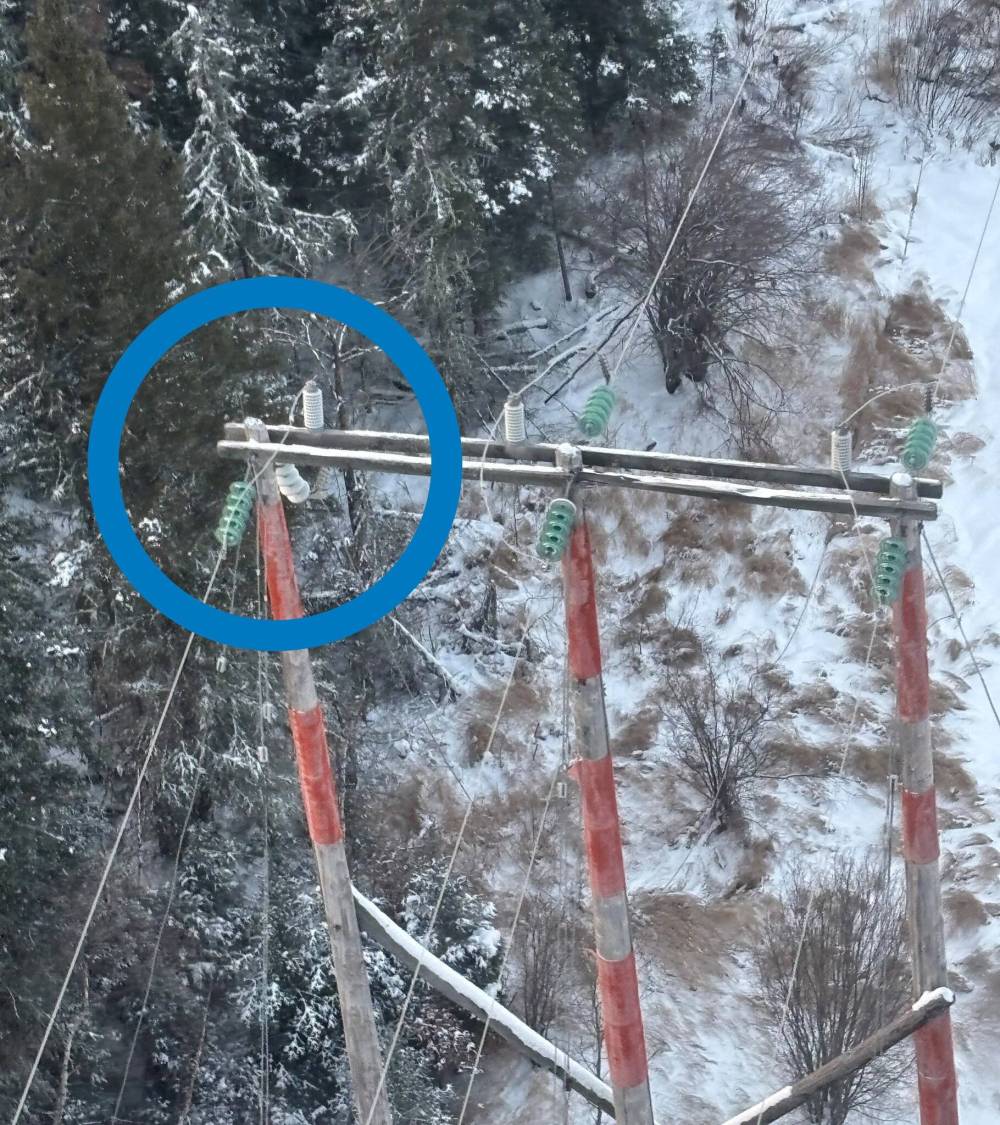
MANITOBA HYDRO Hydro workers spotted a downed line over the Nelson River about 10 kilometres from Pimicikamak Cree Nation, while flying over in a helicopter Monday morning.
The fix came just in time. By Wednesday, with the water treatment plant offline, the First Nation had run out of potable water. Manitoba Hydro supplied a large generator to get the plant working again, as well as eight heavy-duty heaters and generators to power them, to be used by the community at warming centres.
News that the line had been fixed came just hours after Pimicikamak Chief David Monias called on Prime Minister Mark Carney to deploy the Canadian military to help manage the crisis.
In a letter to Carney posted on Facebook, the chief said that despite multiple agencies working to help, including Indigenous Services Canada and the Canadian Red Cross, “the scale and severity of the crisis far exceeds local and regional capacity.” He requested military support to help with evacuations, sanitation, and getting water to residents.
“The safety and lives of our people are at stake,” the letter stated. “As a First Nation, we should not be left to endure repeated emergencies alone, particularly when the risks are foreseeable and preventable.”
The emergency began late Sunday night when a power line stretched between two islands in the Nelson River snapped. It’s not yet clear why the line broke; speaking over the phone on Thursday afternoon, Manitoba Hydro spokesman Peter Chura said the company would be examining the old line to determine a cause.
For over three days, about 20 Hydro workers laboured to fix the line, working outside in temperatures that plunged below -30 C. Because the ice between the islands wasn’t thick enough to support vehicles, Hydro hired two helicopters to fly over the work site, while other workers climbed atop poles in biting wind.
While the elements posed a “major challenge,” Chura said, all Hydro workers were able to complete the job safely.
“There’s nobody working on this right now who can remember a time where we’ve re-energized a community this large, that remote, and in temperatures this cold all at once,” Chura said. “It’s an unusual situation, for sure.”
Even as power was returning on Thursday, Pimicikamak members pleaded for help on Facebook, as they hunkered down in freezing homes and the community nursing station.
“We’re very aware of the great difficulty that community and community members have been in,” Chura said. “It’s a very difficult situation, being out of power in these temperatures for this length of time. It’s of great concern to us and to our employees, and it was a top priority at Manitoba Hydro to get power restored as quickly and safely as possible.”
At a news conference on Wednesday, community leaders questioned why they were forced to plead for help.
“We are in a life-and-death matter right now back home,” said an emotional Shirley Robinson, a councillor at Pimicikamak Cree Nation, as she sat next to Monias and Manitoba Keewatinowi Okimakanak Grand Chief Garrison Settee.
“We have infants that are waiting (to be evacuated), we have amputees who are waiting, we have elders — the very vulnerable — who are confined to wheelchairs that are waiting to be brought out. When is it going to be now?… Why is it we always have to beg? Our people are suffering right at this very moment.”
Robinson called on the provincial government to declare a state of emergency.
“The homes are smelling like a sewer already; (residents) haven’t had a decent meal… both of our stores are without power,” she said. “We deserve the same standards of care as any other ordinary person in this country of ours.”
In a statement, a spokesperson said the province was in direct contact with Pimicikamak leadership, including through the Manitoba Emergency Management Organization.
“With extreme cold weather in the region, multiple generators have been deployed, as well as heaters, blankets and cots have been delivered to the community,” the spokesperson said in an email. “Through the support of various agencies and partners additional food has been made available to the community.”
With electricity restored, the concern turns now to the damage the deep freeze did to pipes. Monias said the community will need at least 1,300 water pumps and new pipes to replace those that froze.
Grand Chief Settee, a member of Pimicikamak, noted that this latest crisis this marks the third state of emergency for the First Nation in the past two years, including this past summer when wildfires forced thousands from their homes for weeks.
“We’re a nation in peril,” Settee said on Wednesday. “It’s more than a state of emergency. It’s a catastrophe… Close to 7,000 people today are huddling with each other, supporting each other in the cold, without proper heating devices and resources, without adequate food and they’ve been running short of water.
“This is a time when the government should step up and respond to a crisis,” he continued. “This is what happens when you place our people in housing that is substandard, without alternate heating resources.”
By Wednesday, Pimicikamak residents were struggling to stay warm, cook food, and access clean water. Many went to stay with friends and family who had alternate heat sources; Pimicikamak resident Eva Muswagon said 11 people, including her grandchildren as young as two, and three dogs were staying in her home, which has a wood stove.
Even still, Muswagon said, her pipes had frozen. She was “praying to God” they wouldn’t burst.
Another resident, Shirley Thomas, faced a water shortage on Wednesday as she cared for her daughter with a disability.
“We need water,” Thomas said, writing over Facebook Messenger. “Propane stoves to cook had to be borrowed, plus long lineup for gas for the generator. I guess no New Year celebration for us. I need a single bed for my paraplegic (daughter) to move in the living room to be warm.
“I am 71 years old but still can help my family,” she continued. “I am crying because it’s sad.”

With hotels in Thompson already full, evacuees began to arrive in Winnipeg on Tuesday night. Red Cross teams worked to connect them with services at a hotel on Wellington Avenue. Many evacuees arrived with little, having had to leave quickly when flights became available.
Speaking to the Free Press on Wednesday, Lauralye Ross, who has a family of 11 in Winnipeg, called it a tough situation.
“We didn’t have time to grab much, not even a toothbrush. Little things like that. I need my medication still,” she said.
melissa.martin@freepress.mb.ca
scott.billeck@freepress.mb.ca
Several wise folks — ok, ok, journalism types — once told Scott he better make sure he can report on news before he learns to write about sports. In what can only be described as a minor miracle, he listened.
Our newsroom depends on a growing audience of readers to power our journalism. If you are not a paid reader, please consider becoming a subscriber.
Our newsroom depends on its audience of readers to power our journalism. Thank you for your support.
Several wise folks — ok, ok, journalism types — once told Scott he better make sure he can report on news before he learns to write about sports. In what can only be described as a minor miracle, he listened.
Our newsroom depends on a growing audience of readers to power our journalism. If you are not a paid reader, please consider becoming a subscriber.
Our newsroom depends on its audience of readers to power our journalism. Thank you for your support.
Related Articles
‘Everything we predicted’: pipes burst for some Pimicikamak residents, sparking new worries after outage




Advertisement Advertise With Us
Advertisement Advertise With Us