High-speed rail line would demand big slice of energy grids already under pressure
Advertisement
Read this article for free:
or
Already have an account? Log in here »
To continue reading, please subscribe:
Digital Subscription
One year of digital access for only $1.44 a week*
- Enjoy unlimited reading on winnipegfreepress.com
- Read the E-Edition, our digital replica newspaper
- Access News Break, our award-winning app
- Play interactive puzzles
*Billed as $5.77 plus GST every four weeks. After 52 weeks, price increases to the regular rate of $19.95 plus GST every four weeks. Offer available to new and qualified returning subscribers only. Cancel any time.
To continue reading, please subscribe:
Add Free Press access to your Brandon Sun subscription for only an additional
$1 for the first 4 weeks*
- Enjoy unlimited reading on winnipegfreepress.com
- Read the E-Edition, our digital replica newspaper
- Access News Break, our award-winning app
- Play interactive puzzles
*Your next Brandon Sun subscription payment will increase by $1.00 and you will be charged $17.95 plus GST for four weeks. After four weeks, your payment will increase to $24.95 plus GST every four weeks.
Read unlimited articles for free today:
or
Already have an account? Log in here »
Hey there, time traveller!
This article was published 08/02/2026 (251 days ago), so information in it may no longer be current.
MONTREAL – The dream of rapid, affordable travel between Central Canada’s biggest cities is alive again as centuries-old concepts — nation-building and trains — meet in the form of a high-speed rail project slated to break ground in fewer than five years.
The corridor between Quebec City and Toronto aims to carry up to 24 million riders annually by 2055 to boost economic growth, foster tourism and expand access to jobs by slashing travel times on dedicated electric tracks.
But as plans become clearer, so too does the need for large amounts of energy to power the line. Experts say planning needs to start now.
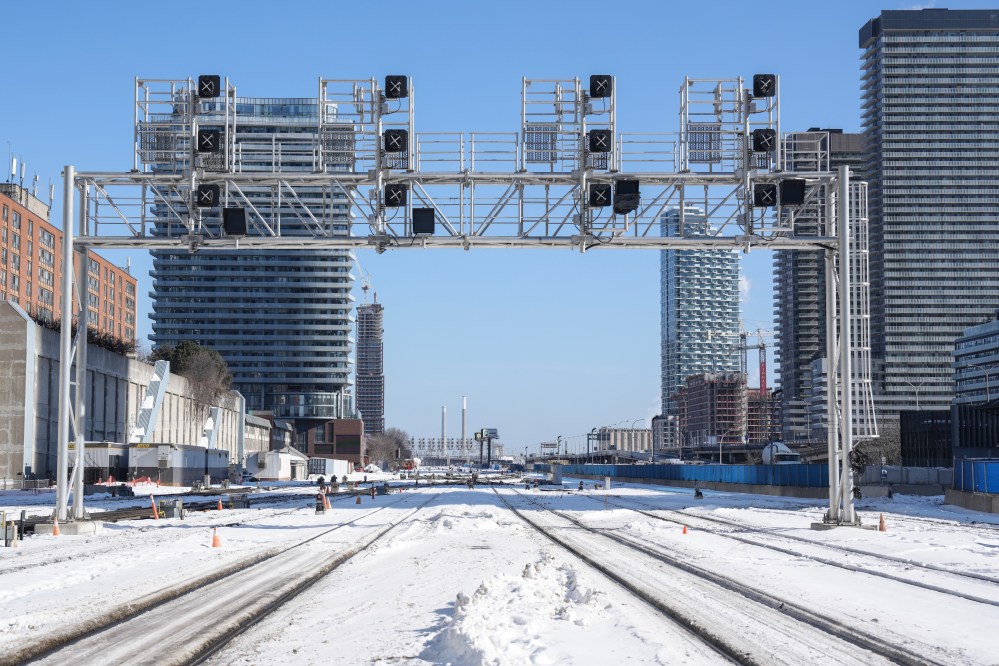
The proposed network would host 72 trains a day running along a 1,000-kilometre track at speeds of up to 300 km/h. It would make for a three-hour trip between the country’s two largest cities and less than an hour between Montreal and Ottawa.
Construction on the first phase between Ottawa and Montreal is currently expected to start in 2029 or 2030. Conceived as a public-private partnership, Crown corporation Alto will oversee the project while a consortium dubbed Cadence will design, build and operate the line.
Alto CEO Martin Imbleau is aware of the challenge the line could pose to already burdened power grids. But he says part of the project’s design phase now underway with utilities looks to head off any potential power shortages.
“It’s a significant block,” Imbleau said in an interview, referring to the amount of energy the line would consume daily.
“But we’re already in discussion with Hydro-Québec to make sure the capacity is there, and there’s no issue either in Ontario.” At least not at the moment.
Ontario expects electricity demand to soar 75 per cent by 2050, while Hydro-Québec aims to boost capacity by 100 per cent within a quarter century, as grids come under strain from artificial intelligence processing sites, electric vehicles and population growth.
The planned rail line would drain between one and three per cent of Ontario and Quebec’s current electrical capacity, said University of Ottawa associate professor Ryan Katz-Rosene. In percentage terms, that puts it on a rough par with steel plants or AI data centres in Ontario, or a large aluminum smelter in Quebec.
That owes partly to the sheer number of trains on the tracks — nearly twice Via Rail’s current average of 39 along the various legs of the Quebec City-Toronto corridor.
Speed plays a big role too. Approaching 300 km/h, the trains would require roughly double the energy of standard electric ones, given the power needed to reach high velocity and sustain it in the face of much greater drag.
Hence the need for high-capacity electrical substations for exclusive use by the rail line along the corridor.
Imbleau expects to build up to a dozen substations, which act as intermediaries between the grid and the railway, allowing electricity to be transmitted at different voltages.
“I haven’t done the calculations on a yearly basis, but at any one point in time we need 50 megawatts of power to supply a train running at 300 kilometres safely,” Imbleau said.
Asked Katz-Rosene: “Each of those little substations is like powering a small town. So then the question becomes, can the existing grid handle it?”
Documents obtained by The Canadian Press through an access-to-information request point to where that power will flow from.
One-third would come from Hydro-Québec and the rest from Ontario’s Hydro One, according to an overview from a 2023 study by Alto’s precursor. At that point, the project was still envisioned as high-frequency rail — with speeds of only up to 200 km/h — rather than high-speed rail and its much heftier electrical demands. But experts expect the proportions from the two provinces to remain roughly the same.
While Alto has declined to lay out a hard timeline, it has projected passenger figures for 2055. By then, many other sectors will already be guzzling energy from the provinces’ grids.
And the need for more juice is urgent. Last month, extreme cold forced Hydro-Québec to temporarily suspend its energy exports to Massachusetts. There is also less water in the utility’s reservoirs at the moment due to a three-year drought.
Once overflowing with excess electricity, Hydro-Québec has rejected several industrial development projects that would have required 21,500 megawatts of power — less than half of the rail line’s threshold — because it lacked the energy to supply them.
In Ontario, pressure on the grid driven in part by EV battery plants and data centres has caused demand projections for the coming decades to skyrocket. Industrial demand in the province is expected to grow 58 per cent by 2035, the Independent Electricity System Operator said in October 2024, marking a big leap from outlooks the year prior.
Experts say they hope the emissions reduction achieved as travellers abandon cars and planes for trains will make up for the high electricity consumption.
Construction of the rail line, with all of its attendant carbon emissions, habitat erosion and use of raw material — not least a 1,000-kilometre ribbon of steel, whose production is emissions-intensive — will take a hefty environmental toll.
“Building something of this scale requires huge amounts of ridership in order to cover those proverbial carbon costs,” said Matti Siemiatycki, director of the Infrastructure Institute at the University of Toronto.
“The way you pay off that bill, so to speak, is by having a ton of people ride this and transfer from more polluting modes of transportation,” he said.
“If it’s people shifting from the bus and the existing train, that’s actually not a huge win for the environment.”

As for financial costs, no business case specifying the precise route, budget, ridership forecast and fare projections has been presented to the public, though one is expected in the coming years.
Alto estimates the full project will cost between $60 billion and $90 billion. The government has not yet made a final decision approving funding for the entire rail line.
Hydro-Québec and Hydro One say they’ve had preliminary talks with Alto, but that specific energy use projections have not yet been made because a precise route remains to be finalized.
“Once Alto identifies its energy needs for the project, Hydro One, along with the province’s energy planner the Independent Electricity System Operator, will have a clearer understanding of potential impacts to the electricity system and the requirements to energize this project,” said Tiziana Baccega Rosa, a spokeswoman for the provincial utility, in an email.
This report by The Canadian Press was first published Feb. 8, 2026.