New study challenges a site that’s key to how humans got to the Americas

Advertisement

Advertise with us

NEW YORK (AP) — For decades, the strongest evidence for the earliest human settlement in the Americas came from a site in Chile called Monte Verde.

Read this article for free:


or

Already have an account? Log in here »

To continue reading, please subscribe:

Subscribe and receive a limited-edition Free Press branded hat or tote.

Digital Subscription

One year of digital access for only $205*

  • Enjoy unlimited reading on winnipegfreepress.com
  • Read the E-Edition, our digital replica newspaper
  • Access News Break, our award-winning app
  • Play interactive puzzles

*First annual payment billed as $205.00 + GST for one year. This annual subscription will automatically renew at $233.00 + GST every 52 weeks (10% off the regular annual price of $259.35). Offer available to new and qualified returning subscribers only. Cancel any time.

To continue reading, please subscribe:

Add Free Press access to your Brandon Sun subscription for only an additional

$1 for the first 4 weeks*

  • Enjoy unlimited reading on winnipegfreepress.com
  • Read the E-Edition, our digital replica newspaper
  • Access News Break, our award-winning app
  • Play interactive puzzles
Start now

*Your next Brandon Sun subscription payment will increase by $1.00 and you will be charged $17.95 plus GST for four weeks. After four weeks, your payment will increase to $24.95 plus GST every four weeks.

NEW YORK (AP) — For decades, the strongest evidence for the earliest human settlement in the Americas came from a site in Chile called Monte Verde.

Scientists found echoes of human presence dating back to around 14,500 years ago, including footprints, wooden tools, foundations for a building and the remains of an ancient fire pit. They dated sediments and artifacts from the site to this time frame.

A new study challenges the age of this important site, suggesting Monte Verde might be much younger than scientists thought. But not everyone agrees with the findings.
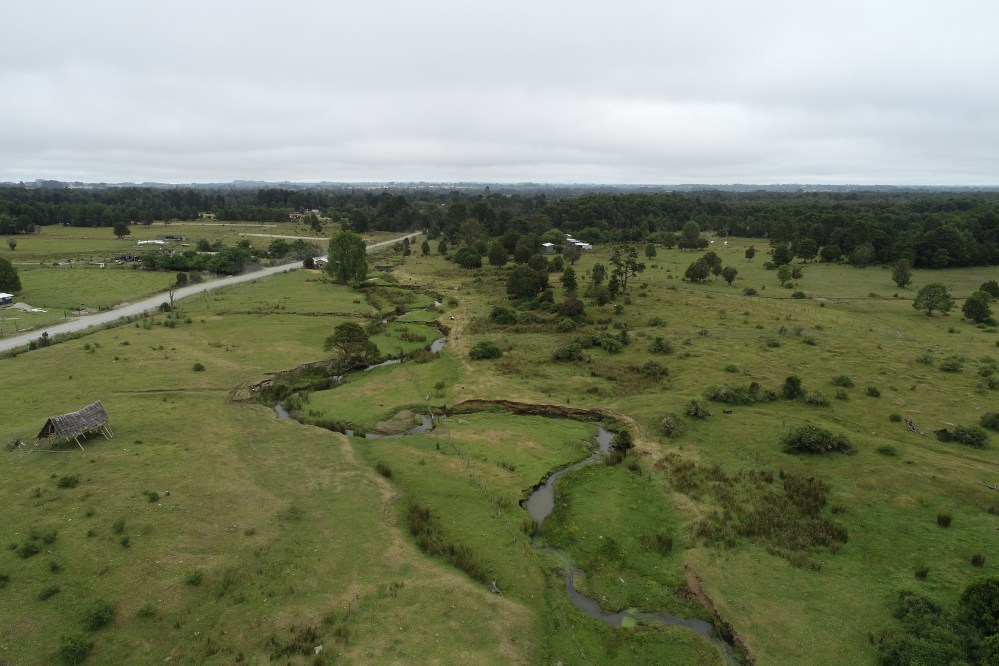
This 2023 image provided by Todd Surovell shows the Monte Verde archaeological site and Chinchihuapi Creek in Chile. (Todd Surovell via AP)

Scientists sampled and dated sediments from nine areas along the Chinchihuapi Creek by the site and analyzed how the landscape changed over thousands of years. They uncovered a layer of volcanic ash from an eruption dating back to about 11,000 years ago.

Anything above that layer — in this case, the Monte Verde wood and artifacts — had to be younger, according to study co-author Claudio Latorre.

“We basically reinterpreted the geology of the site. And we came to the conclusion that the Monte Verde site cannot be older than 8,200 years before present,” said Latorre, who works at the Pontifical Catholic University of Chile.

The researchers think changes to the landscape, including a stream wearing down the rocks, may have mixed old layers with new, causing researchers to date ancient wood as part of the Monte Verde site.

The findings were published Thursday in the journal Science. Several scientists, including those involved with the original excavations, take issue with the results.

“They have provided, at best, a working hypothesis that is not supported by the data they presented,” said Michael Waters of Texas A&M University, who had no role in either study.

Experts not involved with the research say the study includes analysis of samples from the area surrounding Monte Verde, where the geology isn’t comparable to the site itself. And they say there’s not enough evidence that the layer of volcanic ash once covered the entire landscape.

They also say the study doesn’t offer a sufficient explanation for the artifacts found at the site that have been directly dated to 14,500 years ago, including a mastodon tusk fashioned into a tool, a wooden lance and a digging stick with a burned tip.

“This interpretation disregards a vast body of well-dated cultural evidence,” archaeologist Tom Dillehay of Vanderbilt University, who led the site’s first excavation, said in an email.

The new study’s authors disagree with these criticisms, saying they sampled within, upstream and downstream of the site. And there’s not enough evidence that the dated artifacts at the site really are that old, said co-author Todd Surovell, of the University of Wyoming.

The Monte Verde site is critical to scientists’ understanding of how people got to the Americas. Scientists used to think the first arrivals were a group of people 13,000 years ago who made tipped stone tools known as Clovis points. The discovery and dating of Monte Verde, which was initially mired in controversy, appeared to put that to rest.

It’s unclear how a new date for the site might affect the human story. Since Monte Verde, researchers have uncovered sites in North America that predate the Clovis people, such as Cooper’s Ferry in Idaho and the Debra L. Friedkin site in Texas.

But another big question is how, exactly, people got to the Americas from Asia, maneuvering south of two massive ice sheets covering Canada. Did humans arrive in time for the sheets to part, revealing an ice-free corridor? Did they travel along the coast in boats, or over a mix of water and land?

A revised date for Monte Verde could reopen discussions about the most likely route by early humans, said Surovell. Future independent analyses of other early human sites could provide more clarity.

“Given enough time and given the ability to do science, science is self-corrective,” Surovell said. “It eventually reaches the truth.”

___

The Associated Press Health and Science Department receives support from the Howard Hughes Medical Institute’s Department of Science Education and the Robert Wood Johnson Foundation. The AP is solely responsible for all content.

Report Error Submit a Tip

More Stories

Council candidates call out vandalism after campaign signs defaced in Waverley West

Scott Billeck 5 minute read Preview

Council candidates call out vandalism after campaign signs defaced in Waverley West

Scott Billeck 5 minute read Updated: 11:34 AM CDT

A council candidate in Waverley West said she will not be intimidated after 16 of her campaign signs were vandalized this week — some with apparent gang symbols.

Nafiya Naso is the second candidate in the ward whose signs were defaced this month. Jasmine Brar, who is also running for the council seat, had some of her signs broken on Friday along Kenaston Boulevard and signs near Naso’s that were also defaced on Saturday.

Earlier this month, Eaglewood Park in the nearby Prairie Pointe neighbourhood was also vandalized with graffiti that included homophobic slurs, anti-India messages and repeated references to “3LK” — a symbol Naso believes is associated with a gang.

Naso’s signs, located along Waverley Street near Tim Sale Drive and across from École South Pointe School in southwest Winnipeg, were spray-painted with apparent gang signs, crude drawings and other messages, including “loser” and “Ur not winning” written across her name and photograph.

Read
Updated: 11:34 AM CDT

Trump’s tariff tantrum, geopolitical turmoil could be blessings in disguise for Manitoba’s diversified economy

Conrad Sweatman 18 minute read Preview

Trump’s tariff tantrum, geopolitical turmoil could be blessings in disguise for Manitoba’s diversified economy

Conrad Sweatman 18 minute read Friday, Aug. 28, 2026

It’s early July and Warren Luky’s second last day before he retires as president of United Steelworkers Local 6166. After a career at the bargaining table and in and around mineshafts, Luky speaks candidly as he fires up a barbecue at his Thompson home.

Luky, who represents 472 miners at Vale’s Thompson mining operation along with other northern labourers, is quite aware of the buzzwords currently attached to his trade and the region.

Phrases like “Arctic sovereignty,” “trade diversification,” “Indigenous-led” and “critical minerals” have caught on with politicians of all stripes over the past couple years as federal and provincial governments tout the need for greater Canadian sovereignty, with the push for major infrastructure projects declared a matter of national interest.

In light of the bitter collapse in trade negotiations between Canada and the U.S. on Aug. 21 — a historic blow to cross-border relations — these phrases are bound to become more contagious.

Read
Friday, Aug. 28, 2026

Beware invasive, ‘frightening’ waterhemp

Laura Rance-Unger 4 minute read Preview

Beware invasive, ‘frightening’ waterhemp

Laura Rance-Unger 4 minute read Yesterday at 2:01 AM CDT

There’s a threat lurking on the edge of Manitoba farmers’ fields this fall that’s even scarier than the escalating trade war with their biggest customer.

Provincial extension advisers are warning farmers to watch for a weed known as “tall waterhemp,” which, true to its name, may already be towering above ready-to-harvest crops.

Those wispy tentacles waving in the breeze look pretty innocuous from a distance. But this highly invasive member of the pigweed family produces hundreds of thousands of seeds that are just itching for dispersal through farmers’ combines and across their fields.

Each of those tiny seeds — one small pill container filled halfway holds 44,000 — can produce plants with stems the width of saplings and heights of two to five metres. One or two plants can quickly turn into a patch. If waterhemp takes over a field, it can choke out the growing crop and cut yields by more than 90 per cent.

Read
Yesterday at 2:01 AM CDT

Carney’s defence of Lake Ontario carries enormous weight

Niigaan Sinclair 5 minute read Preview

Carney’s defence of Lake Ontario carries enormous weight

Niigaan Sinclair 5 minute read Friday, Aug. 28, 2026

For centuries on Turtle Island (North America), explorers, map makers, and political leaders have erased Indigenous place names and substituted them — more often than not — with political, ethnocentric, and self-aggrandizing names.

In recent years, a few places on the continent have had Indigenous names re-established, but as of today, few of the original names are “official.”

So, it was no surprise when U.S. President Donald Trump on Thursday signed an executive order directing the U.S. Department of the Interior and Board on Geographic Names to take steps within 30 days to officially rename Lake Ontario as “Lake America.”

The move may have been a result of the Canada-U.S. trade war and Trump’s pettiness and ego, but it also fits in perfectly with his career.

Read
Friday, Aug. 28, 2026

Bombers play most complete game of season to dump powerhouse Alouettes

Taylor Allen 6 minute read Preview

Bombers play most complete game of season to dump powerhouse Alouettes

Taylor Allen 6 minute read Friday, Aug. 28, 2026

The Winnipeg Blue Bombers had to play four of their best quarters of football to even stand a chance.

There was no denying it, because with the powerhouse Montreal Alouettes in town, everyone knew it was going to take that — and then some — to slay the CFL’s top team.

Recent weeks suggested the Bombers weren’t capable of such a performance, but they dug deep at the perfect time and silenced a never-ending list of doubters to prevail 44-28 on Friday night at Princess Auto Stadium.

Where the heck have these Bombers been all year?

Read
Friday, Aug. 28, 2026

Winnipeg police ID deceased man, notify family

Free Press staff 3 minute read Preview

Winnipeg police ID deceased man, notify family

Free Press staff 3 minute read 11:26 AM CDT

Winnipeg police have been able to notify next-of-kin about the death of a man found unresponsive on a city street in July.

The man was identified after police asked for the public’s help and issued a composite sketch and description of the unknown man on Friday.

On Sunday, police said his family has been notified and thanked the public. Additional details about the man were not released in order to respect the family’s privacy, police said.

The man died in hospital after being found unresponsive July 28 at the corner of Main Street and James Avenue in Winnipeg, and investigators’ previous efforts to identify him were unsuccessful.

Read
11:26 AM CDT