

Nova Scotia cannabis conflict details relationship gone to pot

Advertisement
Read this article for free:
or
Already have an account? Log in here »
To continue reading, please subscribe:

Digital Subscription
One year of digital access for only $205*
- Enjoy unlimited reading on winnipegfreepress.com
- Read the E-Edition, our digital replica newspaper
- Access News Break, our award-winning app
- Play interactive puzzles
*First annual payment billed as $205.00 + GST for one year. This annual subscription will automatically renew at $233.00 + GST every 52 weeks (10% off the regular annual price of $259.35). Offer available to new and qualified returning subscribers only. Cancel any time.
To continue reading, please subscribe:
Add Free Press access to your Brandon Sun subscription for only an additional
$1 for the first 4 weeks*
- Enjoy unlimited reading on winnipegfreepress.com
- Read the E-Edition, our digital replica newspaper
- Access News Break, our award-winning app
- Play interactive puzzles
*Your next Brandon Sun subscription payment will increase by $1.00 and you will be charged $17.95 plus GST for four weeks. After four weeks, your payment will increase to $24.95 plus GST every four weeks.
Read unlimited articles for free today:
or
Already have an account? Log in here »
In the east of Canada there is one issue so explosive and divisive it seeks to undo nearly a century and a half of relationships between Indigenous communities and Canadians.
Cannabis.
That’s right: marijuana.
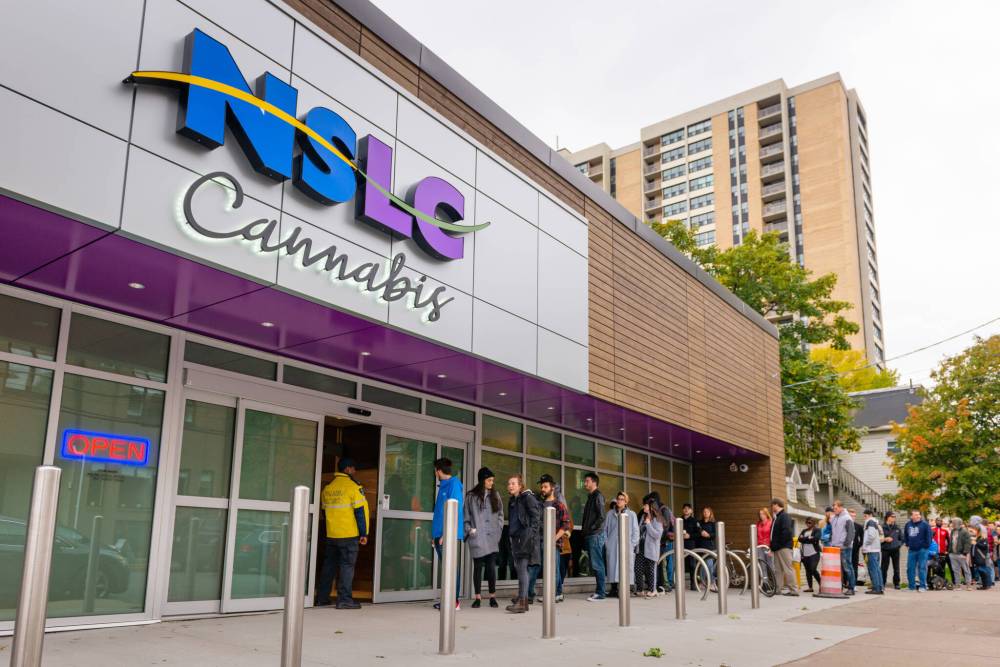
Dean Casavechia / Bloomberg photo
In Nova Scotia, cannabis sales are certified and sold exclusively in Nova Scotia Liquor Corporation stores, giving the Maritime province a monopoly on who can and does profit off the more than $125 million annual sales of cannabis there.
Last December, the leadership of Sipekne’katik First Nation passed a band council resolution banning Nova Scotia Premier Tim Houston, Justice Minister Scott Armstrong, and the minister responsible for L’nu Affairs, Leah Martin, from their territory.
Branding the three politicians as “undesirables” who “don’t have our best interest at heart,” Sipekne’katik Chief Michelle Glasgow announced that if Houston, Armstrong or Martin trespassed on their land, a community of a few thousand people approximately 70 kilometres north of Halifax, they would be subject to a $50,000 fine.
“This banning is not for our protection,” Glasgow told media. “But for theirs.”
The reason for this drastic action came after Houston’s government issued a directive to police forces in the province to crack down on private, unregulated cannabis operations — and everything went up in smoke.
In Nova Scotia, cannabis sales are certified and sold exclusively in Nova Scotia Liquor Corporation stores.
Prince Edward Island, New Brunswick, Québec, and the Northwest Territories also regulate cannabis sales.
Everywhere else in Canada is a mixture of private and public sales under the view of federal and provincial regulators.
According to the Nova Scotia government, a provincially-controlled system “ensures young people are safe, products are tested and traceable, and crime is not involved in the supply chain.”
It also — I’m sure coincidentally — means the Maritime province holds a monopoly on who can and does profit off the annual sales of more than $125 million of cannabis in the province.
Mi’kmaq leaders throughout the 13 First Nations in the province have argued for years that the sale of cannabis is an Indigenous and treaty right.
In 2024, four cannabis retailers on Millbrook First Nation were charged with operating unregulated, illegal operations that violated provincial law.
The operators argued that Nova Scotia laws violate their right to an economic livelihood and the continuity of their culture under the treaties signed between Mi’kmaw leaders and the British Crown in 1752 and 1763.
The trial included research that Mi’kmaq people traditionally traded in hemp with other Indigenous nations and used the material in their fishing nets and ropes.
The judge ruled in favour of the province, saying there was insufficient evidence to prove that Mi’kmaq used cannabis for psychoactive purposes (the way the Millbrook retailers were selling it now).
In essence, the judge interpreted Indigenous and treaty rights as “frozen” and unalterable by time — a highly problematic, archaic, and rejected method in most Indigenous rights court cases today.
The decision did, however, leave room for future court cases, encouraging further analysis of the sale of cannabis as an Indigenous and treaty right.
In other words, cannabis sales may or may not constitute an Indigenous and treaty right — time will tell — but this did not stop the premier of Nova Scotia issuing a directive to police to stop and arrest every private cannabis retailer in the province.
Over the past four months, dozens of raids, arrests, and seizures have taken place by officers at Mi’kmaq-operated cannabis operations throughout the 13 First Nations in Nova Scotia.
Following recent raids at Eskasoni First Nation, Potlotek First Nation, Paqtnkek First Nation, We’koqma’q First Nation and Digby, Mi’kmaq leaders have started to protect themselves. Highway blockades have been set up, as have checkstops at entrances and exists in their communities. They’ve even gone so far to announce police in the province have no jurisdiction on their lands.
The conflict got ugly last week when RCMP raided Potlotek First Nation and were forced to leave seven of their vehicles behind after community members blocked the roads out of the community.
Officers returned Friday to find their car windows smashed and tired slashed. Some vehicles were even missing wheels.
The scene was symbolic of the state of relations between Indigenous and Nova Scotia: broken, shattered and going nowhere.
Nova Scotia has become the example on how to destroy relationships with First Nations.

Its premier has done nearly every single thing that would spark conflict between a province and Indigenous peoples; from imposing a draconian law to sending in the police to refusing to listen to First Nations explaining what their Indigenous and treaty rights are.
No wonder Premier Houston is banned and threatened with a fine.
One hopes everyone can just mellow out and work together.
niigaan.sinclair@freepress.mb.ca
Niigaan Sinclair is Anishinaabe from Peguis First Nation and a professor in the Department of Indigenous Studies at the University of Manitoba. He’s been a columnist for the Free Press since 2018. Read more about Niigaan.
Every piece of writing Niigaan produces is reviewed by an editing team before it is posted online or published in print — part of the Free Press‘s tradition, since 1872, of producing reliable independent journalism. Read more about Free Press’s history and mandate, and learn how our newsroom operates.
Our newsroom depends on a growing audience of readers to power our journalism. If you are not a paid reader, please consider becoming a subscriber.
Our newsroom depends on its audience of readers to power our journalism. Thank you for your support.
Niigaan Sinclair is Anishinaabe from Peguis First Nation and a professor in the Department of Indigenous Studies at the University of Manitoba. He’s been a columnist for the Free Press since 2018. Read more about Niigaan.
Every piece of writing Niigaan produces is reviewed by an editing team before it is posted online or published in print — part of the Free Press‘s tradition, since 1872, of producing reliable independent journalism. Read more about Free Press’s history and mandate, and learn how our newsroom operates.
Our newsroom depends on a growing audience of readers to power our journalism. If you are not a paid reader, please consider becoming a subscriber.
Our newsroom depends on its audience of readers to power our journalism. Thank you for your support.
Related Articles
N.S. premier blasts First Nation highway blockades, calls for RCMP to be respected

Advertisement Advertise With Us
Advertisement Advertise With Us