

Trump’s lust for mining lucre now too close for comfort

Advertisement
Read this article for free:
or
Already have an account? Log in here »
To continue reading, please subscribe:

Digital Subscription
One year of digital access for only $205*
- Enjoy unlimited reading on winnipegfreepress.com
- Read the E-Edition, our digital replica newspaper
- Access News Break, our award-winning app
- Play interactive puzzles
*First annual payment billed as $205.00 + GST for one year. This annual subscription will automatically renew at $233.00 + GST every 52 weeks (10% off the regular annual price of $259.35). Offer available to new and qualified returning subscribers only. Cancel any time.
To continue reading, please subscribe:
Add Free Press access to your Brandon Sun subscription for only an additional
$1 for the first 4 weeks*
- Enjoy unlimited reading on winnipegfreepress.com
- Read the E-Edition, our digital replica newspaper
- Access News Break, our award-winning app
- Play interactive puzzles
*Your next Brandon Sun subscription payment will increase by $1.00 and you will be charged $17.95 plus GST for four weeks. After four weeks, your payment will increase to $24.95 plus GST every four weeks.
Read unlimited articles for free today:
or
Already have an account? Log in here »
I get a sinking feeling when I read news stories about the Boundary Waters in northern Minnesota. And it’s a familiar sinking feeling.
More so when those news stories included the revelation the Trump administration has reopened the process that could allow a giant copper mine near the Boundary Waters Canoe Area, one that would be operated by a Chilean mining enterprise.
Copper demand is high, in part from construction needs for heating and cooling data centres. And about one-third of the known copper reserves in the U.S. are located in the area that could potentially allow mining, after a reversal of earlier protected status.
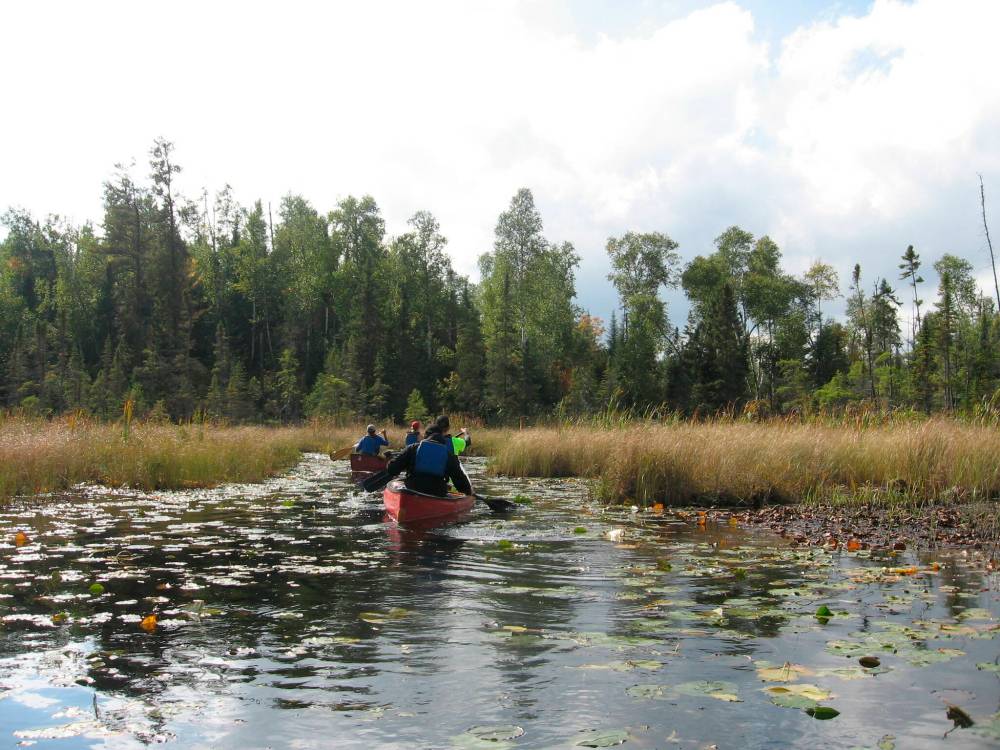
Giovanna Dell’Orto / The Associated Press Files
Two canoes paddle along a lily pad-lined bog in Minnesota’s Boundary Waters Canoe Area Wilderness. The area protects more than 1,200 miles of canoe trails over lakes and rivers fringed by pine forests. U.S. President Donald Trump’s administration has reopened the process that could allow a giant copper mine near the Boundary Waters Canoe Area.
The Boundary Waters flow into the Rainy River watershed, into Lake of the Woods and eventually into Lake Winnipeg. And while the Boundary Waters Treaty from 1909 provides stewardship by the International Joint Commission for waters shared by Canada and the U.S., Donald Trump’s America-first (and always) stance means we can’t depend on guarantees that exist now.
Put bluntly, that means that, even with treaties in place, we can’t necessarily depend on our neighbours to live up to their commitments to protect the water that crosses from their country into ours.
Yes, we need economic development. Yes, we need raw materials. But at what cost?
Modern mining is far from a guaranteed environmental failure. The company proposing the project promises high standards and an underground mining operation without tailings dumps. But there are always risks, and there are always companies that end up not living up to their promises.
Face it: the market is always looking for the cheapest supply of materials to produce the lowest-cost goods. That often means mining or harvesting easily accessible materials in untouched settings. Economic necessity may well be a calculus that’s fine for any of us who are older and won’t live to see the effects.
But just like there are a limited number of sources of raw materials, there are a limited number of untouched natural areas.
While we’re keen on nation-building with big projects, we should also be keen on nation-building with big protections for the most valuable of our currently unprotected natural areas. Resource projects play out, and what’s left behind is not a return to what was there before. The best of reclamations is still a reclamation.
You get one chance to save something unique. There are exceptions, though. Before it became a national park, sections of Gros Morne National Park in Newfoundland were comprehensively logged, including clear-cutting.
But that’s an exception, rather than the rule.
So, as the federal government moves to fast-track projects with national scope, it should set up a parallel nation-building process that can move just as quickly to protect more of Canada’s wildland gems.
South of us, there are plans to open up huge portions of U.S. national forests to logging — plans to allow oil drilling in pristine Alaskan areas. Changes to allow easier disposal of toxic heavy-metal-contaminated coal ash. Plans to broaden all sorts of extractive projects to “make America great again.”
It is almost as if Trump, a creature of New York City, has never walked alone in a high wildland meadow. Has never just sat in the summer heat along the side of a small boreal creek, listening to the water falling over a low falls. Because he seems to see no value in anything that isn’t a cash transaction, falling on the profit side of the ledger.
American nature photographer Ansel Adams said in 1983, “It is horrifying that we have to fight our own government to save the environment.” That saying is apt again in the U.S. — let’s not make it apt here as well.
There may be great immediate wealth in the process of strip-mining the future to provide for economic success in the present, but it doesn’t leave a heck of a lot for our children and grandchildren. It’s gold leaf on the walls today, lead in the drinking water tomorrow.
A country’s greatness is also measured by how well it balances all of its resources — economic, environmental and beyond.

Perhaps it’s selfish of me, but natural areas are, to me, the best of respites. I can feel my soul recovering when I’m in the woods near Pinawa or lying on my back somewhere far from city lights, watching the purple boil of the Milky Way bulge and curve in the night sky above me.
Don’t get me wrong; I have watched the “man-made lava flow” of the Monsanto phosphate-production operation in Soda Springs, Idaho, where glowing industrial slag waste runs down the side of the mammoth slag pile. The 1,000 C calcium silicate is created by a plant that uses as much electricity every year as Kansas City, so it is a wonder of sorts.
But not, somehow, as fine to me as watching a cat’s paw breath of wind track across tall grass in a meadow, or as finding single small and unfamiliar orchids demonstrating their unique design to absolutely no one in the middle of a summer bog.
I’ll pick cool, clear, clean water over a data centre’s output of AI imaginings of lost nature any day.
Russell Wangersky is the Comment Editor at the Free Press. He can be reached at russell.wangersky@freepress.mb.ca
Russell Wangersky
Perspectives editor
Russell Wangersky is Perspectives Editor for the Winnipeg Free Press, and also writes editorials and columns. He worked at newspapers in Newfoundland and Labrador, Ontario and Saskatchewan before joining the Free Press in 2023. A seven-time National Newspaper Award finalist for opinion writing, he’s also penned eight books. Read more about Russell.
Russell oversees the team that publishes editorials, opinions and analysis — part of the Free Press‘s tradition, since 1872, of producing reliable independent journalism. Read more about Free Press’s history and mandate, and learn how our newsroom operates.
Our newsroom depends on a growing audience of readers to power our journalism. If you are not a paid reader, please consider becoming a subscriber.
Our newsroom depends on its audience of readers to power our journalism. Thank you for your support.
Russell Wangersky
Perspectives editor
Russell Wangersky is Perspectives Editor for the Winnipeg Free Press, and also writes editorials and columns. He worked at newspapers in Newfoundland and Labrador, Ontario and Saskatchewan before joining the Free Press in 2023. A seven-time National Newspaper Award finalist for opinion writing, he’s also penned eight books. Read more about Russell.
Russell oversees the team that publishes editorials, opinions and analysis — part of the Free Press‘s tradition, since 1872, of producing reliable independent journalism. Read more about Free Press’s history and mandate, and learn how our newsroom operates.
Our newsroom depends on a growing audience of readers to power our journalism. If you are not a paid reader, please consider becoming a subscriber.
Our newsroom depends on its audience of readers to power our journalism. Thank you for your support.
Advertisement Advertise With Us
Advertisement Advertise With Us