

A new governor general and a return to the culture wars

Advertisement
Read this article for free:
or
Already have an account? Log in here »
To continue reading, please subscribe:

Digital Subscription
One year of digital access for only $205*
- Enjoy unlimited reading on winnipegfreepress.com
- Read the E-Edition, our digital replica newspaper
- Access News Break, our award-winning app
- Play interactive puzzles
*First annual payment billed as $205.00 + GST for one year. This annual subscription will automatically renew at $233.00 + GST every 52 weeks (10% off the regular annual price of $259.35). Offer available to new and qualified returning subscribers only. Cancel any time.
To continue reading, please subscribe:
Add Free Press access to your Brandon Sun subscription for only an additional
$1 for the first 4 weeks*
- Enjoy unlimited reading on winnipegfreepress.com
- Read the E-Edition, our digital replica newspaper
- Access News Break, our award-winning app
- Play interactive puzzles
*Your next Brandon Sun subscription payment will increase by $1.00 and you will be charged $17.95 plus GST for four weeks. After four weeks, your payment will increase to $24.95 plus GST every four weeks.
Read unlimited articles for free today:
or
Already have an account? Log in here »
The culture wars have come for Canada’s next governor general. The institutional symbol of our country’s constitutional monarchy is the latest symbol of cultural conflict between conservatives against progressives, rightists versus leftists, populists over elitists.
One shouldn’t be surprised. Very little is sacred in politics today. But really, the most benign, boring, mostly ceremonial office of state must become a battlefield over the imposition of ideology and identity?
Yup! Its very apex is exactly what makes it ripe for a cultural “capture the flag” skirmish. Take note of this: not one elected federal Conservative deigned to publicly congratulate or even acknowledge Louise Arbour on her appointment. Contrast this with what former leader Erin O’Toole said when Mary Simon was appointed five years ago: “This is an important day for both our country as a whole and particularly Indigenous Peoples.” Or his predecessor Andrew Scheer’s “warm welcome and congratulations” to Julie Payette in 2017.
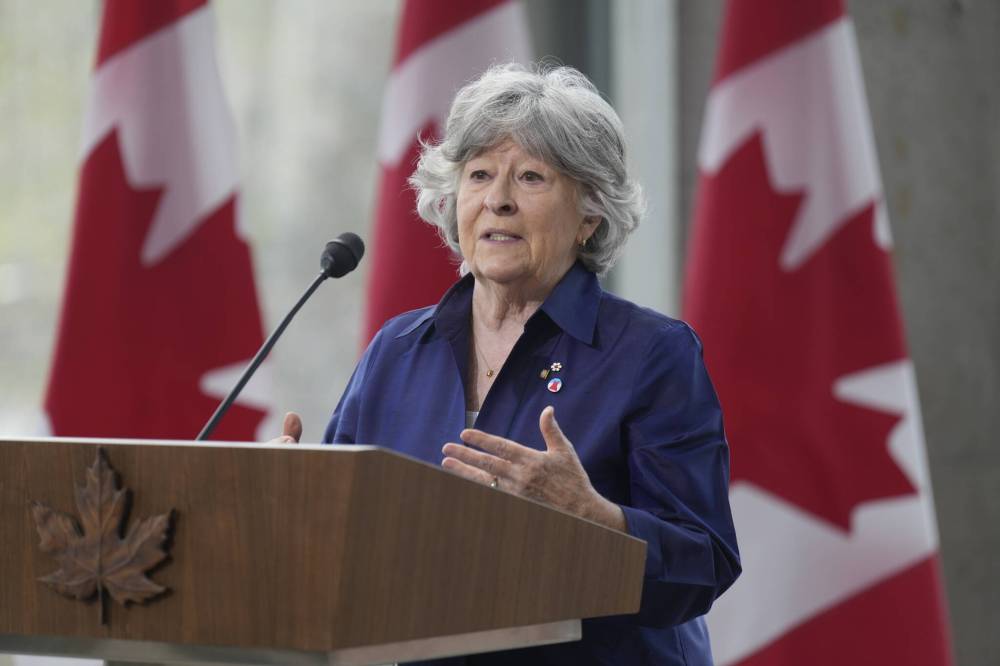
Adrian Wyld / The Canadian Press
Louise Arbour speaks after being named the next Governor General during a news conference in Ottawa on May 5.
There was a time when simple professional civility and a modicum of decorum governed our governance. Evidently not anymore. That conservatives disagree with Arbour’s selection is not in doubt. Look no further than social media postings and Postmedia coverage, in particular, for a negative take. An Ottawa Sun columnist labelled her a “foolish … partisan, political pick”. A National Post contributor called her a member of the “global elite” and “the most ideologically loaded appointment to Rideau Hall in living memory.”
Her crime, ironically, was how she dealt with crime and injustice. Specifically, as a Supreme Court justice, chief prosecutor for the international criminal tribunals dealing with war crimes in the former Yugoslavia and Rwanda, and the United Nations human rights commissioner. Arbour is considered to have taken an “activist” approach leading to expansive jurisprudence and government overreach. And she criticized Israel for human rights violations at one time. High dudgeon over a former high court judge is a sign of the times.
Should we care that the person whose role is above politics is the source of raw politics? Yes. But that is not her fault.
Arbour’s personal and professional integrity is not in doubt. She is a distinguished Canadian with a legacy of serious accomplishment nationally and internationally.
An odd aspect of this controversy is that it is only nominally about the role she will take on.
Even Bloc Quebecois Leader Yves-Francois Blanchet reacted to her appointment saying he had the “utmost respect” for her as a person. The separatist leader’s beef, unsurprisingly, is with the monarchy’s connection to Canada and the existence of the position itself. That remains their long-standing attitude. But that was the only whiff of classic republicanism versus monarchists that we smelled this week.
Indeed, the conservative response to Arbour is not about the institution she will represent. Conservatives are mostly monarchists, themselves. It is about the place and influence of institutions in our public life.
After serial losses in election after election, conservatives are chafing at their outsider status. Each loss means Liberals can keep appointing their choices to all the state positions that matter. That grates.
This results, to them, in a Laurentian elite in central Canada continuing to exercise real power for themselves via control of state institutions. The rest — Western Canada, to name one — is left out. Appointing a GG from Quebec who has spent her life serving in national and international public institutions is proof positive of this impulse.
This is not new for Canada. But it is line of attack that finds purchase in the culture war trenches. Institutions must be taken over and populated with like-minded followers to overcome the woke, liberal, globalist, interventionist virus that has taken root. We need to do what liberals have been doing all these years if the tide that has built up against us is to be reversed.
In this, Arbour is not their real target.
Prime Minister Mark Carney is. Carney is a fervent believer in the benefits of strong public institutions and the rules and norms of international law. His famous Davos speech said that multilateral institutions, such as the UN, are “under threat.”
Choosing a governor general whose career has emanated from public institutions and the rule of law in the form of Arbour is therefore totally on brand for this prime minister. It is another incremental step to reinforce public institutions as the “load-bearing walls of a civil society,” as he puts it. Given that one role of the vice-regal office is to represent Canada abroad, look for this particular governor general to make several high-profile trips carrying exactly that message.

Former prime minister Justin Trudeau’s proclamation that “Canada is back” when he took power never took root.
Carney is more deliberate. He is not taken to extolling Canadian foreign policy influence where it does not exist.
But he is trumpeting something more enduring in his mind: Canadian values that support public institutions at home and abroad. In this, he has chosen a most representative governor general to represent this version of Canada to Canadians and the world.
It’s a civil way to say “culture wars be damned.”
David McLaughlin is a former clerk of the executive council and cabinet secretary in the Manitoba government.
Our newsroom depends on a growing audience of readers to power our journalism. If you are not a paid reader, please consider becoming a subscriber.
Our newsroom depends on its audience of readers to power our journalism. Thank you for your support.
Our newsroom depends on a growing audience of readers to power our journalism. If you are not a paid reader, please consider becoming a subscriber.
Our newsroom depends on its audience of readers to power our journalism. Thank you for your support.
Related Articles
Someone call the PM: next governor general doesn’t speak a single Indigenous language

Advertisement Advertise With Us
Advertisement Advertise With Us