Some parents don’t want their kids to use tech at school. But districts are pushing back
Advertisement
Read this article for free:
or
Already have an account? Log in here »
To continue reading, please subscribe:

Digital Subscription
One year of digital access for only $205*
- Enjoy unlimited reading on winnipegfreepress.com
- Read the E-Edition, our digital replica newspaper
- Access News Break, our award-winning app
- Play interactive puzzles
*First annual payment billed as $205.00 + GST for one year. This annual subscription will automatically renew at $233.00 + GST every 52 weeks (10% off the regular annual price of $259.35). Offer available to new and qualified returning subscribers only. Cancel any time.
To continue reading, please subscribe:
Add Free Press access to your Brandon Sun subscription for only an additional
$1 for the first 4 weeks*
- Enjoy unlimited reading on winnipegfreepress.com
- Read the E-Edition, our digital replica newspaper
- Access News Break, our award-winning app
- Play interactive puzzles
*Your next Brandon Sun subscription payment will increase by $1.00 and you will be charged $17.95 plus GST for four weeks. After four weeks, your payment will increase to $24.95 plus GST every four weeks.
Read unlimited articles for free today:
or
Already have an account? Log in here »
ARDMORE, Pa. (AP) — For high school senior Aliyah Pack, getting distracted during school is the norm. Kids in her Pennsylvania school district use iPads starting in kindergarten, switch to Chromebooks in second grade and get their own MacBooks in eighth grade.
Aliyah said she has difficulty focusing, and she finds it hard to concentrate when she’s learning from a screen. She’ll watch Netflix in class on her school laptop, hiding her earbuds behind her long, curly hair.
“It’s very hard to get into the mindset of being in school,” Aliyah said.
Aliyah’s mother saw her grades were falling and asked the school to take away her laptop. But she was told that wasn’t possible.
Across the country, parents are voicing concerns about excessive screen time in schools and lobbying educators to go back to pencil and paper. In places like Lower Merion Township, where Aliyah goes to high school, some are taking it even further. Over 600 people in the affluent Philadelphia suburb have signed a petition asking to preserve parents’ ability to opt their children out of using digital devices during the school day. The public school district has pushed back, saying it’s not feasible to let hundreds of students opt out of technology that is essential to the curriculum.
Disagreement over how tech is used in the classroom
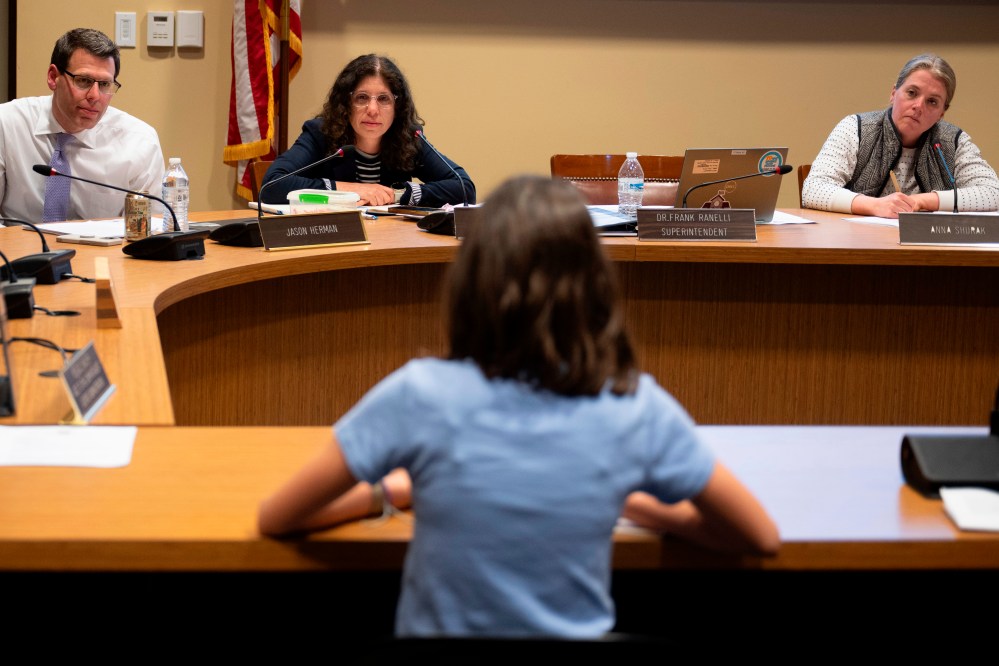
At a meeting Monday night, school board members said they were considering many ways to respond to parental concerns about technology, but allowing opt-outs was not one of them.
“There is not an option for us to not have technology in schools,” said Lower Merion School Board member Anna Shurak.
The board was meeting to discuss updates to the district’s technology policies, including repealing a policy that allows opt outs. Over 100 people showed up to protest, many wearing buttons that said “Screens Down, Pencils Up.”
Many emphasized they’re not anti-tech — in fact, most parents agree that learning how to responsibly use computers is an essential life skill. They just don’t want tech to dominate the classroom.
“Teaching how to use technology is not the same thing as using technology to teach everything else,” said Sara Sullivan, a parent.
Technology has become inescapable at schools
The debate in Lower Merion raises the question of whether technology has become so intertwined with learning that it’s impossible to opt out. Kids use devices to play educational games, submit their homework, access online resources and write essays — but parents are questioning the value of gamified edtech software.
Subashini Subramanian said the software her second-grade daughter uses for math, DreamBox, incentivizes rushing through levels to gain points. When she encouraged her daughter to think through the problems methodically, the 8-year-old said, “If I go through all the steps, it’s slowing me down. I have to click, click, click.”
At the school board meeting, many parents said they were exhausted from battling their kids over screen time. Adam Washington says his son struggles with screen addiction, so sometimes he takes away his phone or TV — only to find him watching YouTube on the school laptop instead.
“The screen is killing him. It is killing me, and him, together with our relationship,” Washington said.
Another parent at the meeting questioned what students would do instead of using their computers.
“Opting out is not a solution. It’s avoiding the hard work of finding a solution,” Seth Ruderman said.
Parental pushback on edtech has led to change
The pushback on technology in the classroom has gained steam around the country. At least 14 states have proposed laws to limit screen time in schools, according to Ballotpedia, with four states — Alabama, Tennessee, Utah and Iowa — passing such legislation.
In Los Angeles, the nation’s second-largest school district said it will ban screens until second grade, require daily caps for screen time per grade, ban YouTube and require an audit of all education technology contracts.
In Vermont, proposed legislation would allow not just parents but also teachers to decline to use classroom tech. Democratic State Rep. Angela Arsenault, a bill co-sponsor, said she’s responding to parents’ worries about edtech.
“Parents in many districts and states just aren’t being listened to or not being heard when they ask that their students not be forced to use these products,” Arsenault said.
The Lower Merion school district said it’s listening to community concerns and has already made changes, including blocking some problematic websites flagged by parents.
“We have wonderful teachers who have continuously prioritized human interaction and relationships,” Superintendent Frank Ranelli wrote in a letter to parents. He declined to comment to the AP for this story.
The district said it is looking into possible changes, including stronger cellphone restrictions, not allowing the youngest students to take devices home and installing software to monitor students in class.
However, surveillance software can bring its own problems and poses risks to student privacy. In 2010, the Lower Merion School District paid $610,000 to settle lawsuits by two students who alleged the district had spied on them via the webcam on their school-issued laptops.
Kids want ways to hold themselves accountable
High school student Mia Tatar, 16, raised concerns at the board meeting that there’s been an unintended consequence to the anti-tech backlash. The internet filters on school computers are now so strict, she said she’s been blocked while doing research on appropriate topics for school, like breast cancer.
Mia said students need to learn how to responsibly use technology, and adding filters or getting rid of laptops won’t do that.
“It doesn’t teach kids how to hold themselves accountable and how to be responsible for regulating their own screen time once they’re in the world,” Mia said in an interview.
Her friend Elliot Campbell, 15, said there should be strict limits on screen use in the youngest grades, but students should get more freedom as they get older.
“If we lose our laptops or if we lose the partial freedom we have on them, it’s not going to prepare us for college,” Elliot told board members at the hearing.
Fellow high schooler Joaquin Imaizumi takes a different view. He said it’s “completely unfair” to expect children to regulate their usage of devices that even adults find addictive.
“This isn’t about learning to constrain yourself,” he said in an interview. “We don’t give someone drugs and say, ‘OK, now learn how to deal with this.’”
His biggest concern is that devices make it far too tempting to access AI tools like ChatGPT, which he sees eroding his classmates’ ability to think for themselves.
“I’ve seen the atrophy of my peers’ thinking, which is existentially concerning,” Joaquin said.
The influence of AI starts early. A second-grader named Lillian Keshet, who got up to speak at the board meeting, said Google Docs will give her “suggestions” about what to write in class.

“I’m a pretty good writer by myself,” Lillian said. “I don’t need your suggestions, Google!”
___
Associated Press writer Jocelyn Gecker contributed to this report from San Francisco.
___
The Associated Press’ education coverage receives financial support from multiple private foundations. AP is solely responsible for all content. Find AP’s standards for working with philanthropies, a list of supporters and funded coverage areas at AP.org.