

Manitobans prefer later sunsets in time-change debate: poll
Thirty-four per cent of 1,060 residents give thumbs-up to permanent daylight time

Advertisement
Read this article for free:
or
Already have an account? Log in here »
To continue reading, please subscribe:

Digital Subscription
One year of digital access for only $205*
- Enjoy unlimited reading on winnipegfreepress.com
- Read the E-Edition, our digital replica newspaper
- Access News Break, our award-winning app
- Play interactive puzzles
*First annual payment billed as $205.00 + GST for one year. This annual subscription will automatically renew at $233.00 + GST every 52 weeks (10% off the regular annual price of $259.35). Offer available to new and qualified returning subscribers only. Cancel any time.
To continue reading, please subscribe:
Add Free Press access to your Brandon Sun subscription for only an additional
$1 for the first 4 weeks*
- Enjoy unlimited reading on winnipegfreepress.com
- Read the E-Edition, our digital replica newspaper
- Access News Break, our award-winning app
- Play interactive puzzles
*Your next Brandon Sun subscription payment will increase by $1.00 and you will be charged $17.95 plus GST for four weeks. After four weeks, your payment will increase to $24.95 plus GST every four weeks.
Read unlimited articles for free today:
or
Already have an account? Log in here »
A new public opinion poll suggests year-round daylight time is the leading choice among Manitobans, as the provincial government considers ditching twice-annual clock changes.
The survey by Winnipeg-based Prairie Research Associates found roughly three in four Manitobans support an end to seasonal time changes, a move that would lead to the permanent use of standard or daylight time.
“There is a large group of people who say, ‘I don’t care what the change is as long as there is no (seasonal time) change.’ That group was larger than I expected,” PRA partner Nicholas Borodenko said about the survey results.
“The fact that more people are leaning toward wanting to have more summer daylight in the evening was expected.”
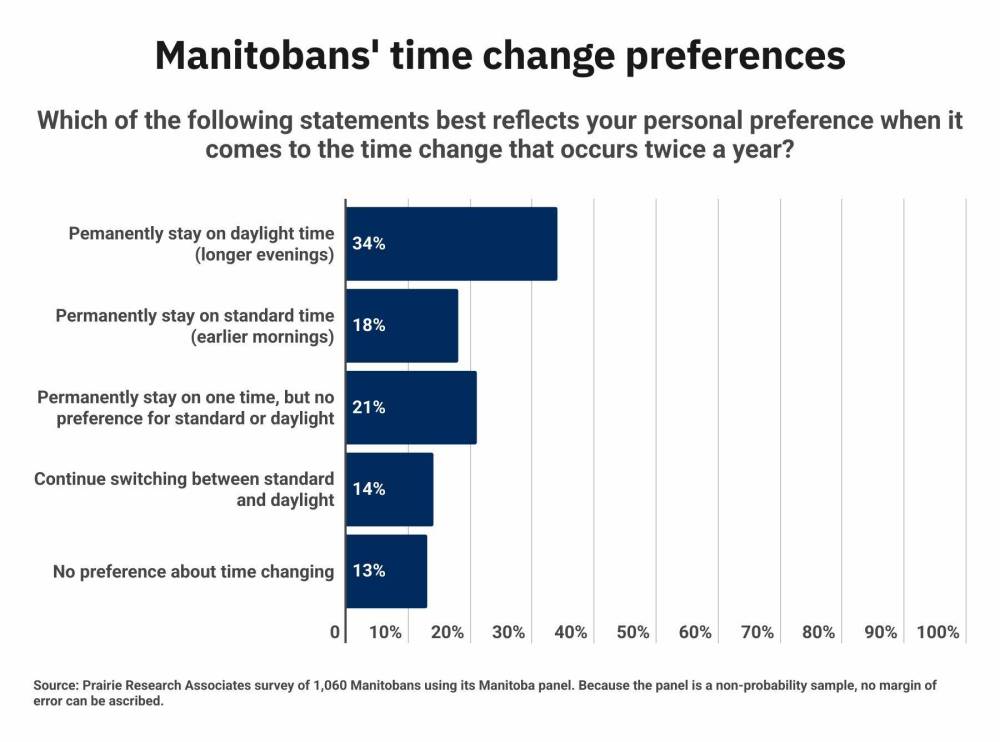
Thirty-four per cent of 1,060 respondents want permanent daylight time (later sunsets), 18 per cent prefer permanent standard time (earlier sunrises), and 21 per cent want a permanent system but they don’t care which one.
Only 14 per cent want to continue changing their clocks twice per year. The remaining 13 per cent said they do not have a preference.
The poll is separate from a Manitoba government online survey that was launched May 20. The province is asking Manitobans if it should adopt permanent standard time or permanent daylight time, or stick with the status quo.
“When the province gets those results, I imagine they’re going to be pretty much in line with what we’re seeing as well,” Borodenko said.
A Manitoba Health analysis found that eliminating the time change would be better for people’s health than continuing with biannual time changes.
In Manitoba, clocks spring forward to daylight time on the second Sunday in March, and fall back to standard time on the first Sunday in November.
B.C. moved to permanent daylight time this year, and Alberta plans to follow suit. Saskatchewan observes year-round central standard time. The Northwest Territories is moving to permanent standard time.
The PRA online survey was conducted from May 21-25. The polling firm said no error rate can be calculated because it is a non-probability sample. A random population survey of similar size would yield an error rate of plus or minus three per cent, 19 times out of 20, PRA said.
Respondents who favour permanent daylight time, which increases evening sunlight, believe that system would improve their quality of life and mental well-being during winter, and lead to more time spent outdoors for recreation or family activities.
Proponents of permanent standard time cited brighter mornings, safety during the commute to work and school in winter, and alignment with natural sleep and circadian rhythms.

Most parents who were polled want the province to scrap biannual time changes. Prairie Research Associates heard from parents who said their family or children’s routines are disrupted when clocks move forward or backward by one hour.
People who want to stick with the current system believe seasonal time changes provide the best balance between winter mornings and summer evenings, PRA said.
Caedmon Malowany, a press secretary with the NDP government, said the province’s online survey will run until the fall.
“We couldn’t possibly comment on the results this early in the consultations, but we certainly appreciate all points of view on the subject,” he wrote in an email.
Premier Wab Kinew initially indicated in March the province didn’t plan to make a change, after the B.C. government decided to go with permanent daylight time.
About a week later, he announced plans for an online survey after he said MLAs had received an earful from Manitobans who are tired of changing their clocks twice a year.
At the time, Kinew referenced a 2025 study by researchers at California’s Stanford University, who concluded that permanent standard or daylight time is better for human health than changing clocks twice a year.
The study, which is cited in the province’s survey, suggested permanent standard time would bring the most health benefits and reduce obesity and stroke at higher rates than permanent daylight time.
The daylight saving time transition in spring originated during the First World War to boost productivity, conserve energy and extend daylight leisure time.
chris.kitching@freepress.mb.ca
Chris Kitching is a general assignment reporter at the Free Press. He began his newspaper career in 2001, with stops in Winnipeg, Toronto and London, England, along the way. After returning to Winnipeg, he joined the Free Press in 2021, and now covers a little bit of everything for the newspaper. Read more about Chris.
Every piece of reporting Chris produces is reviewed by an editing team before it is posted online or published in print — part of the Free Press‘s tradition, since 1872, of producing reliable independent journalism. Read more about Free Press’s history and mandate, and learn how our newsroom operates.
Our newsroom depends on a growing audience of readers to power our journalism. If you are not a paid reader, please consider becoming a subscriber.
Our newsroom depends on its audience of readers to power our journalism. Thank you for your support.
Chris Kitching is a general assignment reporter at the Free Press. He began his newspaper career in 2001, with stops in Winnipeg, Toronto and London, England, along the way. After returning to Winnipeg, he joined the Free Press in 2021, and now covers a little bit of everything for the newspaper. Read more about Chris.
Every piece of reporting Chris produces is reviewed by an editing team before it is posted online or published in print — part of the Free Press‘s tradition, since 1872, of producing reliable independent journalism. Read more about Free Press’s history and mandate, and learn how our newsroom operates.
Our newsroom depends on a growing audience of readers to power our journalism. If you are not a paid reader, please consider becoming a subscriber.
Our newsroom depends on its audience of readers to power our journalism. Thank you for your support.
Related Articles
Time for change? Province launches survey to review clock changes








Advertisement Advertise With Us
Advertisement Advertise With Us
History
Updated on Tuesday, May 26, 2026 6:25 PM CDT: Updated to clarify the PRA's survey results.