

City needs more fire-paramedic stations as population grows: outgoing WFPS boss

Advertisement
Read this article for free:
or
Already have an account? Log in here »
To continue reading, please subscribe:

Digital Subscription
One year of digital access for only $205*
- Enjoy unlimited reading on winnipegfreepress.com
- Read the E-Edition, our digital replica newspaper
- Access News Break, our award-winning app
- Play interactive puzzles
*First annual payment billed as $205.00 + GST for one year. This annual subscription will automatically renew at $233.00 + GST every 52 weeks (10% off the regular annual price of $259.35). Offer available to new and qualified returning subscribers only. Cancel any time.
To continue reading, please subscribe:
Add Free Press access to your Brandon Sun subscription for only an additional
$1 for the first 4 weeks*
- Enjoy unlimited reading on winnipegfreepress.com
- Read the E-Edition, our digital replica newspaper
- Access News Break, our award-winning app
- Play interactive puzzles
*Your next Brandon Sun subscription payment will increase by $1.00 and you will be charged $17.95 plus GST for four weeks. After four weeks, your payment will increase to $24.95 plus GST every four weeks.
Read unlimited articles for free today:
or
Already have an account? Log in here »
Winnipeg Fire Paramedic Service Chief Christian Schmidt says the city will need to add fire paramedic stations to ensure rapid growth in new neighbourhoods doesn’t extend already lengthy emergency-response times.
In a wide-ranging interview leading up to his July 3 retirement, Schmidt said his department is exploring new stations needed to handle the population increase.
“Our city’s growing… and a lot of these areas where the new development is planned, we simply can’t service those areas with our existing fire paramedic station infrastructure or with the existing personnel. So there needs to be good plans in place … so that we can maintain good response times (and) also good unit availability for the existing parts of the city,” he said.
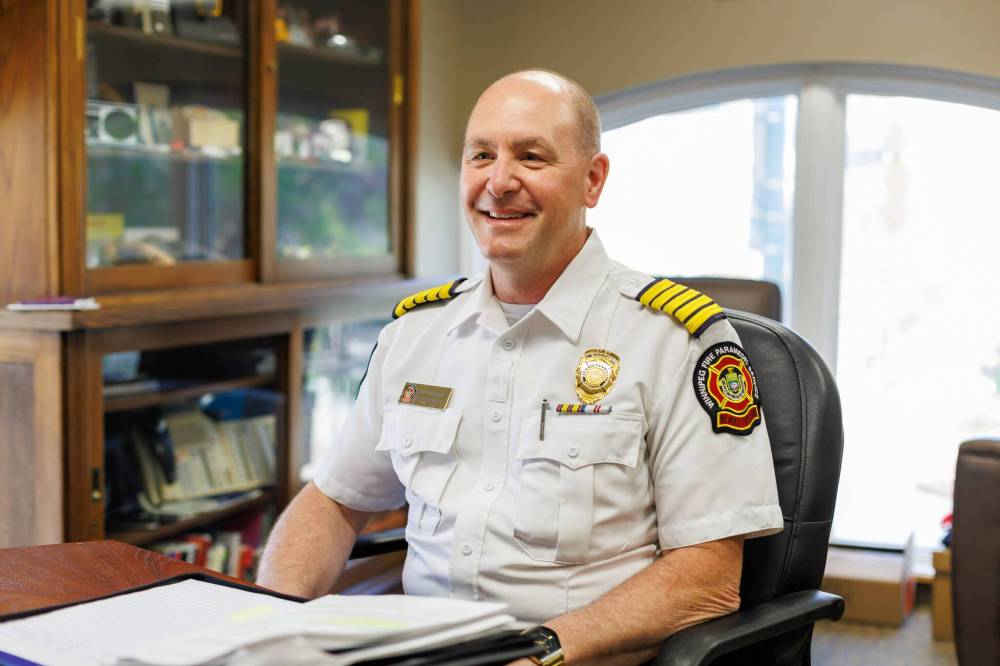
MIKE DEAL / FREE PRESS
Winnipeg Fire Paramedic Chief Christian Schmidt is set to retire July 3 after nearly 33 years of service.
In 2020, WFPS approved a master plan that would move Station 19 in Silver Heights to the north, closer to CentrePort, among many other changes. The plan called for a reduction in the number of fire-paramedic halls from 30 to 23. It also called for a 24th station to be built in Waverley West.
Hot issues for fire service
As he prepares to retire, Winnipeg Fire Paramedic Service Chief Christian Schmidt weighed in on several key issues facing emergency services in an interview Wednesday.
As he prepares to retire, Winnipeg Fire Paramedic Service Chief Christian Schmidt weighed in on several key issues facing emergency services in an interview Wednesday.
Here are a few highlights:
• On how the five-priority system used to determine emergency medical call responses could be updated:
“These are things that we need to do in terms of sustainability and ensuring that we’re doing everything we can to address the rising call volumes. And one of those things is making sure that we’re actually just dispatching our fire apparatus and our firefighters and our paramedics out to true emergencies that they actually need to be responding to. Where we can spend additional time on the phone with the caller to glean additional information, to determine the right resource for the patient, we need to take that time.”
“And then that allows us to identify calls that we can transfer to folks like the Downtown Community Safety Partnership… (such as) going out and checking on the person that appears to be sleeping on the park bench. That’s a call that we can ask our service provider colleagues to check out. And then, if we’re needed, they can let us know and we’ll respond.”
• On the strain of responding to vacant building fires:
“Some of (the structures) have been fire-damaged on multiple occasions. And so there can be holes in the floor, in the walls — just very, very profound safety risks for our firefighters…. And, in some cases, some of these buildings, there’s always risks of places being booby-trapped (to keep others out.) So, these are all things that our folks have to train for and be ready for. So there’s huge risks associated with these.”
• On how the city could collect more of the fees charged to property owners for WFPS responses to vacant building fires:
“The (city’s) public service, at the direction of council, has made a prior request of the province to make some changes that would allow us to put the fire fees on the individual’s property tax bill. And that’s huge, because that then triggers a number of other things. If you don’t pay your property taxes, the municipality can then… take action to seize or take over the property… I think (that if) we get the fire fees… added to the property tax, and that would be a very good tool in the City of Winnipeg’s toolbox in order to hold these property owners accountable.”
Now the chief says WFPS will likely need four new stations — in south Transcona, the northeast McPhillips area, St. Norbert, and south Charleswood in the coming years.
“This is all new growth…. We’ll be bringing forward that plan to outline what should be done in order to service these new areas,” said Schmidt.
Without changes, the average time for the first emergency vehicle to arrive at a fire call in those new neighbourhoods would be expected to exceed 14 minutes, based on models, doubling a seven-minute national standard, he said.
Meanwhile, he said Winnipeg’s current average response time is already too high. In 90 per cent of cases, the first crew arrives at about 9:28 for the highest-priority fire calls, according to WFPS.
For ambulances, the current response time for 90 per cent of the highest-priority medical calls is 19:27, well above an 8:59 target.
Schmidt deemed that wait “simply too long.”
“We were having, far too often, situations where staff members were into their 10th and 11th hour without having their meal break yet. (That’s) simply not sustainable or acceptable.”
However, WFPS notes a firefighter paramedic response would be expected within 9:42 in 90 per cent of those cases.
WFPS is also helping the city plan roads and other infrastructure in new neighbourhoods to ensure quick emergency access and reduce fire risks. For example, the upcoming Water Tower District in St. Boniface will be Winnipeg’s first community to include a dedicated emergency services access road.
“This will be a road that is gated and (can only) be accessed by emergency response vehicle(s). It’ll allow us quick access into the heart of the community,” said Schmidt.
That district will also have sprinklers included in every residential building, since it won’t include any single-family homes where that protection is not required. And it will use a train-monitoring system that alerts emergency responders to pick other routes when rail crossings are blocked.
“In these new neighbourhoods, we’re working with the planning department up front to identify what the road networks need to look like in order for us to get ready access,” said Schmidt, who was appointed chief in 2021.
He has been with the WFPS for nearly 33 years.
Schmidt said the volume of emergency calls grew “exponentially” during his career.
“The city’s in a good spot as we move (on to) the next chief.”
He recently asked Shared Health to fund at least eight more ambulances and about 120 full-time paramedic positions over the next four years, along with three additional community paramedic units.
Schmidt said staff are currently stretched thin, with paramedics rushing from call to call. That led WFPS to begin entering lunch breaks into its dispatch system to ensure they happen.
“We work 12-hour shifts here… and we were having, far too often, situations where staff members were into their 10th and 11th hour without having their meal break yet. (That’s) simply not sustainable or acceptable,” he said.
The service hopes a WFPS wellness clinic at 180 King St., which will provide occupational, behavioural, physiotherapy and return-to-work services, will help staff on long-term leaves get back to their jobs.
“We have about 300 staff that are currently out of the workplace, between fire and (emergency medical services). They will come to the wellness clinic… all with an eye of getting them returned to the workplace and supporting them,” he said.
The clinic is expected to open next month.

When asked to reflect on his key accomplishments as chief, Schmidt said he was proud to help ensure Waverley West received a temporary modular fire station while it awaits a permanent one, and to finalize a contract for Shared Health to fund ambulance service.
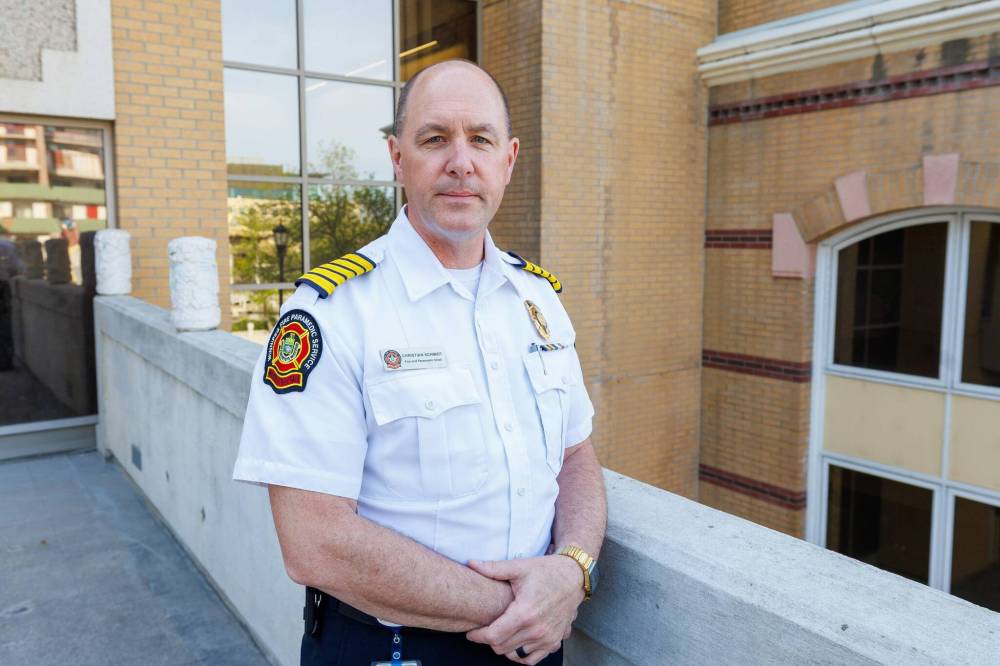
MIKE DEAL / FREE PRESS
Schmidt says WFPS will likely need four new stations in the coming years.
He also believes the service’s workplace culture, including once-strained relations between firefighters and paramedics, has improved since he took on the role, though he stressed staff deserve much of the credit for that change.
“They’re a unified team. They go to bat for each other. They look out for each other. They care about each other…. The city’s in a good spot as we move (on to) the next chief,” he said.
joyanne.pursaga@freepress.mb.ca
X: @joyanne_pursaga
Joyanne is city hall reporter for the Winnipeg Free Press. A reporter since 2004, she began covering politics exclusively in 2012, writing on city hall and the Manitoba Legislature for the Winnipeg Sun before joining the Free Press in early 2020. Read more about Joyanne.
Every piece of reporting Joyanne produces is reviewed by an editing team before it is posted online or published in print — part of the Free Press‘s tradition, since 1872, of producing reliable independent journalism. Read more about Free Press’s history and mandate, and learn how our newsroom operates.
Our newsroom depends on a growing audience of readers to power our journalism. If you are not a paid reader, please consider becoming a subscriber.
Our newsroom depends on its audience of readers to power our journalism. Thank you for your support.
Joyanne is city hall reporter for the Winnipeg Free Press. A reporter since 2004, she began covering politics exclusively in 2012, writing on city hall and the Manitoba Legislature for the Winnipeg Sun before joining the Free Press in early 2020. Read more about Joyanne.
Every piece of reporting Joyanne produces is reviewed by an editing team before it is posted online or published in print — part of the Free Press‘s tradition, since 1872, of producing reliable independent journalism. Read more about Free Press’s history and mandate, and learn how our newsroom operates.
Our newsroom depends on a growing audience of readers to power our journalism. If you are not a paid reader, please consider becoming a subscriber.
Our newsroom depends on its audience of readers to power our journalism. Thank you for your support.
Related Articles
WFPS stretched to limit by city’s around-the-clock drug OD crisis, retiring chief says



Advertisement Advertise With Us
Advertisement Advertise With Us