

Winnipeg police to launch body camera program next week
Extensive rules will protect people’s privacy: deputy chief

Advertisement
Read this article for free:
or
Already have an account? Log in here »
To continue reading, please subscribe:

Digital Subscription
One year of digital access for only $205*
- Enjoy unlimited reading on winnipegfreepress.com
- Read the E-Edition, our digital replica newspaper
- Access News Break, our award-winning app
- Play interactive puzzles
*First annual payment billed as $205.00 + GST for one year. This annual subscription will automatically renew at $233.00 + GST every 52 weeks (10% off the regular annual price of $259.35). Offer available to new and qualified returning subscribers only. Cancel any time.
To continue reading, please subscribe:
Add Free Press access to your Brandon Sun subscription for only an additional
$1 for the first 4 weeks*
- Enjoy unlimited reading on winnipegfreepress.com
- Read the E-Edition, our digital replica newspaper
- Access News Break, our award-winning app
- Play interactive puzzles
*Your next Brandon Sun subscription payment will increase by $1.00 and you will be charged $17.95 plus GST for four weeks. After four weeks, your payment will increase to $24.95 plus GST every four weeks.
Read unlimited articles for free today:
or
Already have an account? Log in here »
Winnipeg police say the use of body-worn cameras will be automatic in many cases, when officers start wearing them next week, and extensive rules will be in place to protect privacy.
The long-debated pilot project will begin with 40 front-line Winnipeg Police Service officers on Wednesday and last six months.
“It’s an opportunity for police accountability. We owe it to the membership, we owe it to the police service, and, more importantly, to the citizens of Winnipeg,” said George Labossiere, deputy chief of operations.
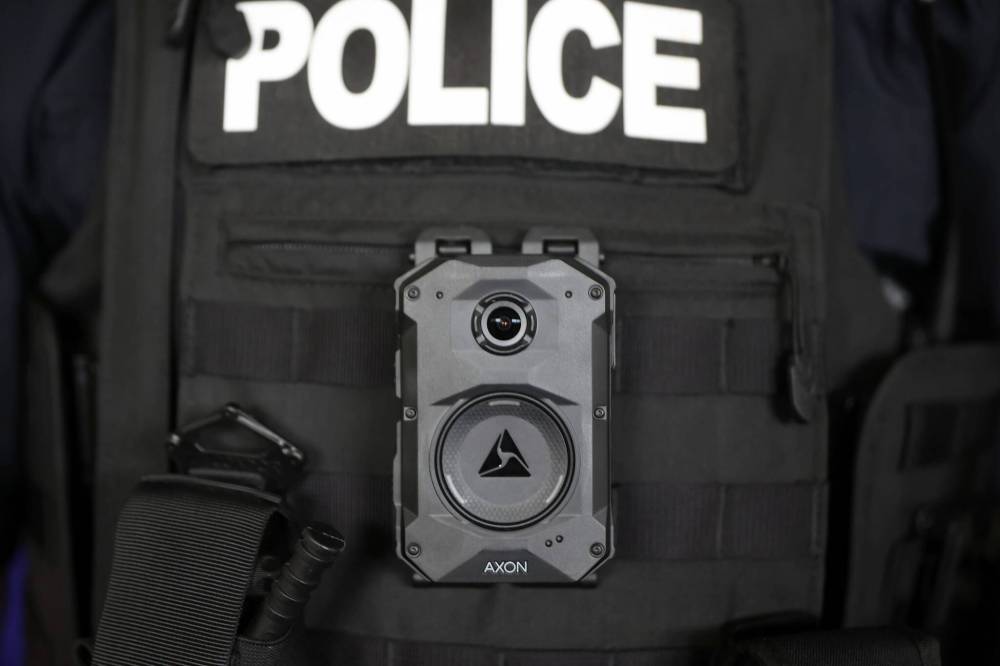
A constable with the Brandon Police Service wears a body-worn video camera. (Tim Smith / The Brandon Sun files)
“We have a responsibility to the courts (to) provide the best possible evidence available to allow our justice system to work properly. This is the best way to ensure that the facts come out and I do believe it’ll also add safety to all people involved in a situation.”
Anecdotally, Labossiere said people tend to behave differently when they know an interaction is being recorded.
“I see this as a positive step towards decreasing violence in some of the interactions we have with the public,” he said.
Privacy issues discussed
During a police board meeting Friday, officials discussed how the footage will affect the privacy of people with whom police interact, including whether citizens will have a choice about whether they are recorded.
“In public settings, despite (people) not wanting to be recorded, recording would remain active. There are certain privacy situations, like within facilities, health-care facilities … where the officers have discretion to make sure that they’re protecting people’s privacy, and, so, in those situations, the camera can be deactivated,” said Insp. Colin Brander.
“The officers have discretion to make sure that they’re protecting people’s privacy.”
On the flip side, if a citizen asks for their interaction with police to be recorded, the officer would be trained to turn on the camera, said Brander.
“The direction for officers would be, of course, activate the camera. There’s nothing to lose,” he said.
Brander said footage would be stored in a secure Canadian-based system and subject to all privacy laws. He said he’d be surprised if much video was released to the public, owing to the extent of those rules.
Labossiere said video submitted as evidence in court may be adjusted to blur faces or subjected to publication bans to further protect privacy, such as when youth are involved in a case.
Police interactions that require officers to answer a call for emergency service at a private home would be recorded, while visits simply aimed at asking questions might not require a recording.
“If we were there on consent alone, asking questions, and they didn’t want to be recorded within the residence, then we would respect that request or offer to do it outside the home,” said Brander.
WPS officers will be required to notify individuals that they’re being recorded at the beginning of an interaction or “as soon as is reasonably possible.”
‘Committed to making this work’
The pilot project will test Axon Body 4 cameras. WPS says a survey and public forums will gather feedback on the program.
The company is providing the technology free of charge throughout the testing period.
Labossiere said the exact date and cost to expand the use of the cameras to all front-line officers haven’t been determined. If the pilot proves a success, the service could take that step soon.
“We’ll do everything we can to put this in play in the 2027 year.”
“We are very much committed to making this work, so we’ll do everything we can to put this in play in the 2027 year,” he said.
The city has debated the use of body-worn cameras by police for more than a decade.
A $1-million pilot project was scheduled for 2016 but was cancelled to save money. A 2021 proposal for a citywide program was expected to cost $32 million by the end of 2027, which city council rejected.
WPS said the price has dropped dramatically, since the province provided a new digital evidence management system and the cameras have become much cheaper.
In an email, the head of the union that represents Winnipeg police officers expressed mixed views about the project.
“I believe that the addition of body-worn cameras will assist our officers for investigative purposes. My only concern is that courts and oversight bodies are properly educated on the many limitations that this tool has and the importance of the supporting investigation that goes with them,” wrote Cory Wiles, president of the Winnipeg Police Association.

The chairwoman of the police board said the oversight body supports adding the cameras.
“It’s for safety of our members, safety of the public, it captures true information, and I think … that trickles down into the courts,” said Colleen Mayer.
She said any privacy concerns will be closely monitored.
Police Chief Gene Bowers did not attend the meeting Friday, with Mayer noting he was away on other police business.
joyanne.pursaga@freepress.mb.ca
X: @joyanne_pursaga
Joyanne is city hall reporter for the Winnipeg Free Press. A reporter since 2004, she began covering politics exclusively in 2012, writing on city hall and the Manitoba Legislature for the Winnipeg Sun before joining the Free Press in early 2020. Read more about Joyanne.
Every piece of reporting Joyanne produces is reviewed by an editing team before it is posted online or published in print — part of the Free Press‘s tradition, since 1872, of producing reliable independent journalism. Read more about Free Press’s history and mandate, and learn how our newsroom operates.
Our newsroom depends on a growing audience of readers to power our journalism. If you are not a paid reader, please consider becoming a subscriber.
Our newsroom depends on its audience of readers to power our journalism. Thank you for your support.
Joyanne is city hall reporter for the Winnipeg Free Press. A reporter since 2004, she began covering politics exclusively in 2012, writing on city hall and the Manitoba Legislature for the Winnipeg Sun before joining the Free Press in early 2020. Read more about Joyanne.
Every piece of reporting Joyanne produces is reviewed by an editing team before it is posted online or published in print — part of the Free Press‘s tradition, since 1872, of producing reliable independent journalism. Read more about Free Press’s history and mandate, and learn how our newsroom operates.
Our newsroom depends on a growing audience of readers to power our journalism. If you are not a paid reader, please consider becoming a subscriber.
Our newsroom depends on its audience of readers to power our journalism. Thank you for your support.
Related Articles
Brandon police roll out body cams


Advertisement Advertise With Us
Advertisement Advertise With Us
History
Updated on Friday, June 5, 2026 5:55 PM CDT: Updated throughout with quotes and information.