

Push for Canada came too late
Would be shame if country’s historic bid died on hill of principle
Advertisement
Read this article for free:
or
Already have an account? Log in here »
To continue reading, please subscribe:

Digital Subscription
One year of digital access for only $205*
- Enjoy unlimited reading on winnipegfreepress.com
- Read the E-Edition, our digital replica newspaper
- Access News Break, our award-winning app
- Play interactive puzzles
*First annual payment billed as $205.00 + GST for one year. This annual subscription will automatically renew at $233.00 + GST every 52 weeks (10% off the regular annual price of $259.35). Offer available to new and qualified returning subscribers only. Cancel any time.
To continue reading, please subscribe:
Add Free Press access to your Brandon Sun subscription for only an additional
$1 for the first 4 weeks*
- Enjoy unlimited reading on winnipegfreepress.com
- Read the E-Edition, our digital replica newspaper
- Access News Break, our award-winning app
- Play interactive puzzles
*Your next Brandon Sun subscription payment will increase by $1.00 and you will be charged $17.95 plus GST for four weeks. After four weeks, your payment will increase to $24.95 plus GST every four weeks.
Read unlimited articles for free today:
or
Already have an account? Log in here »
This is already a historic World Cup for Canada’s men’s national soccer team.
First point? Check. First win? Check. First progression to the knockout rounds? Check. All of it on home soil, no less.
And yet, for all that, it also risks being a big disappointment. It can be both things at once.
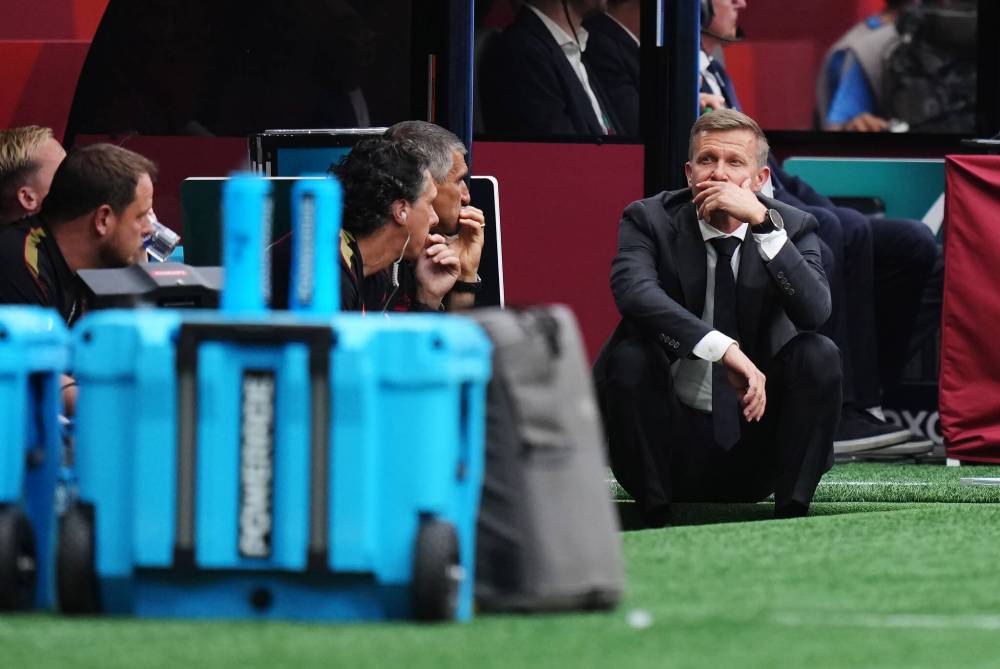
Darryl Dyck / The Canadian Press
Canada manager Jesse Marsch sits on the sideline during the first half of the Canada-Switzerland match on Wednesday. A change of field formation for Canada would go a long way in Canada’s bid to continue to the Round of 16 and beyond.
To say that Wednesday’s 2-1 loss to Switzerland complicated the Canadian campaign would be an understatement. A win or draw in Vancouver would have secured top spot in Group B and a Round of 32 match — as well as a prospective Round of 16 encounter — in the same city.
Crucially, it would also have provided eight days’ rest, and Alphonso Davies and Moise Bombito would have no doubt appreciated that.
Instead, Canada will play on Sunday in southern California — a four-day turnaround.
It’s all a bit nitpicky, granted, but by losing to the Swiss, the Canadian men closed out the first phase of the schedule with just a single win. A historic win, yes, but also a win against a weak Qatar outfit that played an hour with 10 men and 40 minutes with nine.
That reality doesn’t diminish the 6-0 triumph and Jonathan David hat trick, but it does add some context.
Nor does it take away from the fact that expectations for this team are considerable — something that, in itself, is impressive.
But the gushing, mouth-agape reaction to every passage of positive play against “traditional soccer nations” was already patronizing some time ago. Canada wanted to beat Switzerland. It did not. We move on.
For the players and coaching staff — especially the coaching staff — how they move on will be of vital importance, especially now that they have half as much recovery time as they would have liked. They’ll have to move cities in that timeframe, too.
Head coach Jesse Marsch and his assistants must not overemphasize, or even emphasize, the meaningful attacking play that nearly tied the game and won the group in the second half.
Yes, Canada cut the Swiss lead, and substitute Nathan Saliba did magnificently well to control an arcing pass before squaring the ball to fellow substitute Promise David, who applied an expert finish. But the push came too late.
There’s little to take away from it other than to maybe push sooner next time. Besides, you don’t start a match with the personnel you end up sending on when you’re desperately trying to get a late goal.
No, the adjustments Marsch must consider are of the tactical variety, and rather comprehensive at that. Simply put, he needs a Plan B, and ideally a Plan C, but let’s not get greedy.
We know — along with everyone else in world football — that Canada will line up in a narrow 4-4-2 that prioritizes overlaps and high, energetic pressing. To Marsch’s credit, it’s a formation that suits his players’ athleticism and makes good use of the full-backs and wingers at his disposal.
But it’s also entirely predictable. The moment Canada’s Round of 32 opponent is determined it will know the set-up and strategy it will face on Sunday. Tactical preparation will barely be needed, and players can be briefed on exactly who they’ll be marking, running at and clipping long balls over in Inglewood, Calif.
Now, imagine if Marsch showed up with, say, a 4-2-3-1 that added a body to a midfield that could really have used it on Wednesday. Or, at risk of being nitpicky once again, if he held a similar option in reserve for a mid-game tweak. He’d be giving his opponent something it hadn’t seen and hadn’t prepared for.
It sounds so simple, and it is. Which is why it won’t happen.
Marsch knows he has options. He’s a very smart guy. If he’s sticking to a certain formula it’s because, for him, it’s less a formula than a principle. He wants two strikers on the pitch at all times. End of story.
Only, in a tournament like the World Cup, and against teams like Switzerland (and even better teams), starting two up top in 2026 is hopelessly naive. Just take the Swiss game as an example.
There’s a lot to be said for a coach and squad who are confident enough to believe that opponents should adjust for them, and not the other way around. It’s an admirable mindset that can certainly be beneficial, but it’s also totally unrealistic.

Switzerland was always going to boss possession in Vancouver. It was entirely predictable. It also shouldn’t have been a problem. Possession doesn’t win football matches. There’s zero shame in shaping your team to conform to that reality. Just ask Ghana. And England.
It’s when principle so decisively outstrips practicality that there’s a problem. At that point, you’re entertaining hubris.
This has been a historic World Cup, and Canadian fans will be hoping that history continues to be made. Maybe it will.
But it would be some shame if the story of Canada’s World Cup died on a hill of principle.
winnipegfreepress.com/jerradpeters
Our newsroom depends on a growing audience of readers to power our journalism. If you are not a paid reader, please consider becoming a subscriber.
Our newsroom depends on its audience of readers to power our journalism. Thank you for your support.
Our newsroom depends on a growing audience of readers to power our journalism. If you are not a paid reader, please consider becoming a subscriber.
Our newsroom depends on its audience of readers to power our journalism. Thank you for your support.
Related Articles
World Cup what to know: Round of 32 to be finalized after final 6 matches of group play

















Advertisement Advertise With Us
Advertisement Advertise With Us