Quebec and Alberta plan to work together to integrate AI in government

Advertisement

Advertise with us

MONTREAL - The Quebec and Alberta governments plan to work together to implement artificial intelligence in public administration, which Quebec's cybersecurity minister says will help both provinces build on each other's experience to develop new tools.

Read this article for free:


or

Already have an account? Log in here »

To continue reading, please subscribe:

Subscribe and receive a limited-edition Free Press branded hat or tote.

Digital Subscription

One year of digital access for only $205*

  • Enjoy unlimited reading on winnipegfreepress.com
  • Read the E-Edition, our digital replica newspaper
  • Access News Break, our award-winning app
  • Play interactive puzzles

*First annual payment billed as $205.00 + GST for one year. This annual subscription will automatically renew at $233.00 + GST every 52 weeks (10% off the regular annual price of $259.35). Offer available to new and qualified returning subscribers only. Cancel any time.

To continue reading, please subscribe:

Add Free Press access to your Brandon Sun subscription for only an additional

$1 for the first 4 weeks*

  • Enjoy unlimited reading on winnipegfreepress.com
  • Read the E-Edition, our digital replica newspaper
  • Access News Break, our award-winning app
  • Play interactive puzzles
Start now

*Your next Brandon Sun subscription payment will increase by $1.00 and you will be charged $17.95 plus GST for four weeks. After four weeks, your payment will increase to $24.95 plus GST every four weeks.

MONTREAL – The Quebec and Alberta governments plan to work together to implement artificial intelligence in public administration, which Quebec’s cybersecurity minister says will help both provinces build on each other’s experience to develop new tools.

France-Élaine Duranceau, Quebec minister of cybersecurity and digital technology, announced an agreement between the provinces on Tuesday alongside Nate Glubish, Alberta minister of technology and innovation.

The agreement will span five years and includes no financial engagement, but rather a sharing of knowledge between both administrations. 

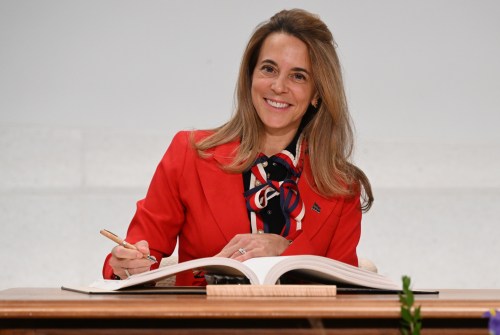
Quebec Treasury Board President France-Elaine Duranceau is sworn in at the legislature in Quebec City Tuesday, April 21, 2026. THE CANADIAN PRESS/Jacques Boissinot

“We’re all moving forward on AI, it’s new, and it changes at a phenomenal speed,” Duranceau said in a phone interview. “So why start from scratch, each on our own? We chose to work together and exchange freely to learn from what the other jurisdiction is doing.”

She explained that talks between the two provinces on AI have been ongoing since 2022, with Tuesday’s agreement making the partnership “official,” and praised Alberta’s interest in AI development. 

“They’ve really made it a priority to transform their public administration and to set the tone from the top, and I think Quebec has that same wish,” she said.

Alberta has leaned into AI and is the centre of Canada’s emerging data centre landscape, according to recent research out of York University. Meta, the tech giant behind Facebook and Instagram, recently announced a $13-billion-plus investment to build a data centre in Alberta, its first in Canada.

Duranceau suggests that the provinces could share AI tools they’ve developed, such as the one developed by Alberta to assist in their budgetary authorization or the one developed by Quebec to identify cybersecurity vulnerabilities. She also points to training for civil servants as an area where the provinces could share ideas, noting that Quebec is rolling out training to help employees use Microsoft Copilot, for example. 

“Citizens are currently using AI to organize their travel in record time, to write letters quickly…. Those are examples of how citizens can be more efficient in their personal lives. Well, at the state level, we have to automate tasks in that way,” said Duranceau. 

This agreement could help find ways to use AI to make government services faster by performing some administrative tasks or assisting with research, she said. 

Vass Bednar, managing director of the think tank Canadian Shield Institute, sees this announcement as a continuation of the general direction of AI policy in Canada. She points to the significance of Quebec and Alberta — “the two provinces who are both deeply engaged in their own kind of sovereignty questions” — joining forces in this deal.

Duranceau says that parallel had little to do with the agreement, except when it comes to a shared policy philosophy. “We have similarities in our desire to take the lead on issues that affect our population and not wait for the federal government on these issues,” she said.

To Bednar, the agreement announced on Tuesday lacks important discussions about digital sovereignty and building Canadian digital infrastructure. Rather than focusing on using AI to save money, she said governments should consider the cost-cutting potential of owning digital infrastructure to do things like video calls and sending emails. 

“For whatever reason, our imagination is not there yet,” she said. 

She criticized Canadian governments’ use of American AI and tech tools, and encouraged them to invest instead in Canadian innovation.

“(Sovereignty) is something you build and work towards. It’s not just going to be under our pillow one day when we wake up,” she said. 

This report by The Canadian Press was first published July 15, 2026.

Report Error Submit a Tip

More Stories

Somali refugee admits he helped to smuggle African migrants into Manitoba for money

Erik Pindera 6 minute read Preview

Somali refugee admits he helped to smuggle African migrants into Manitoba for money

Erik Pindera 6 minute read Yesterday at 5:54 PM CDT

A Somali refugee who was twice caught by RCMP assisting in the smuggling of desperate African migrants into Manitoba during the frigid winter — including while out on bail, months after he was first arrested with eight foreign nationals in his vehicle — has admitted he did so for money.

Read
Yesterday at 5:54 PM CDT

Demolition ordered after fire in vacant city home

Free Press staff 2 minute read Preview

Demolition ordered after fire in vacant city home

Free Press staff 2 minute read 11:56 AM CDT

A Winnipeg firefighter was assessed by paramedics and an emergency demolition was ordered after a vacant house caught fire Thursday morning for the second time in less than three months.

The two-storey home, at Argyle Street and Disraeli Freeway, in South Point Douglas, was boarded up following a blaze that occurred June 1.

Firefighters returned to the house after flames were reported shortly after 6 a.m. Thursday. The house was engulfed when crews arrived.

“Due to heavy fire conditions, crews were unable to enter the structure,” a Winnipeg Fire Paramedic Service spokesperson wrote in an email to the Free Press.

Read
11:56 AM CDT

Legal aid underfunding violates Charter, lawsuit claims

Free Press staff 2 minute read Preview

Legal aid underfunding violates Charter, lawsuit claims

Free Press staff 2 minute read 12:25 PM CDT

The Canadian Civil Liberties Association is taking the provincial and federal government to court, alleging that decades of underfunding for criminal legal aid violates Canada’s Charter of Rights and Freedoms.

“Whether you are rich or poor should never determine whether you are found guilty of a crime,” Shakir Rahim, co-counsel in the case and director of the CCLA criminal justice program, said in a news release.

“Legal aid is supposed to protect that principle, ensuring that every person receives adequate legal representation.”

Funding for legal aid is woefully insufficient and has been for decades, the non-profit organization said.

Read
12:25 PM CDT

Low-income residents of 114-year-old downtown block staggered by proposed rent hikes

Malak Abas 9 minute read Preview

Low-income residents of 114-year-old downtown block staggered by proposed rent hikes

Malak Abas 9 minute read Updated: 11:27 AM CDT

Marcel Blanchette’s life has not travelled down a smooth road.

In 2014, he was violently assaulted in his home, an unprovoked attack that left him with severe injuries, including permanent brain damage. He underwent months of hospitalization and rehabilitation. During that time, he learned his possessions had been sold off when the Office of The Public Guardian and Trustee took over his affairs.

Twelve years later, he finds himself in another fight. This time, it comes in the form of a proposal from the new owners of the Conway Court apartment block that would nearly double his monthly rent. While he’s been able to live in the Kennedy Street unit with the support of disability income assistance for nearly five years, the sudden spike, he said, could leave him homeless.

“To go through that, and now I’m going through this, it’s another obstacle,” Blanchette told the Free Press. “I fought the Public Guardian and Trustee, and I’ll fight this too, with whatever I have.”

Read
Updated: 11:27 AM CDT

U.S. tariffs pause elicits relief, frustration in Manitoba

Gabrielle Piché 5 minute read Preview

U.S. tariffs pause elicits relief, frustration in Manitoba

Gabrielle Piché 5 minute read Yesterday at 6:10 PM CDT

Fifty per cent tariffs weren’t the only thing paused in the Canada-U.S. trade dispute.

Read
Yesterday at 6:10 PM CDT

Quebec and Alberta plan to work together to integrate AI in government

Marieke Glorieux-Stryckman, The Canadian Press 4 minute read Preview

Quebec and Alberta plan to work together to integrate AI in government

Marieke Glorieux-Stryckman, The Canadian Press 4 minute read Wednesday, Jul. 15, 2026

MONTREAL - The Quebec and Alberta governments plan to work together to implement artificial intelligence in public administration, which Quebec's cybersecurity minister says will help both provinces build on each other's experience to develop new tools.

France-Élaine Duranceau, Quebec minister of cybersecurity and digital technology, announced an agreement between the provinces on Tuesday alongside Nate Glubish, Alberta minister of technology and innovation.

The agreement will span five years and includes no financial engagement, but rather a sharing of knowledge between both administrations. 

“We’re all moving forward on AI, it’s new, and it changes at a phenomenal speed,” Duranceau said in a phone interview. “So why start from scratch, each on our own? We chose to work together and exchange freely to learn from what the other jurisdiction is doing.”

Read
Wednesday, Jul. 15, 2026