Quebec and Alberta plan to work together to integrate AI in government

Advertisement

Advertise with us

MONTREAL - The Quebec and Alberta governments plan to work together to implement artificial intelligence in public administration, which Quebec's cybersecurity minister says will help both provinces build on each other's experience to develop new tools.

Read this article for free:


By clicking the button above, an account will be created and you will begin to receive some of our recommended newsletters. You may opt out of any newsletter by visiting your Email and Communication Preferences page or by clicking "unsubscribe" at the bottom of any email.

or

Already have an account? Log in here »

To continue reading, please subscribe:

Digital Subscription

One year of digital access for only $1.44 a week*

  • Enjoy unlimited reading on winnipegfreepress.com
  • Read the E-Edition, our digital replica newspaper
  • Access News Break, our award-winning app
  • Play interactive puzzles

*Billed as $5.77 plus GST every four weeks. After 52 weeks, price increases to the regular rate of $19.95 plus GST every four weeks. Offer available to new and qualified returning subscribers only. Cancel any time.

To continue reading, please subscribe:

Add Free Press access to your Brandon Sun subscription for only an additional

$1 for the first 4 weeks*

  • Enjoy unlimited reading on winnipegfreepress.com
  • Read the E-Edition, our digital replica newspaper
  • Access News Break, our award-winning app
  • Play interactive puzzles
Start now

*Your next Brandon Sun subscription payment will increase by $1.00 and you will be charged $17.95 plus GST for four weeks. After four weeks, your payment will increase to $24.95 plus GST every four weeks.

MONTREAL – The Quebec and Alberta governments plan to work together to implement artificial intelligence in public administration, which Quebec’s cybersecurity minister says will help both provinces build on each other’s experience to develop new tools.

France-Élaine Duranceau, Quebec minister of cybersecurity and digital technology, announced an agreement between the provinces on Tuesday alongside Nate Glubish, Alberta minister of technology and innovation.

The agreement will span five years and includes no financial engagement, but rather a sharing of knowledge between both administrations. 
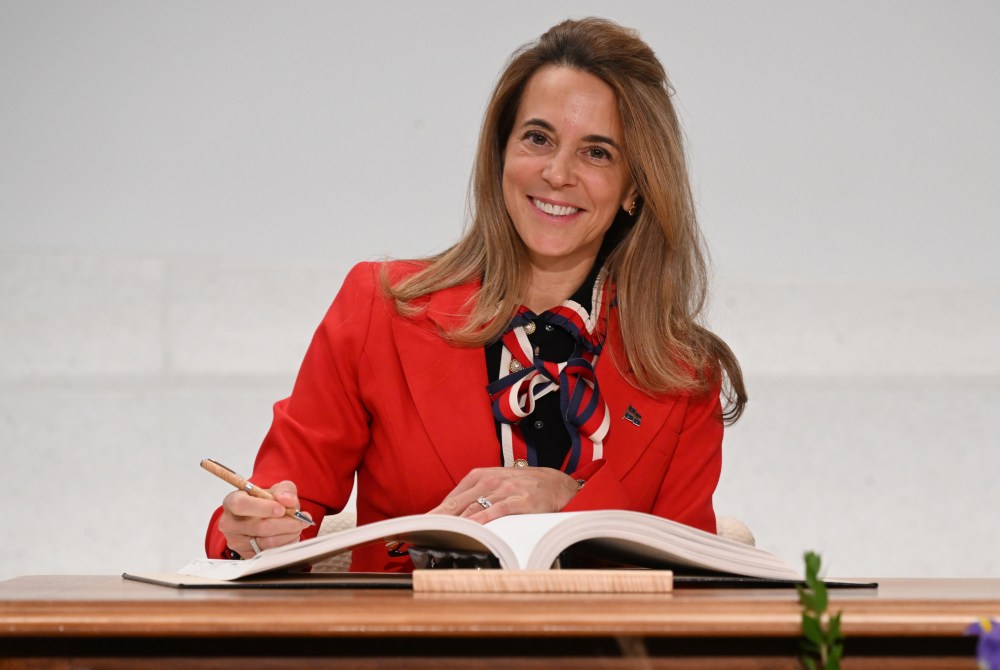
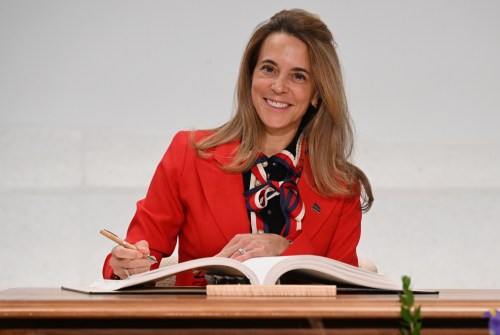
Quebec Treasury Board President France-Elaine Duranceau is sworn in at the legislature in Quebec City Tuesday, April 21, 2026. THE CANADIAN PRESS/Jacques Boissinot

“We’re all moving forward on AI, it’s new, and it changes at a phenomenal speed,” Duranceau said in a phone interview. “So why start from scratch, each on our own? We chose to work together and exchange freely to learn from what the other jurisdiction is doing.”

She explained that talks between the two provinces on AI have been ongoing since 2022, with Tuesday’s agreement making the partnership “official,” and praised Alberta’s interest in AI development. 

“They’ve really made it a priority to transform their public administration and to set the tone from the top, and I think Quebec has that same wish,” she said.

Alberta has leaned into AI and is the centre of Canada’s emerging data centre landscape, according to recent research out of York University. Meta, the tech giant behind Facebook and Instagram, recently announced a $13-billion-plus investment to build a data centre in Alberta, its first in Canada.

Duranceau suggests that the provinces could share AI tools they’ve developed, such as the one developed by Alberta to assist in their budgetary authorization or the one developed by Quebec to identify cybersecurity vulnerabilities. She also points to training for civil servants as an area where the provinces could share ideas, noting that Quebec is rolling out training to help employees use Microsoft Copilot, for example. 

“Citizens are currently using AI to organize their travel in record time, to write letters quickly…. Those are examples of how citizens can be more efficient in their personal lives. Well, at the state level, we have to automate tasks in that way,” said Duranceau. 

This agreement could help find ways to use AI to make government services faster by performing some administrative tasks or assisting with research, she said. 

Vass Bednar, managing director of the think tank Canadian Shield Institute, sees this announcement as a continuation of the general direction of AI policy in Canada. She points to the significance of Quebec and Alberta — “the two provinces who are both deeply engaged in their own kind of sovereignty questions” — joining forces in this deal.

Duranceau says that parallel had little to do with the agreement, except when it comes to a shared policy philosophy. “We have similarities in our desire to take the lead on issues that affect our population and not wait for the federal government on these issues,” she said.

To Bednar, the agreement announced on Tuesday lacks important discussions about digital sovereignty and building Canadian digital infrastructure. Rather than focusing on using AI to save money, she said governments should consider the cost-cutting potential of owning digital infrastructure to do things like video calls and sending emails. 

“For whatever reason, our imagination is not there yet,” she said. 

She criticized Canadian governments’ use of American AI and tech tools, and encouraged them to invest instead in Canadian innovation.

“(Sovereignty) is something you build and work towards. It’s not just going to be under our pillow one day when we wake up,” she said. 

This report by The Canadian Press was first published July 15, 2026.

Report Error Submit a Tip

More Stories

Bombers top B.C. Lions 34-10 to earn playoff spot

Taylor Allen 4 minute read Preview

Bombers top B.C. Lions 34-10 to earn playoff spot

Taylor Allen 4 minute read Yesterday at 8:41 AM CDT

Dru Brown saved the Winnipeg Blue Bombers’ season.

They were a trainwreck for the opening 40-plus minutes in Vancouver on Friday night before Brown provided the ultimate spark, accounting for 31 consecutive points in a 34-10 victory over the B.C. Lions to clinch a playoff berth.

The Lions — who had nothing to play for and rested a long list of key starters — somehow led 10-3 late in the third quarter when Bombers quarterback Zach Collaros was forced to leave the game. Lions defensive tackle Nathan Cherry was flagged for roughing the passer after driving Collaros into the turf, and the 38-year-old pivot was ruled out shortly thereafter.

And then Brown’s brilliance began.

Read
Yesterday at 8:41 AM CDT

Opening of Portage and Main shows even seemingly insurmountable impasses can be overcome

Jason Syvixay 10 minute read Preview

Opening of Portage and Main shows even seemingly insurmountable impasses can be overcome

Jason Syvixay 10 minute read Yesterday at 2:00 AM CDT

There are places in a city that become more than places. Portage and Main is one of them. For generations of Winnipeggers, the intersection has represented downtown, traffic, development and civic identity. Its reopening to pedestrians in 2025, after 46 years of closure, was about more than crossing a street. It was a reminder that decisions made by one generation can shape the choices available to another — and that even seemingly permanent decisions can be reconsidered.

I have spent much of my professional life thinking about Winnipeg as a planner, working in public, private and non-profit settings. My PhD research gave me an opportunity to examine Portage and Main differently: not simply as a debate about cars and pedestrians, but as a window into how power operates in a city. I reviewed 569 archival documents spanning the 1960s to the present, interviewed 48 planners with experience in Winnipeg, and mapped the relationships between planners, politicians, developers, engineers, residents, businesses and advocacy groups.

What emerged was a story about how planning decisions become embedded in a city’s institutions, agreements, infrastructure, professional practices and political expectations — shaping not only what gets built, but who gets to influence what gets built.

The closure of Portage and Main in 1979 did not remain a decision confined to a particular political moment. Over time, it was reinforced by development agreements, physical infrastructure, property relationships, traffic-engineering practices, administrative routines, and public narratives about mobility and downtown revitalization. The people who made many of those original decisions eventually left office. The arrangements they created remained. Later planners inherited them.

Read
Yesterday at 2:00 AM CDT

Quebec and Alberta plan to work together to integrate AI in government

Marieke Glorieux-Stryckman, The Canadian Press 4 minute read Preview

Quebec and Alberta plan to work together to integrate AI in government

Marieke Glorieux-Stryckman, The Canadian Press 4 minute read Wednesday, Jul. 15, 2026

MONTREAL - The Quebec and Alberta governments plan to work together to implement artificial intelligence in public administration, which Quebec's cybersecurity minister says will help both provinces build on each other's experience to develop new tools.

France-Élaine Duranceau, Quebec minister of cybersecurity and digital technology, announced an agreement between the provinces on Tuesday alongside Nate Glubish, Alberta minister of technology and innovation.

The agreement will span five years and includes no financial engagement, but rather a sharing of knowledge between both administrations. 

“We’re all moving forward on AI, it’s new, and it changes at a phenomenal speed,” Duranceau said in a phone interview. “So why start from scratch, each on our own? We chose to work together and exchange freely to learn from what the other jurisdiction is doing.”

Read
Wednesday, Jul. 15, 2026

Echoes of Idle No More as Carney set to meet with First Nations

Niigaan Sinclair 5 minute read Preview

Echoes of Idle No More as Carney set to meet with First Nations

Niigaan Sinclair 5 minute read 10:29 AM CDT

The prime minister, premiers and First Nations leaders will meet in Ottawa Monday to discuss a host of issues, including Indigenous involvement in energy and resource development projects.

Read
10:29 AM CDT

Security under magnifying glass after suspicious death on Mountain Avenue

Morgan Modjeski 5 minute read Preview

Security under magnifying glass after suspicious death on Mountain Avenue

Morgan Modjeski 5 minute read Yesterday at 8:15 AM CDT

Homicide detectives are investigating the suspicious death of a 70-year-old man at a seniors high-rise on Mountain Avenue.

Forensic investigators and detectives have been at the building, at 595 Mountain Ave., and questioning residents about the death of Richard Boychuk, whose body was found in his second-storey suite Tuesday morning.

The 70-year-old, who used a wheelchair, had lived in the Winnipeg Housing Rehabilitation Corp. apartment for several years, said close friend Angela Abdilla.

She would clean, shop and take care of Boychuk, a former Elvis impersonator.

Read
Yesterday at 8:15 AM CDT

Woman receives 8½-month sentence for disposal of body

Dean Pritchard 4 minute read Yesterday at 5:04 PM CDT

A Winnipeg woman who helped dispose the body of a slain Mexican man under threat of death from his killers has been ordered to serve another 8½ months in jail.

Devlin Langlois, 25, had pleaded guilty to accessory after the fact to murder in the March 2025 killing of 28-year-old Diego Moscoza in a Selkirk Avenue house.

Court of King’s Bench Justice Candace Grammond, in a written ruling delivered Friday, rejected a recommendation by Langlois’s lawyer Joshua Rogala that she be sentenced to the equivalent of nearly 16 months of time served.

Grammond said she accepted that Langlois feared for her life. However, she made no effort to help Moscoza when he was gravely injured and his killers were not present in the home and had not yet threatened her.