

Giant Tiger decision creates giant void for desperate population

Advertisement
Read this article for free:
or
Already have an account? Log in here »
To continue reading, please subscribe:

Digital Subscription
One year of digital access for only $205*
- Enjoy unlimited reading on winnipegfreepress.com
- Read the E-Edition, our digital replica newspaper
- Access News Break, our award-winning app
- Play interactive puzzles
*First annual payment billed as $205.00 + GST for one year. This annual subscription will automatically renew at $233.00 + GST every 52 weeks (10% off the regular annual price of $259.35). Offer available to new and qualified returning subscribers only. Cancel any time.
To continue reading, please subscribe:
Add Free Press access to your Brandon Sun subscription for only an additional
$1 for the first 4 weeks*
- Enjoy unlimited reading on winnipegfreepress.com
- Read the E-Edition, our digital replica newspaper
- Access News Break, our award-winning app
- Play interactive puzzles
*Your next Brandon Sun subscription payment will increase by $1.00 and you will be charged $17.95 plus GST for four weeks. After four weeks, your payment will increase to $24.95 plus GST every four weeks.
Read unlimited articles for free today:
or
Already have an account? Log in here »
A lot of Winnipeggers may shrug, but the end of Giant Tiger’s downtown store is a giant problem for many of the people living in the centre of the city.
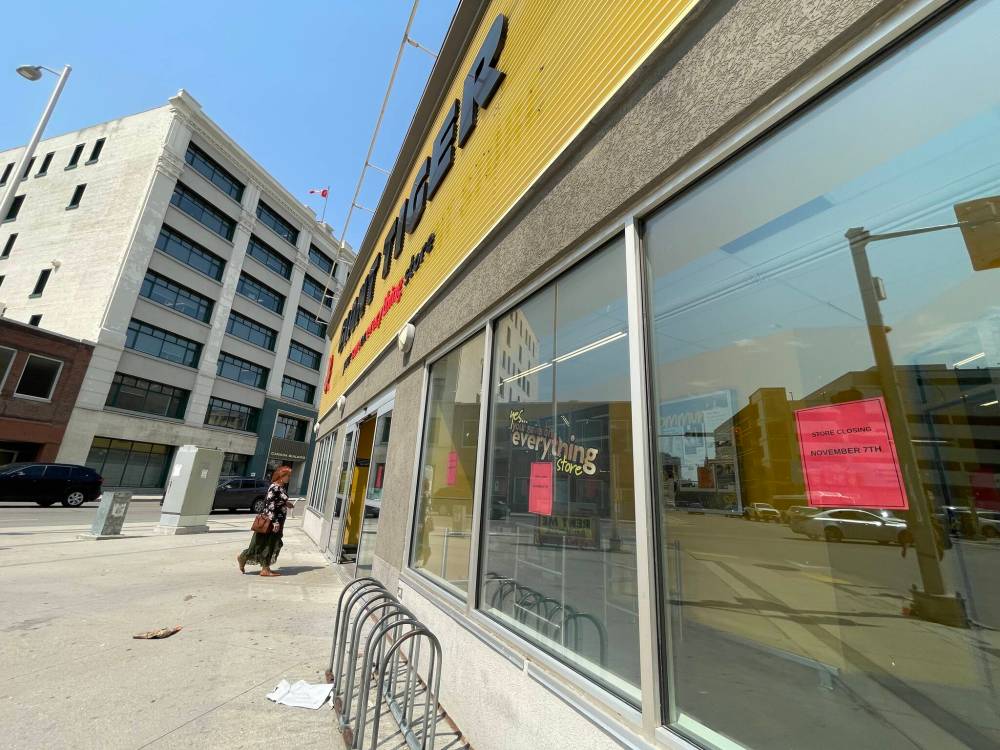
It would have been difficult for anyone going into or passing by the Canadian discount chain’s Donald Street and Ellice Avenue location Thursday to miss the red notices posted on the store’s windows advising it will close on Nov. 7.
Ruth Bonneville / Free Press
Red flyers tacked to Giant Tiger’s front windows announce the location will be closing Nov. 7.
According to a 2024 Downtown Winnipeg BIZ report, about 18,000 people live in Winnipeg’s downtown.
More than 60,000 people work there, and some days — when there’s a big concert or the Jets play at Canada Life Centre, for example — the number of people spending time in the area increases significantly.
The statistics, however, are made up of people who can be tracked easily because they have a home address, a steady job and some measure of social stability.
The numbers, however, are not nearly as clear — but crucial for accuracy — when it comes to people living less-privileged lives in the area: people working low-paying jobs; those with no fixed address and the homeless population, estimated at more than 8,200 (80 per cent of whom are Indigenous) by End Homelessness Winnipeg.
All of these people are more difficult to count. Some live on relatives’ or friends’ couches. Others spend time in shelters or other temporary arrangements and get missed.
So here’s some math.
For argument purposes, I’ll use the after-tax low-income measure used by the City of Winnipeg, which states that 13 per cent (or one in eight) live under the poverty line.
If 18,000 people in Winnipeg’s downtown are what statisticians see, it’s safe to say there’s another 2,300 living there — adding up to more than 10,500 individuals who have nowhere else but Winnipeg’s core to get the things they need to survive.
Which brings me back to Giant Tiger.
A spokesperson for the discount food and clothing store chain said the decision was made after a “thorough analysis” of the location’s viability.
Anyone who has been to the downtown Giant Tiger — as I have many times — knows that it’s one of the busiest stores in the downtown. And that’s because it’s one of the only places to buy affordable fruit, vegetables, ingredients to make a sandwich, gloves, underwear or household items needed in an apartment or a tent.
The store is, literally, a lifeline for many.
Giant Tiger isn’t closing because there’s a shortage of customers. It’s closing for the same reasons that shuttered the Indigenous-owned grocery store Neechi Commons on Main Street in 2018.
I’ve written many times about how the ongoing theft of food — and particularly the black market for fresh meat in the city — left Neechi Commons unable to pay its debts and eventually close.
In other words, a situation driven by poverty forced the operation to close.
Now the same forces will close Giant Tiger.
I need not rehash the increasingly dire situation for unprivileged individuals in Winnipeg’s downtown but the closing of one of the last affordable food and clothing options will be nothing short of catastrophic.
It will take the area one step further towards becoming a food desert, where there is little to no access to affordable, nutritious items. In urban areas, it’s defined by a walking distance of about 1.5 kilometres.
There are precious few options left that aren’t too expensive, too inaccessible or too far to transport purchases without a vehicle. And there are convenience stores filled with overpriced, unhealthy, processed choices.
Or the terrible decision to steal, or buy things on the black market.
Combined, those factors take too many downtown residents down a dangerous path of obesity and diabetes, anxiety and stress, conflict and crime.
Many of the people living downtown are already challenging police and paramedics and the health-care, justice, and child-welfare systems now. Imagine what adding hunger will do to the equation.
Many of the people living downtown are already challenging police and paramedics and the health-care, justice, and child-welfare systems now. Imagine what adding hunger will do to the equation.
This is where the rest of Winnipeg enters the picture.
In March 2020, the COVID-19 pandemic began and Winnipeg’s downtown was, essentially, shut down.
At the time, I was walking weekly with the Mama Bear Clan street patrol.
Not long after stores, libraries and bathrooms across the downtown were shut down, our patrol team witnessed a massive increase in drug and alcohol use, domestic violence and mental illness.

We saw first-hand how when basic necessities of life are compromised, instability takes over.
When life slowly returned to whatever normal was, it was clear that the situation was not to turn a blind eye to the problem.
It was starting food banks and school-lunch programs, supporting the creation of more citizen patrols rather than increased police funding and incentivizing the business community to see that investments in people result in profit.
For the people who rely on Giant Tiger there will be a giant void after Nov. 7.
niigaan.sinclair@winnipegfreepress.com
Niigaan Sinclair is Anishinaabe from Peguis First Nation and a professor in the Department of Indigenous Studies at the University of Manitoba. He’s been a columnist for the Free Press since 2018. Read more about Niigaan.
Every piece of writing Niigaan produces is reviewed by an editing team before it is posted online or published in print — part of the Free Press‘s tradition, since 1872, of producing reliable independent journalism. Read more about Free Press’s history and mandate, and learn how our newsroom operates.
Our newsroom depends on a growing audience of readers to power our journalism. If you are not a paid reader, please consider becoming a subscriber.
Our newsroom depends on its audience of readers to power our journalism. Thank you for your support.
Niigaan Sinclair is Anishinaabe from Peguis First Nation and a professor in the Department of Indigenous Studies at the University of Manitoba. He’s been a columnist for the Free Press since 2018. Read more about Niigaan.
Every piece of writing Niigaan produces is reviewed by an editing team before it is posted online or published in print — part of the Free Press‘s tradition, since 1872, of producing reliable independent journalism. Read more about Free Press’s history and mandate, and learn how our newsroom operates.
Our newsroom depends on a growing audience of readers to power our journalism. If you are not a paid reader, please consider becoming a subscriber.
Our newsroom depends on its audience of readers to power our journalism. Thank you for your support.
Advertisement Advertise With Us
Advertisement Advertise With Us