How Nevada made big strides to keep kids with behavioral health issues out of institutions
Advertisement
Read this article for free:
or
Already have an account? Log in here »
To continue reading, please subscribe:

Digital Subscription
One year of digital access for only $205*
- Enjoy unlimited reading on winnipegfreepress.com
- Read the E-Edition, our digital replica newspaper
- Access News Break, our award-winning app
- Play interactive puzzles
*First annual payment billed as $205.00 + GST for one year. This annual subscription will automatically renew at $233.00 + GST every 52 weeks (10% off the regular annual price of $259.35). Offer available to new and qualified returning subscribers only. Cancel any time.
To continue reading, please subscribe:
Add Free Press access to your Brandon Sun subscription for only an additional
$1 for the first 4 weeks*
- Enjoy unlimited reading on winnipegfreepress.com
- Read the E-Edition, our digital replica newspaper
- Access News Break, our award-winning app
- Play interactive puzzles
*Your next Brandon Sun subscription payment will increase by $1.00 and you will be charged $17.95 plus GST for four weeks. After four weeks, your payment will increase to $24.95 plus GST every four weeks.
Read unlimited articles for free today:
or
Already have an account? Log in here »
State officials announced a “dramatic drop” in the number of children with behavioral health disabilities who have been placed in institutional settings and other changes, including the launch of new services as well as service rate increases, marking progress on Nevada’s efforts to comply with federal disabilities law since the Department of Justice called out the deficiencies four years ago.
Ann Jensen, administrator of Nevada Medicaid, described the decrease and new community-based mental healthcare model as a “big win” that needs to be celebrated. Still, she said it’s just the first of many improvements that must happen.
“It’s reflective of a lot of small pieces of our system continuing to improve on a daily basis,” Jensen told The Nevada Independent. “But there’s going to be a lot more work to make sure people get access to the care they need.”
Data from the Nevada Health Authority indicates that youth with behavioral health disabilities who were covered by the state-managed Nevada Medicaid program and placed in psychiatric residential treatment facilities decreased from 35 percent (404 youth out of a population of 1,147) to 16 percent (382 youth out of a population of 2,408) since January 2025.
Behavioral health disabilities can manifest in a range of ways, including acute mental health crises, significant emotional or behavioral dysregulation, or safety concerns such as self-harm behaviors or aggression or risk of harm to others. The data focused on the highest acuity Medicaid-eligible children in the state who are tied to the settlement agreement, defined as youth with a serious emotional disturbance or serious mental illness and high utilization of behavioral health services, such as emergency room visits, mobile crisis or other behavioral healthcare.
The reduction in the percentage of institutional placements by more than half comes after the Department of Justice (DOJ) determined that Nevada was unnecessarily segregating children with behavioral health disabilities in institutions such as youth psychiatric hospitals — many of which were out of state — instead of more homelike environments in their communities.
The changes are part of a five-year settlement agreement between the state and the DOJ after findings that Nevada had violated the Americans with Disabilities Act. They also come as the state has invested more than $100 million in children’s behavioral healthcare through Nevada Medicaid, which will help raise reimbursement rates for rural and in-home therapy services, specialized foster care services and residential psychiatric treatment for children with complex needs.
Read below for a deeper understanding of what the reduction in institutional placements means, how the state is working to ensure children receive the care they need and how officials working to comply with the agreement define success.
What did the institutional placements look like? What were the harms of that environment?
In 2022, the Department of Justice published a 25-page report detailing the state’s failure to provide “community-based services” (such as therapy, crisis support and behavioral support programs) that led to hundreds of children being “isolated in residential treatment facilities each year” when they might have remained with their families if those services existed.
The DOJ investigation noted that in fiscal year 2020, more than 1,700 Nevada children were admitted to psychiatric hospitals and more than 480 children were admitted to psychiatric residential treatment facilities. On average, children remained in those facilities for nine to 12 months, with about 27 percent staying more than a year.
Reporting from the DOJ found children experienced emotional trauma and disruption. One example cited in the report was of a child who spent almost 15 months away from home in in-state and out-of-state facilities and described his only desire as “to not be here.”
Psychiatric residential treatment facilities are associated with elevated risks of physical and sexual abuse, the report noted, and long-term stays in such facilities are linked to delayed cognitive and language development, emotional attachment disorders and increased risk of substance abuse.
What are community-based services and why are they a better approach?
Community-based services such as therapy, crisis support and behavioral support aim to keep individuals with disabilities or other healthcare needs in their own homes and neighborhoods.
A 2013 Centers for Medicare & Medicaid Services bulletin notes that offering community-based services is more effective and cheaper (saving an average of $40,000 per child annually) than long residential stays. The DOJ report also noted that community-based programs typically lead to increased emotional strengths, better school outcomes and fewer suicide attempts, among other benefits.
What is the new community-based mental health model and how does it work?
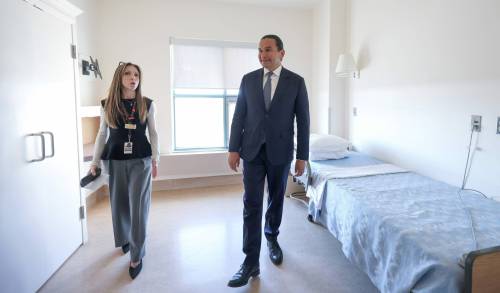
The state announced this month that it was launching a short-term therapeutic home model that’s meant to be homelike and less restrictive than inpatient or intensive psychiatric facilities.
Jensen noted that the model is more implicit than explicit in the agreement. The model was established through an interim health bill in the 2025 legislative session, AB514, which recommended developing these step‑down, community‑based options.
The goal, Jensen explained, is to have short-term stays at the facility of between one and three months. Trained behavioral health professionals who staff the home support children in their routines, school attendance, community activities and interactions with family.
Jensen added it will serve as a home in a neighborhood or other residential community that allows kids to go about their daily life — something that’s not possible in institutions far from home. The new model will allow children to receive higher levels of care, without automatically being sent to a residential treatment facility.
“The ultimate goal is these residential homes are not intended to replace the child’s home,” she said. “They’re just there for a short time to get the skills, get the support they need to then move back home and be really successful.”
She and others clarified that the model is not meant to replace psychiatric residential treatment facilities nor is it inherently better than those facilities.
Instead, it is intended to add an intermediate, community-based residential treatment option to a system that previously only supported children needing a higher level of care going directly from home to highly restrictive psychiatric residential treatment facilities or staying in those facilities for longer than necessary.
“There always will be that need for this type of residential institutional treatment, but it needs to be very specific to their clinical situation, and for a limited time while we focus on discharge,” Jensen said.
Is this shift more expensive?
No.
Jensen said it’s more expensive to have children in inpatient care than offering them community-based outpatient services. She estimated that a day at a psychiatric residential treatment facility costs the state between $800-$950 per child.
What challenges are Nevada officials facing while making this shift?
Offering a short-term therapeutic home option requires new staffing and infrastructure investments as well as system design and culture change, Jensen said.
For decades, Nevada defaulted to institutional placements because intermediate options didn’t exist. Many psychiatric residential treatment facilities tried to fill the gap by creating more community-like group homes, but they were often ill-equipped to take care of children, she said, and many of the youth placed in those settings needed secure psychiatric treatment that only a psychiatric residential treatment facility could provide.
Jensen noted that “secure” refers to ensuring that the environment is safe and appropriately structured for youth receiving psychiatric treatment. She clarified that it doesn’t always mean a locked facility, but it does require safeguards that prevent children — who may be in crisis or vulnerable — from leaving the setting unsafely and ensuring that clinical staff can maintain a therapeutic and protective environment.
“Moving toward a ‘community-first, least-restrictive’ approach requires realigning how decisions are made when children present with behavioral health needs that cannot be treated with simply outpatient or home services,” Jensen said.
Is the DOJ still monitoring compliance with the settlement and when does that “probation” end?
The settlement, signed on Jan. 2, 2025, is a five-year agreement between the state and the Department of Justice. Jensen said the state works closely with the DOJ on all required reporting and compliance activities, including meeting monthly with the team.
Though the agreement is technically five years, it could be dismissed before 2030 if the state comes into compliance before then.
What is success? Will we be able to completely eliminate institutional or out-of-state placements or is there a target number the state has?
Success is not achieved by completely eliminating institutional or out-of-state placements — sometimes those are unavoidable, Jensen said — but rather by meeting specific, meaningful goals. “The focus is on ensuring children receive care in the most integrated, least restrictive environment appropriate to their needs,” Jensen said.
___
This story was originally published by The Nevada Independent and distributed through a partnership with The Associated Press.