Ottawa to hit U.S. back with tariffs on steel, aluminum, smartphones and golf clubs
Read this article for free:
or
Already have an account? Log in here »
To continue reading, please subscribe:

Digital Subscription
One year of digital access for only $205*
- Enjoy unlimited reading on winnipegfreepress.com
- Read the E-Edition, our digital replica newspaper
- Access News Break, our award-winning app
- Play interactive puzzles
*First annual payment billed as $205.00 + GST for one year. This annual subscription will automatically renew at $233.00 + GST every 52 weeks (10% off the regular annual price of $259.35). Offer available to new and qualified returning subscribers only. Cancel any time.
To continue reading, please subscribe:
Add Free Press access to your Brandon Sun subscription for only an additional
$1 for the first 4 weeks*
- Enjoy unlimited reading on winnipegfreepress.com
- Read the E-Edition, our digital replica newspaper
- Access News Break, our award-winning app
- Play interactive puzzles
*Your next Brandon Sun subscription payment will increase by $1.00 and you will be charged $17.95 plus GST for four weeks. After four weeks, your payment will increase to $24.95 plus GST every four weeks.
Read unlimited articles for free today:
or
Already have an account? Log in here »
OTTAWA – The federal government hit back at the latest escalation in the trade war with the United States on Tuesday, announcing plans to hike American steel and aluminum tariffs from 25 to 50 per cent.
The move, which will come into force on Sept. 8, is part of a list of nearly 900 U.S. products being tariffed in retaliation for the United States imposing new tariffs on Canada last week.
The government will also impose 50 per cent tariffs on smartphones, golf clubs, video game consoles, fishing rods, clothing and apparel, furniture and perfumes, among other goods.
It will levy a 25 per cent tariff on appliances, agricultural machinery, dairy products, seafood and certain steel and aluminum derivatives products.
A 15 per cent tariff is also being tacked on a small list of items including hand tools, air conditioners and forklifts.
Finance Minister François-Philippe Champagne said the U.S. levies have “real consequences” for Canadian companies and consumers.
“Canada must respond and today we are — in a proportionate, targeted and strategic way,” he said.
Champagne was among a number of federal cabinet ministers who presented the government’s response at a news conference at an Ottawa roofing manufacturer on Tuesday.
Before the announcement, government officials gave a briefing on background to reporters on the plan and stressed Canada was not targeting any new products beyond ones already hit by U.S. President Donald Trump, as not to further escalate the trade war.
However the officials did not say whether the list targeted products from specific U.S. states.
“The first (goal) is to protect our workers, protect our markets,” Industry Minister Mélanie Joly told reporters later.
“But of course, we’ve always been clear we need to put pressure. And that is actually the reason why there are counter-tariffs. I think in the U.S., they’re very much aware of that. And that’s why they’ve been pushing to get (U.S. alcohol back on shelves) because they know that it’s having political pressure back home for them.”
Officials could not provide any figures on how much revenue Canada is expecting to generate from these new tariffs, but said it wouldn’t be more than the $7.5 billion in aid Ottawa also announced on Tuesday.
The aid package is meant to help Canadian businesses impacted by the trade war with the United States. Among the measures are new loan programs for businesses and more flexibility to apply for employment insurance.
Candace Laing, president of the Canadian Chamber of Commerce, said while she welcomed the aid package she is worried about businesses being able to repay the loans.
“We see that the intention of loans is helpful, but they can also be a monkey on the back when they come due,” Laing said in a statement.
“As this rolls out, we understand there will be improvements along the way, as we have seen from past iterations of government-led crisis management.”
Ottawa is matching the dollar amount of the U.S. tariffs, but the list does not include all of the same items targeted by President Donald Trump — like hockey sticks and Canadian alcohol.
“Economic sovereignty means the capacity to produce, invest and grow in Canada,” Joly said.
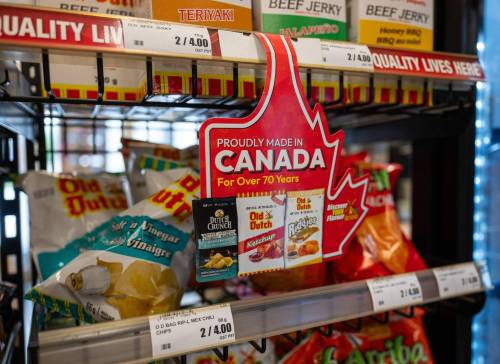
She said the government has already spoken with Canadian retailers about ensuring Canadian products on their shelves are clearly identified and said Canadians should buy domestic products.
The White House has not yet responded to a request for comment about the retaliatory duties.
Brooke Rollins, Trump’s agriculture secretary, told reporters at the White House that “with regards to Canada, the president has been very clear for the last year and a half that the way they treat our dairy farmers in America is just not … going to continue any longer.”
When asked about Canada’s retaliatory measures she said there’s no doubt it causes concern among ranchers and farmers because there’s a lot of “unknown out there.” But she added that Trump is a master negotiator and he always prioritizes farmers.
While the tariffs on aluminum are a direct response to the measures the U.S. took on Canada, the move is likely to resonate with Trump.
Bloomberg reported on Monday that while Trump was on a call endorsing a Republican candidate for governor in Oklahoma, the president said the U.S. “desperately needs” aluminum, which he said they almost entirely get from Canada.

Prime Minister Mark Carney briefed opposition leaders Tuesday morning on the state of trade talks with the United States. A media release from the Prime Minister’s Office says the leaders spoke about the ongoing response and “the importance of a united Team Canada approach.”
Conservative Leader Pierre Poilievre spoke to reporters in Windsor on Tuesday and said he would put aside partisanship to work with other parties to respond to Trump’s “unjustified” tariffs.
He reiterated calls for the Liberals to recall Parliament and release the text of the proposed deal that Canada’s trade team walked away from last week.
This report by The Canadian Press was first published Aug. 25, 2026.
— With files from Craig Lord, and Kelly Geraldine Malone in Washington
What the tariffs cover
Here’s a look at the new levies that are set to come into effect on Sept. 8:
Dairy
A 50 per cent tariff is being applied to a variety of American dairy products.
This includes milk and cream, including concentrated and sweetened varieties and powders. It also applies to whey and several milk and whey protein products.
A 25 per cent tariff applies to fresh cheese and curd, including grated, powdered and processed varieties. The list specifies types of cheese: Camembert, brie, blue cheese, cheddar, mozzarella, Swiss, Gruyère, Havarti and Parmesan, to name a few.
Under the Canada-U.S.-Mexico Agreement on trade, imports of U.S. dairy products are tariff-free until specific quotas are reached. Imports over the quotas are subject to tariff rates of upwards of 200 per cent.
These new 50 per cent tariffs will apply to imports both below and above the quota rate, according to the Finance Department.
Seafood
Canada is imposing a 25 per cent tariff on a range of U.S. seafood, including live trout, eels, carp and tuna.
It also covers a imports of many kinds of fresh, preserved and frozen seafood: salmon, halibut, cod, haddock, tilapia, lobster, crabs, shrimps and prawns, oysters and mollusks, swordfish, mackerel, and a variety of smaller fish such as herring, capelin, anchovies and sardines.
Forestry and wood
Canada will target U.S. wood products with 25 per cent tariffs. This includes softwood like pine, fir and spruce that has been sawn or sliced thicker than six millimetres.
Plywood and veneered panels made from a variety of different softwoods and hardwoods will be hit with a 50 per cent levy.
Tariffs of either 25 or 50 per cent will apply to products like toilet paper, facial tissue, napkins and similar sanitary products (the rate will depend on specific import sizes).
A 50 per cent tariff will apply to most types of paper and paperboard, envelopes, and corrugated boxes and cases, with a lower 25 per cent levy for some imports of kraft paper and bleached paper products under a certain weight.
Wooden furniture for household use is subject to a 50 per cent tariff, except for kitchen furniture items which are at 25 per cent.
Steel and aluminum
A variety of steel and aluminum products are being hit with a 50 per cent tariff, raising the rate from the current 25 per cent.
It includes steel rods, bars and sheets, along with prefabricated items like bridges, towers, scaffolding and door and window frames.
Aluminum products such as wires, bars, rods and foil are all subject to the 50 per cent tariff rate.
Canada had imposed a 25 per cent tariff on American steel and aluminum products in March 2025 in retaliation for U.S. President Donald Trump’s tariffs on Canadian steel and aluminum. Trump raised the tariff on steel to 50 per cent in June.
Trump’s latest threat, posted on Truth Social on Monday, was to raise tariffs to 50 per cent on Canadian steel, aluminum and vehicles as of Jan. 1, 2027.
Cosmetics, clothing and textiles
Some beauty products and makeup will be subject to 50 per cent tariffs.
This includes perfumes and eau de toilets, sunscreen and suntan products, lip and eye makeup, manicure and pedicure preparations, and hair products.
Tariffs of 50 per cent are being applied to a long list of clothing items that range from men’s suits and overcoats to T-shirts and dresses, track suits and ski suits.
The tariff would also apply to hazardous material suits and protective clothing.
A 25 per cent levy applies to handwoven rugs, tiles and carpets made of wool, animal hair and a range of other textile materials.
Other products
A 50 per cent tariff is set to begin in September on smartphones.
The same rate will apply to golf clubs and equipment, video game consoles, chandeliers and light fixtures, exercise equipment and fishing rods.
American natural honey will be subject to a 50 per cent tariff, as is molasses.
Tariffs of 50 per cent will apply to plastic wall and ceiling coverings made with vinyl chloride.
Plastics, including bags, packaging, tableware and kitchenware, are subject to 50 per cent tariffs.
Most air conditioners are subject to 15 per cent tariffs.
A 25 per cent tariff will kick in on appliances including stoves and ranges, refrigerators and freezers, laundry machines and small appliances including rice cookers, bread makers, grills and cooking plates.
Tariffs of 15 or 25 per cent will be applied to tower cranes, jacks and hoists, forklift trucks and lawn mowers.
Rail locomotives, train parts and railway maintenance vehicles are being hit with 25 per cent tariffs.
A 50 per cent tariff will apply on motorcycles. Trailers and semi-trailers will be subject to 25 per cent tariffs.
A 15 per cent tariff will apply to moulds for metal, rubber and plastics.
-The Canadian Press
Related Articles
Ex-Alberta premier Jason Kenney says oil needs to be on the table in U.S. tariff war