Poster protocol
Winnipeg venues saying no to AI-made advertisements
Advertisement
Read this article for free:
or
Already have an account? Log in here »
To continue reading, please subscribe:

Digital Subscription
One year of digital access for only $205*
- Enjoy unlimited reading on winnipegfreepress.com
- Read the E-Edition, our digital replica newspaper
- Access News Break, our award-winning app
- Play interactive puzzles
*First annual payment billed as $205.00 + GST for one year. This annual subscription will automatically renew at $233.00 + GST every 52 weeks (10% off the regular annual price of $259.35). Offer available to new and qualified returning subscribers only. Cancel any time.
To continue reading, please subscribe:
Add Free Press access to your Brandon Sun subscription for only an additional
$1 for the first 4 weeks*
- Enjoy unlimited reading on winnipegfreepress.com
- Read the E-Edition, our digital replica newspaper
- Access News Break, our award-winning app
- Play interactive puzzles
*Your next Brandon Sun subscription payment will increase by $1.00 and you will be charged $17.95 plus GST for four weeks. After four weeks, your payment will increase to $24.95 plus GST every four weeks.
Read unlimited articles for free today:
or
Already have an account? Log in here »
Although the days when telephone poles and notice boards across the city were thick with gig posters, either slopped up with wheat paste or wrapped tight with packing tape, are behind us, the art of making an appealing visual ad for live music events is still a vital part of the local creative scene.
However, a widespread backlash against a new kind of slop — the use of generative AI images — has been building, especially among creatives when it comes to promoting live music.
“Live music is and always has been a DIY type of scene, especially locally,” says Evan Simpson, who has been working as a graphic designer for nearly a decade.
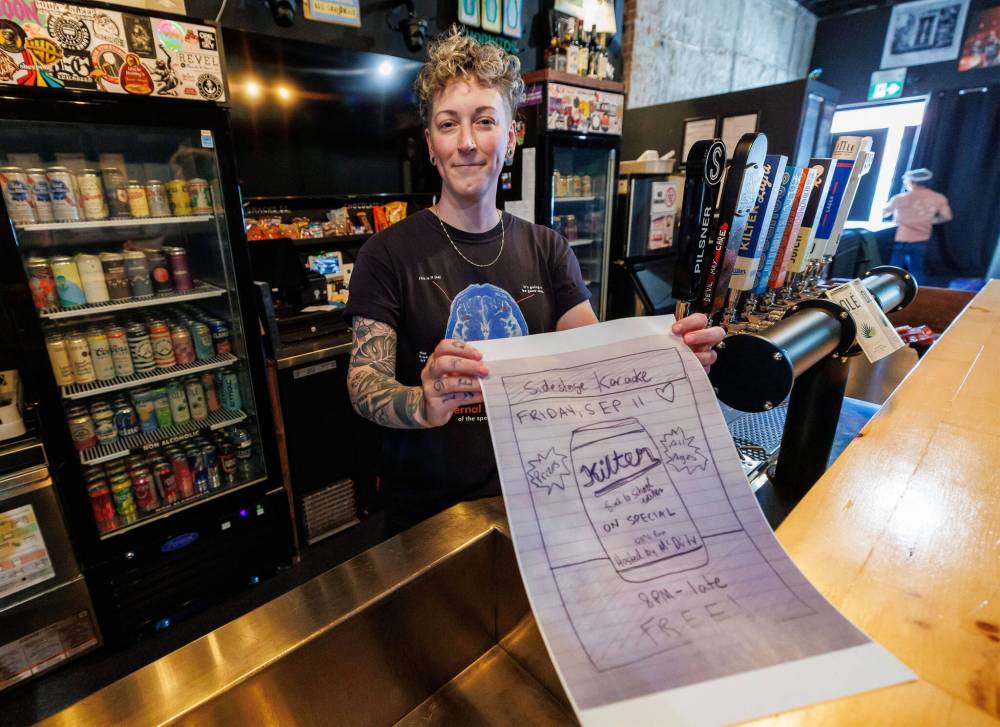
Jenna Priestner, co-owner of Sidestage at 700 Osborne St., and a musician in Mobina Galore. Sidestage doesn’t use AI, and a recent hand-drawn poster Priestner made for a karaoke event got a lot of buzz for its anti-AI caption on social media.
“For years people have been making their own flyers, or if they have the budget, hiring a designer or artist to come up with some artwork for their flyers. It’s a whole ecosystem, a scene supporting itself. If you take away the visual side of it, the spark, individuality and uniqueness of each gig poster is lost. What a sad world it would be if all art were made by AI.”
AI image generators, such as ChatGPT, Google’s Nano Banana, or Midjourney, for example, take a text prompt written by the user. The algorithm-based models then use data scraped — often with no regard or financial recompense to intellectual property or copyright owners — from a wide variety of sources to produce an image quickly and for little to no cost to the user.
Earlier this summer, Halifax live-music mainstay Gus’ Pub & Grill posted on Instagram that it would no longer share AI-made posters or flyers.
“A shit box poster made in MS Paint is better than AI. Support artists or DIY,” the viral post read.
Recently, closer to home, management at the Keystone Centre in Brandon posted a public apology after using generative AI to promote its annual Wheat City Fall Festival.
“What a sad world it would be if all art were made by AI.”
“It was a quick decision made while we were trying to get information about the festival out,” CEO and general manager Connie Lawrence wrote in a social media post. “That decision missed the mark, and I understand why people were disappointed by it.”
Winnipeg has a long and storied local music scene, with artists from the Guess Who to the Crash Test Dummies, Propagandhi to the Weakerthans, winning fans the world over after getting their starts in local clubs and community centres.
Visual artists such as Marcel Dzama, Simon Hughes and Ben Clarkson cut their teeth creating visual art for local acts. That link between visual art and live music isn’t one that’s easily slopped out.
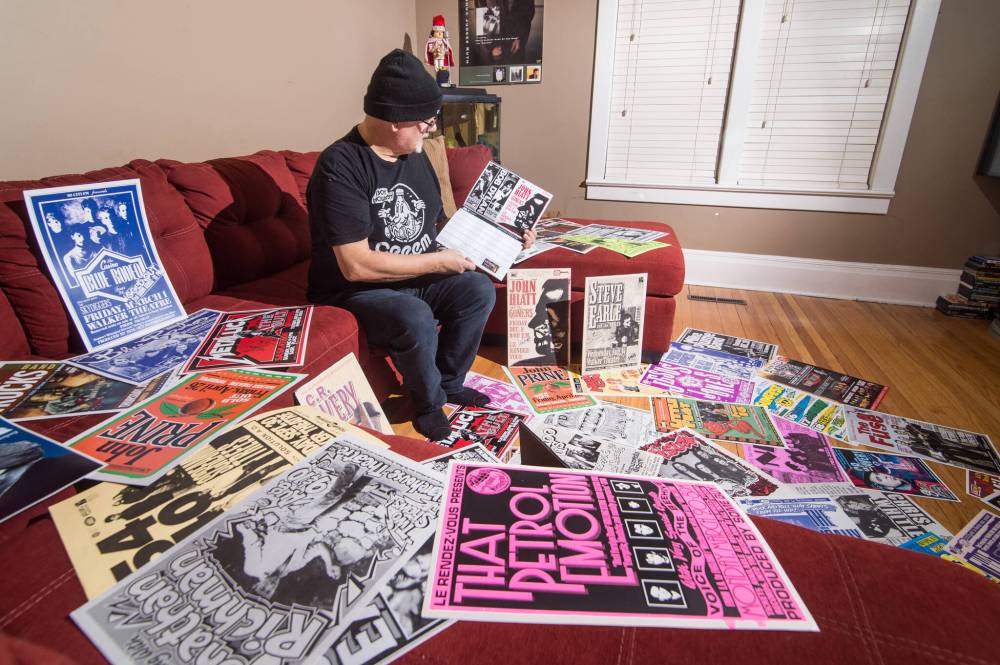
Over the course of his career in graphic design, Stu Reid has created thousands of posters for local bands, promoters and venues, including Pink Floyd’s 1994 gig at the Winnipeg Stadium.
“It was just something I fell into because of the love of it. A love of the scene. A love of the music and a knowledge of it as well,” Reid says.
While Reid doesn’t do much by way of gig posters anymore, apart from the odd show he puts on at the Stu-Dome, a.k.a. the living room of his Crescentwood home, as an avid showgoer, he keeps an eye on the scene.
“I’ve seen enough of (AI art), and you know it when you see it at this point. It’s when you really dig into the reasons it’s being used that depresses me,” he says.
Charlotte Melnyk is a RRC Polytech graphic design creative arts graduate who recently left Winnipeg for Montreal. She got her start doing flyers and posters for skateboard events, then got into working within the local music scene as a member of Our Friend Oscar. She has since done work for the Rainbow Trout Music Festival, Into the Music, Real Love and other events.
“When designing for musicians, whether that’s tour merchandise or posters, I’m very observant of what that artist wants to reflect in their visual idea. There’s so much that AI misses, like design principles and styles that are trending. It’s easy to see an AI flyer and it’s so disconnected, overall it’s unappealing,” she says.
“I think you lose credibility. It shows how likely you are to cut corners,” says Simpson, who has been the go-to designer for Sidestage since the South Osborne venue opened two years ago.
“Venues and artists are always huge advocates of ‘supporting your local scene.’ Imagine saying that and then using AI to make all your gig posters? A gig poster with imperfections made by a human is far better than a gig poster made in two minutes on AI with little to no thought put into it.”
While Jenna Priestner, co-owner and operator of Sidestage, says the venue doesn’t have an explicit policy against using generative AI, they do make a conscious decision to forgo it themselves — not least because it can become a distraction in and of itself.
“I’d rather make a silly or simple sign at the bar for a drink special then have an overly complicated AI design to sell a product. If it’s AI, all people talk about is that.”
“I’d rather make a silly or simple sign at the bar for a drink special then have an overly complicated AI design to sell a product. If it’s AI, all people talk about is that,” Priestner says.
The West End Cultural Centre put a policy against AI use in place this month after receiving numerous AI-generated poster submissions from renters this summer.
“We decided to take a stand,” says Jorge Requena Ramos, artistic director of the Ellice Avenue venue. “It is super important, as a non-for-profit venue, to support artists. We must also support graphic artists. We do not see any value, in fact we see it as a negative, when an artist wants to share an AI poster. The ecosystem of artists that support the music industry cannot survive unless we are supporting each other.”
For Requena Ramos, a musician himself, the matter is also personal.
“As a person in the arts, the creation of AI-generated content prevents you from participating in the edification that is done by sucking at your art until you’re good at it. You are a better person when you do those things, and you’re losing out on that when using artificial intelligence to create content. I think AI is our enemy in the arts,” he says.
While Dave McKeigan, owner of the Pyramid Cabaret, doesn’t use AI to make posters for shows hosted by the longstanding downtown club, he also doesn’t have a policy against it.
“As a person in the arts, the creation of AI-generated content prevents you from participating in the edification that is done by sucking at your art until you’re good at it.”
“I wouldn’t want to tell somebody what to do,” says McKeigan, who fondly recalls the days of making posters by hand for the Pyramid and the Spectrum before it, using scissors, glue and a LetraSet.
“The way I look at it, if someone wants to do AI, that’s their business.”
Although designer Reid admits that seeing bands use AI imagery to advertise upcoming gigs online “depresses” him, he understands the impulse and the economics behind it.
“If it’s not going to cost you a nickel versus hiring me for $100, if that’s the difference between putting a show on, it’s hard to argue with,” Reid says. “But on the other hand, you probably have a buddy with a 12-year-old who’s kind of good at drawing; why not just give them 20 bucks to make you a poster?”
“Anything that takes care should take a few hours,” Melnyk adds. “Sadly, a lot of the smaller independent music industry doesn’t have the money always to hire a graphic designer to do flyers or posters. It’s usually a team of people that decide it’s the easiest route to put in a prompt, but you lose the community aspect, in a way.”
sheldon.birnie@winnipegfreepress.com
More local venues, promoters and AI art
The Park Theatre has no strict policy regarding generative AI use, but owner Erick Casselman says the South Osborne venue tries to steer clear of it.
“We have also unfortunately in the past, months ago, posted some AI stuff, but have put a complete stop to that,” he says. “Good thing with bands, and creative types, they are pretty anti-AI anyways, so that is a plus, and the only time we have seen stuff is when people are trying to rush things out.”
Ditto the Times Change(d) High and Lonesome Club, long a fixture of the downtown music scene.
“We do not use AI for in-house graphics. Honestly, I’d still be cutting and pasting pieces out of newspapers and magazines for posters if that were easily possible,” says the club’s John Scoles.
West Broadway’s Handsome Daughter has taken a stance against AI use.
“We do have a policy, it’s simple: we do not accept AI-generated posters,” says the venue’s Corey Hykaway. “It can be hard to enforce because sometimes you just can’t know if a promoter is using AI to make a poster, but for everything that is booked in house, we use our own graphic designer.”
One of the city’s largest entertainment providers, True North Sports & Entertainment — booking acts into the Canada Life Centre and the Burton Cummings Theatre, among others — is still evaluating its position towards generative AI use.
“As AI use continues to evolve across creative spaces, we are considering what guidelines may be needed to support its responsible application,” Krista Sinaisky, True North’s director of corporate communications, wrote in an email.
“Regardless of the tools used, we continue to apply the same care and review we would to any creative work.”
Related Articles
Tattoo artists beset by requests for unworkable AI pieces


Advertisement Advertise With Us
Advertisement Advertise With Us
History
Updated on Monday, September 14, 2026 10:22 AM CDT: Updates photo cutline