The perks and drawbacks of using your personal cell as a work phone

Advertisement

Advertise with us

Leaving your work cellphone behind as you embark on a days-long hike or head out for dinner at your favourite restaurant is a clear indication: you're off the clock.  

Read this article for free:


or

Already have an account? Log in here »

To continue reading, please subscribe:

Subscribe and receive a limited-edition Free Press branded hat or tote.

Digital Subscription

One year of digital access for only $205*

  • Enjoy unlimited reading on winnipegfreepress.com
  • Read the E-Edition, our digital replica newspaper
  • Access News Break, our award-winning app
  • Play interactive puzzles

*First annual payment billed as $205.00 + GST for one year. This annual subscription will automatically renew at $233.00 + GST every 52 weeks (10% off the regular annual price of $259.35). Offer available to new and qualified returning subscribers only. Cancel any time.

To continue reading, please subscribe:

Add Free Press access to your Brandon Sun subscription for only an additional

$1 for the first 4 weeks*

  • Enjoy unlimited reading on winnipegfreepress.com
  • Read the E-Edition, our digital replica newspaper
  • Access News Break, our award-winning app
  • Play interactive puzzles
Start now

*Your next Brandon Sun subscription payment will increase by $1.00 and you will be charged $17.95 plus GST for four weeks. After four weeks, your payment will increase to $24.95 plus GST every four weeks.

Leaving your work cellphone behind as you embark on a days-long hike or head out for dinner at your favourite restaurant is a clear indication: you’re off the clock.  

But that separation of devices also means you have to carry both your personal and work phones during work hours — juggling texts from your child’s daycare on your personal phone while taking calls from clients on your work device.  And sometimes, work obligations could mean carrying both devices outside of business hours.

For some, separating work and personal lives with two cellphones seems like a necessity and to others, a hassle. But experts say it comes down to your profession, life priorities and comfort level with your company’s data privacy policies.
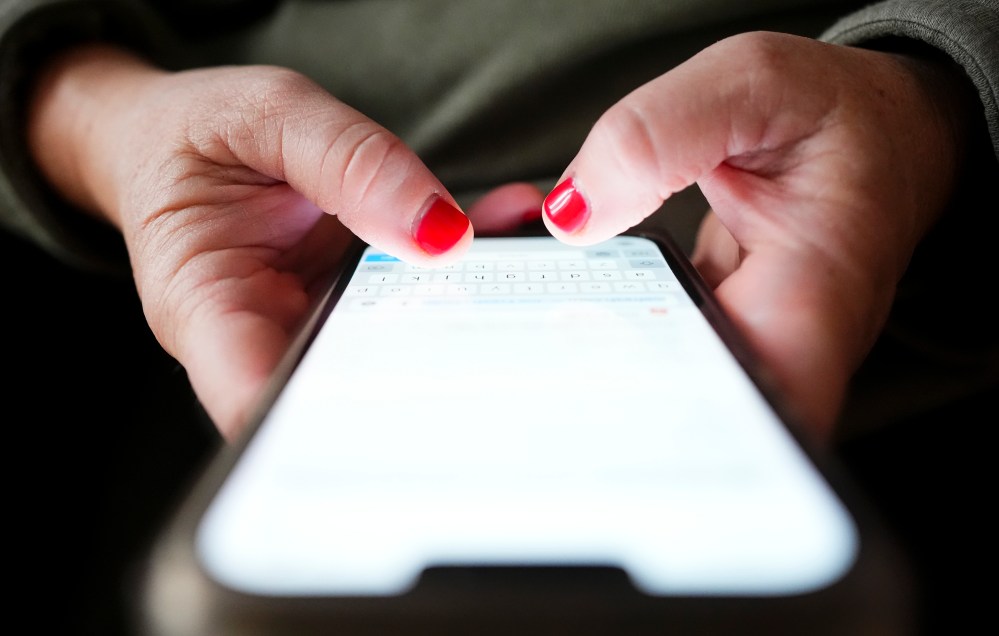
A person types on a cellphone in Ottawa on, Dec. 15, 2025. THE CANADIAN PRESS/Sean Kilpatrick

A professional in banking or health care, for instance, would typically carry both a personal and work cellphone for data security and personal safety reasons, said Lisa Stam, managing partner and owner of employment law firm Spring Law.

Meanwhile, a small-business owner would likely assume that employees use their own phones at work, she said.  

At her law firm, Stam said employees use their personal phones on the job, but there are policies to safeguard work data and privacy while laying out expectations about job-related data on the device.

She says employers need to think through bring-your-own-phones policies: whether workers are expected to work after hours, if employers contribute to the phone plan and what happens to data on those phones if a worker resigns.

Stam recommended employers pay a portion of their workers’ phone plan if they use their personal device for their jobs.

“If you’re asking the employee to use their device but you’re asking them to put on some of your applications, your apps, then in that case, contributing to the data plan gives you a seat at the table about what to do with that phone and the data that’s on that phone,” she said.

Many companies have been using security measures such as multi-factor authentication or ring-fencing, which virtually separate apps and safeguard the company’s data on a worker’s personal phone. It allows companies to remotely erase work-related data from an employee’s phone without affecting personal information when that worker leaves.

Jane Arnett, cybersecurity expert at Check Point Software, said these security layers often work like a container, protecting work-related apps inside it, holding files, emails and work chats.

“Your employer is very concerned that their data is protected, and their customers’ data is protected,” Arnett said. “If your device has been compromised and you … connect into where their data resides, their data is now compromised.”

She said if a personal phone is broken into, it could make the company susceptible to hackers stealing work data or impersonating an employee. 

But no matter which device management service a company uses, Arnett said these tools can see some basic information about your phone, such as your location and web traffic. But it cannot read emails or see passwords.

Arnett said if your biggest concern is an embarrassing web search on your phone, then you don’t really need two phones. But if you’re doing something outside your work that you don’t want the employer to find out, then opt to keep your devices separate. 

There are benefits to either choice. For those with two phones, she said there are clearer boundaries between work life and personal life, as well as better control over your personal device. 

Those with one phone have the convenience of checking work emails anywhere, get additional security guardrails installed on their phones and the perk of not having to pay for all or part of their phone plan.

For Arnett, carrying one cellphone is a choice grounded in convenience.

“I’m not myself concerned that my cybersecurity team has the time and energy available to just randomly see what I’m up to and what I am searching on the internet because they’re extremely busy,” she said.

Many companies, including Arnett’s, block access to risky websites on work devices and would alert the cybersecurity team if those sites are accessed, or block them altogether. 

Arnett said those security aspects supersede her concerns about privacy and that she can freely access sensitive data on her device, such as banking.

The ergonomics of carrying two phones can also be a hassle for some, Arnett said.

“I’m short. I’m small,” Arnett said. “I’m travelling a lot for work and every ounce counts.”

But the rules flip when an employer offers a separate phone for work.

“You’ve made it very clear that this second device is the workplace one and that we as the employer have all the rights to look at this,” Stam said.

She said it could also be difficult for an employee to argue rights to privacy if they use a work phone for personal reasons and get in trouble.

“If you have really clear workplace policies that say, ‘Hey everybody, you’re getting a workplace device, you have no expectation of privacy on that, that is only for work,’ don’t use it for personal stuff.” 

This report by The Canadian Press was first published Sept. 14, 2026.

Report Error Submit a Tip

More Stories

Grieving child builds backyard rocket ship

Harriet Zaidman 4 minute read 2:01 AM CDT

I Built a Rocket Ship (Kids Can Press, 32 pages, hardcover, $22) by Winnipegger Anna Lazowski is a tender story for children ages 4-8 about a little girl trying to make sense of her mother’s death. The child engages in conversation with her late mom, agreeing and disagreeing about things said as she carries objects (and of course, the cat) to the backyard. There, she is building a rocket ship she will pilot into the skies to find her mom again.

Jennica Lounsbury’s varied perspectives show the range of emotions the little girl experiences.

● ● ●

Northwoods Lullaby by Mary Casanova (University of Minnesota Press, 32 pages, hardover, $25) is a bedtime book for readers up to age eight, perfect to bring a busy, happy day to a close. Just like children who are listening to adults reading the book, all the animal babies are being tucked into their nests and burrows by loving parents: “Thump and scamper,/nimble clover./ Soon it’s time to rest. Baby loon/ nestles in/as Papa floats along.”

American Hostage stars recall warmth of Winnipeggers during brutal winter

Randall King 7 minute read Preview

American Hostage stars recall warmth of Winnipeggers during brutal winter

Randall King 7 minute read Yesterday at 6:13 PM CDT

TORONTO — When you stream the eight-part series American Hostage, a sense of familiarity may strike.

That’s because the show was shot in Winnipeg — especially in the Exchange District — from November of last year to the beginning of February, with Winnipeg portraying Indianapolis circa 1977.

The whole world seemed to be watching that midwest American city that year as a hostage crisis unfolded involving one Tony Kiritsis, an angry man who goes ballistic when a mortgage brokerage was poised to foreclose on property he had dreamed of developing into a shopping centre.

Kiritsis kidnapped his mortgage broker, Richard Hall, wiring a shotgun to the back of his head, and demanded a public airing of his grievances, with the reluctant help of popular radio broadcaster Fred Heckman.

Read
Yesterday at 6:13 PM CDT

The perks and drawbacks of using your personal cell as a work phone

Ritika Dubey, The Canadian Press 5 minute read Preview

The perks and drawbacks of using your personal cell as a work phone

Ritika Dubey, The Canadian Press 5 minute read Monday, Sep. 14, 2026

Leaving your work cellphone behind as you embark on a days-long hike or head out for dinner at your favourite restaurant is a clear indication: you're off the clock.  

But that separation of devices also means you have to carry both your personal and work phones during work hours — juggling texts from your child's daycare on your personal phone while taking calls from clients on your work device.  And sometimes, work obligations could mean carrying both devices outside of business hours.

For some, separating work and personal lives with two cellphones seems like a necessity and to others, a hassle. But experts say it comes down to your profession, life priorities and comfort level with your company's data privacy policies.

A professional in banking or health care, for instance, would typically carry both a personal and work cellphone for data security and personal safety reasons, said Lisa Stam, managing partner and owner of employment law firm Spring Law.

Read
Monday, Sep. 14, 2026

‘She was looking to destroy me’: convicted harasser faces new charges

Dean Pritchard 6 minute read Preview

‘She was looking to destroy me’: convicted harasser faces new charges

Dean Pritchard 6 minute read Thursday, Sep. 17, 2026

When Agnieszka Ciochon-Newton moved into the 55-plus apartment building on Stradbrook Avenue last year, she came across as “timid, soft-spoken and sensitive,” said building manager Tanya Owen.

Little did Owen know the meek-looking 58-year-old woman would soon turn her life and the lives of many of her tenants upside down and threaten her career and family.

“She was looking to destroy me for a simple tenant disagreement,” Owen said Thursday.

Court records show Ciochon-Newton was arrested earlier this month and charged with seven counts of criminal harassment, two counts of uttering threats and one count each of fraud, breaking and entering, attempting to obstruct justice, intimidation of a justice official, mischief and defamatory libel.

Read
Thursday, Sep. 17, 2026

Canada-U.S. trade relationship is broken, but the damage can — and will — be repaired

Tom Brodbeck 5 minute read Preview

Canada-U.S. trade relationship is broken, but the damage can — and will — be repaired

Tom Brodbeck 5 minute read Thursday, Sep. 17, 2026

Canada needs to get serious about diversifying its trade beyond the United States. But at the same time, Canadians should expect relations with the U.S. to normalize after Donald Trump is no longer in the White House.

For generations, Canada-U.S. trade was considered almost a fact of geography. The two countries share the world’s longest undefended border, deeply integrated supply chains and a century of commercial relationships.

Canadian manufacturers depend on American customers. American manufacturers depend on Canadian suppliers. Energy, agriculture, automotive production and countless other industries operate across the border as though it barely exists.

That isn’t going to change dramatically, even in the midst of a bitter trade war unleashed by the U.S. president.

Read
Thursday, Sep. 17, 2026

A quick look at where provinces and territories stand on time changes

The Canadian Press 2 minute read Preview

A quick look at where provinces and territories stand on time changes

The Canadian Press 2 minute read Updated: Yesterday at 6:28 AM CDT

WINNIPEG - Manitoba's government said Thursday the province will be sticking with daylight time year-round, making it the latest jurisdiction to move away from twice-annual time changes. Here's a look at where things stand across Canada:

British Columbia said in March that it was moving to permanent Pacific daylight time. The change also means that parts of northeastern B.C., which have been on mountain standard time year round, are now in alignment with the rest of the province.

Alberta also switched to permanent daylight time this year in what it calls Alberta time. The change means it now has the same time as Saskatchewan year round.

Saskatchewan has been on permanent central standard time since 1966.

Read
Updated: Yesterday at 6:28 AM CDT