Microsoft commits to sweeping AI privacy rules for students. Will other tech giants follow?
Advertisement
Read this article for free:
or
Already have an account? Log in here »
To continue reading, please subscribe:

Digital Subscription
One year of digital access for only $205*
- Enjoy unlimited reading on winnipegfreepress.com
- Read the E-Edition, our digital replica newspaper
- Access News Break, our award-winning app
- Play interactive puzzles
*First annual payment billed as $205.00 + GST for one year. This annual subscription will automatically renew at $233.00 + GST every 52 weeks (10% off the regular annual price of $259.35). Offer available to new and qualified returning subscribers only. Cancel any time.
To continue reading, please subscribe:
Add Free Press access to your Brandon Sun subscription for only an additional
$1 for the first 4 weeks*
- Enjoy unlimited reading on winnipegfreepress.com
- Read the E-Edition, our digital replica newspaper
- Access News Break, our award-winning app
- Play interactive puzzles
*Your next Brandon Sun subscription payment will increase by $1.00 and you will be charged $17.95 plus GST for four weeks. After four weeks, your payment will increase to $24.95 plus GST every four weeks.
Read unlimited articles for free today:
or
Already have an account? Log in here »
Millions of students every day turn to AI chatbots for help with schoolwork, emotional support and personal advice — often unaware of where their conversations and other personal information end up.
How that data is used — and schools’ role in protecting it — is a growing concern for educators, parents and kids as artificial intelligence becomes a ubiquitous part of the school day, embedded in many of the classroom tools students are required to use.
As the school year started, the country’s two largest school districts, New York City and Los Angeles, announced they were putting the brakes on student use of AI for one year, as they study how to best incorporate the technology into education.
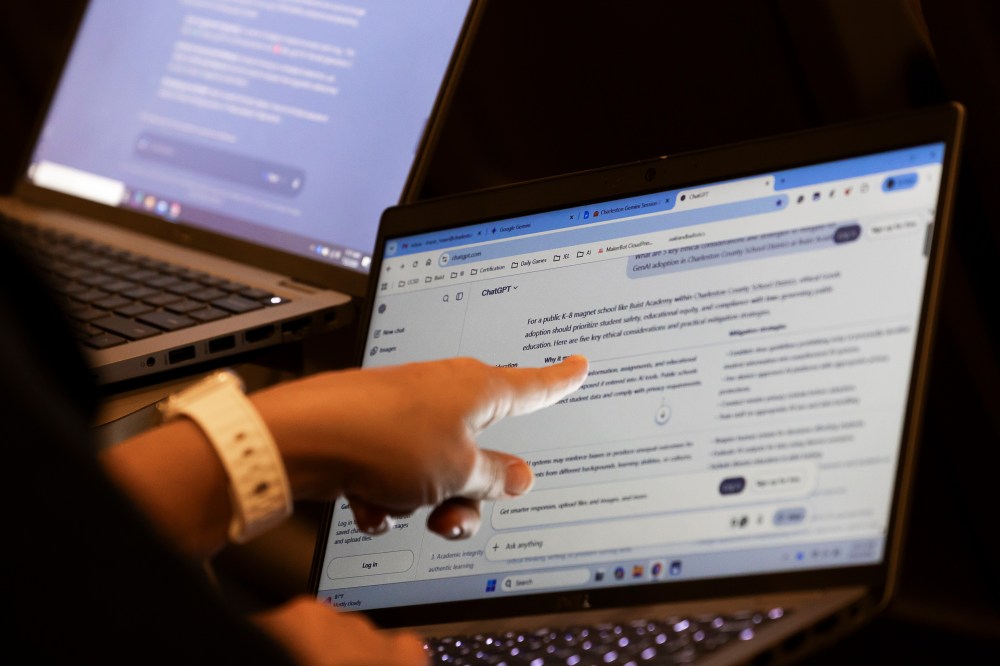
In response to a growing AI and screentime backlash, Microsoft announced last week it had agreed to adopt guardrails and privacy standards for its AI in schools, as negotiated with the American Federation of Teachers, the country’s second-largest teachers union.
The safety provisions in the agreement are meaningful, but the standards will only be effective if all AI companies, especially the tech giants, sign on, said Josh Golin, executive director of online safety nonprofit Fairplay. He said the agreement sidesteps the question of whether AI products even belong in classrooms, or at what age they should be introduced.
“I worry that a high-profile framework like this will be misunderstood and schools will think, ‘If they’re doing a good job on data privacy and safety, then that means we should be using the tool,’” Golin said.
The AFT said the agreement, which is legally binding and requires third-party audits for compliance, could set an industry standard. Two other leading AI companies, OpenAI and Anthropic, said they also were discussing safety and privacy pacts with the AFT. But Google, the dominant provider of education technology for America’s schools, has not said whether it plans to offer similar protections.
Agreement puts limits on using student data for training AI
As part of the wide-ranging agreement, Microsoft says it will not use student or educator data to train AI systems, apart from a narrow exception for data that could help protect students. It says the data it collects cannot be sold, used for advertising or used for product development.
The agreement prohibits any use of AI companions or features “designed to foster emotional attachment or dependency” and to keep students engaged for longer than a learning task requires. It also includes a range of audit and transparency measures that require the company to disclose to families, in plain language, how its tools work.
“This standard sets a high bar for child privacy and AI safety, and we’ll extend this agreement to every school district across the country,” Brad Smith, Microsoft’s vice chair and president, said in a statement. The standards will apply to all schools that Microsoft has contracts with starting Nov. 1, he said.
AFT President Randi Weingarten called the agreement the “first of its kind” and an important step to setting an industry standard in the absence of federal and state legislation on AI in schools.
“We want parents to have control of their kids’ education. We want educators to have control of kids’ education, not ed tech. And that’s what this agreement is,” Weingarten said.
She spoke at a joint news conference with Smith at the headquarters of the United Federation of Teachers, the AFT’s New York City affiliate. The headquarters is home to AFT’s National Academy for AI Instruction for teachers, which launched a year ago backed by $23 million from Microsoft, OpenAI and Anthropic.
Along with their yearlong AI moratorium, the school systems for New York City and Los Angeles plan extensive audits of their education technology contracts and AI tools, with a focus on data privacy, transparency and accountability. The ban in New York City applies to all elementary and middle school students, while in Los Angeles it extends through high school.
The teachers union also has courted Google and AI companies
Weingarten said she contacted Google directly to tell them about the agreement before making it public, in hopes the company would become a signatory.
The company has not responded to a request for comment from The Associated Press on whether it plans to offer similar protections.
“Is Google going to embrace this framework? That is a huge question,” said Golin, the online safety nonprofit chief. He noted schools also use thousands of AI-driven educational technology products produced by smaller companies.
Google found itself at the center of controversy over AI in schools when it announced in August it had turned on its Gemini chatbot for many K-12 students using Google Classroom, its learning management system. The company says Google Classroom is used by 150 million teachers and students worldwide.
Critics decried Google’s move as an escalation of the race between tech giants to make inroads in schools and win over the next generation of AI users. The AI addition to Classroom only affects schools that allow student access to its Gemini app or Gemini Notebook, but it marks a major shift. Until August, Google had only allowed Gemini to be turned on for students 18 or older.
Weingarten said she is also in talks with OpenAI and Anthropic, which both issued public praise for the agreement.
OpenAI, the maker of ChatGPT, called it an “important milestone for AI safety and privacy in schools.” The company has been working with AFT, it said in a statement, “and we look forward to finalizing our own agreement.”
Anthropic, the maker of Claude, said in a statement, “We applaud all efforts to drive responsible AI use in education.” The company said it was working with AFT to shape “a gold standard for safety and privacy.”
The standards shift the burden on privacy to companies
Experts in data privacy say the new standards could help shape the conversation that schools have with AI providers, whether a school is a Microsoft customer or not.
“What I’m hopeful about is that this takes some of the pressure off individual school districts to negotiate with large tech companies,” said Elizabeth Laird, director at the Center for Democracy and Technology. Until now, the negotiating power of schools to secure privacy protections from tech firms often depended on financial clout. “I think this standard makes progress toward not having that type of inequity across school districts.”
Laird commended the agreement for going “above and beyond” what is legally required for vendors working with schools. For instance, Microsoft has committed not to use sensitive data that many companies leverage, such as information about gender, race, age, ZIP code that can be used to identify a person even if their name is removed.
But until others sign on, Laird said, the agreement highlights how difficult it is to set AI standards in the absence of legislation. It also emphasizes that the burden of protecting student privacy should fall on tech companies — not on parents, students or schools.
Microsoft’s Smith noted that tech companies have been late to accept that.
“We all know there are important discussions and debates all across the country, about when AI should be used in schools, how it should be used, for what purpose,” Smith said. “It is our role, even our responsibility, to ensure that AI is provided in a form that teachers and kids and parents can trust.”
_____
The Associated Press’ education coverage receives financial support from multiple private foundations. AP is solely responsible for all content. Find AP’s standards for working with philanthropies, a list of supporters and funded coverage areas at AP.org.

Advertisement Advertise With Us
Advertisement Advertise With Us