NASA spacecraft discovers a huge new crater on the moon

Advertisement

Advertise with us

CAPE CANAVERAL, Fla. (AP) — Scientists have discovered a crater on the moon that's bigger than the Roman Colosseum and is the result of a powerful impact two years ago that initially went undetected.

Read this article for free:


or

Already have an account? Log in here »

To continue reading, please subscribe:

Subscribe and receive a limited-edition Free Press branded hat or tote.

Digital Subscription

One year of digital access for only $205*

  • Enjoy unlimited reading on winnipegfreepress.com
  • Read the E-Edition, our digital replica newspaper
  • Access News Break, our award-winning app
  • Play interactive puzzles

*First annual payment billed as $205.00 + GST for one year. This annual subscription will automatically renew at $233.00 + GST every 52 weeks (10% off the regular annual price of $259.35). Offer available to new and qualified returning subscribers only. Cancel any time.

To continue reading, please subscribe:

Add Free Press access to your Brandon Sun subscription for only an additional

$1 for the first 4 weeks*

  • Enjoy unlimited reading on winnipegfreepress.com
  • Read the E-Edition, our digital replica newspaper
  • Access News Break, our award-winning app
  • Play interactive puzzles
Start now

*Your next Brandon Sun subscription payment will increase by $1.00 and you will be charged $17.95 plus GST for four weeks. After four weeks, your payment will increase to $24.95 plus GST every four weeks.

CAPE CANAVERAL, Fla. (AP) — Scientists have discovered a crater on the moon that’s bigger than the Roman Colosseum and is the result of a powerful impact two years ago that initially went undetected.

The steep-sided hole — about 728 feet (222 meters) across and up to 141 feet (43 meters) deep — is the solar system’s biggest known impact crater carved out in recent times.

Such a large-scale event is estimated to occur only once every 132 years, researchers said, making this a treasure trove of information as NASA prepares to build a base for astronauts on the moon.
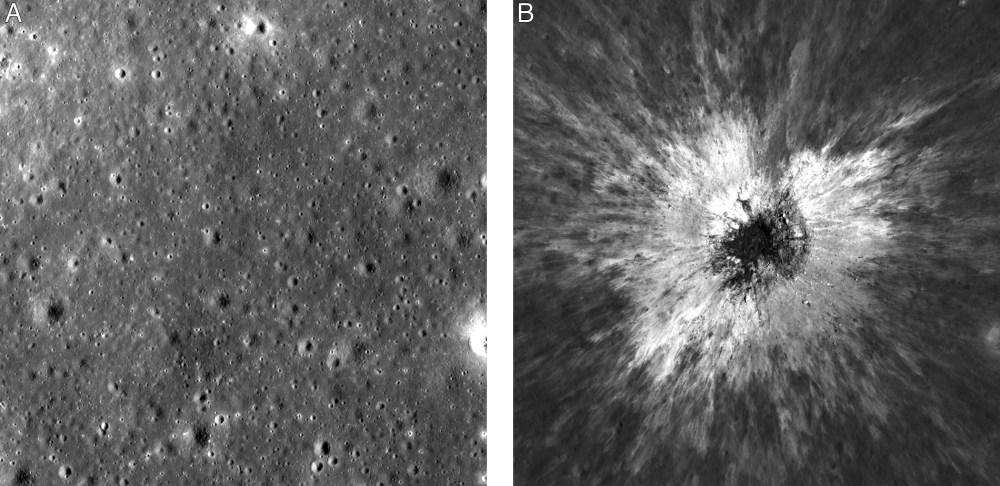
This combination of photos made by NASA's Lunar Reconnaissance Orbiter shows the same area on the surface of the moon before and after a newly-discovered crater in May 2024. (NASA/Goddard Space Flight Center/Intuitive Machines via AP)

“This event constitutes a statistically rare, effectively once-in-a-lifetime observation,” the scientists wrote in one of two studies appearing on the subject Wednesday in the journal Science Advances.

NASA’s Lunar Reconnaissance Orbiter spotted the crater on the moon’s near side in May 2024 soon after it was formed by an incoming fragment of an asteroid or comet. The moon strike escaped real-time detection by telescopes on Earth and in space.

LRO’s wide-angle images were not identified in the crush of data until August 2025. The spacecraft gathered more detailed pictures last fall, followed by confirmation of the discovery early this year.

The crater — named for the late Thomas McGetchin, a former director of Houston’s Lunar and Planetary Institute — is three times bigger than the previous record-holder found by the LRO a decade ago. Pockmarked since ancient times, the moon bears some of the solar system’s largest impact craters, including one that stretches more than 1,500 miles (2,400 kilometers) across.

This latest impact churned the lunar surface for more than 66 miles (100 kilometers). Dust and rocky soil were hurled away at a higher angle than expected, according to Mark Robinson, chief scientist for the LRO’s cameras who works at Intuitive Machines. Robinson was the lead author for one of the studies.

A separate study identified a 4-mile-wide (7-kilometer-wide) cold spot around the new crater, consistent with a loosening of the moon’s top soil. Co-author David Paige of the University of California, Los Angeles, likens it to gardening.

“We’re now thinking of impacts as a way to garden the regolith — churning the sediments and putting stuff above that’s usually below the surface,” Paige said in a statement.

The LRO’s numerous crater discoveries since its launch in 2009 show that the moon’s top inch (2 centimeters) of soil is being overturned by ejected material every 80,000 years, faster than previously thought, according to Robinson.

Contrary to the popular belief that the Apollo moonwalkers’ dusty lunar footprints will last forever, they will “definitely be long gone in that time frame,” Robinson said in an email.

The next step is to calculate the risk of ejected crater material striking NASA’s planned moon base, he added. “That information will help engineers harden structures so one won’t have to worry about damage, or maybe worry less.”

___

The Associated Press’ health and science coverage receives financial support from the AP Fund for Journalism and private foundations. AP is solely responsible for all content. Find AP’s standards for working with philanthropies, a list of supporters and funded coverage areas at AP.org.


Report Error Submit a Tip

More Stories

Sweeney’s sexist U.S. gambling-site ad isn’t the real problem

Dan Lett 5 minute read Preview

Sweeney’s sexist U.S. gambling-site ad isn’t the real problem

Dan Lett 5 minute read Yesterday at 1:33 PM CDT

Until very recently, there was no reason to connect actress and model Sydney Sweeney with online sports betting. But the degrees separating these two culture trends evaporated in short order this week.

Read
Yesterday at 1:33 PM CDT

Winnipeg, police and downtown crime

Editorial 4 minute read Preview

Winnipeg, police and downtown crime

Editorial 4 minute read Yesterday at 2:01 AM CDT

A safer downtown is not much use if people are still afraid to walk there.

That is the uncomfortable message from Winnipeg’s latest police citizen survey, and one city council should take seriously.

Downtown crime has fallen this year, according to the most recent police statistics. Violent crime is down even more. But for most Winnipeggers, the downtown still feels like a place to avoid, particularly after dark.

Only 44 per cent of survey respondents said they feel very or reasonably safe walking alone downtown during the day. At night, that number plunges to just eight per cent. Among women, it is an appalling three per cent, compared with 14 per cent of men.

Read
Yesterday at 2:01 AM CDT

Police officer faces charges of domestic assault

Free Press staff 2 minute read Preview

Police officer faces charges of domestic assault

Free Press staff 2 minute read 4:26 PM CDT

A Winnipeg police officer has been charged after police said he broke into a woman’s home and attacked her.

Police were sent to a home on Wednesday shortly before 10:20 p.m., the Winnipeg Police Service said in a Thursday news release. When officers arrived, they found the man, 20-year member in his 40s, inside a home assaulting the woman, the release said.

The man was taken into custody and the woman was given medical aid.

She told officers the man broke into the home, threatened to kill her and then attacked her.

Read
4:26 PM CDT

Manitoba abandoning spring, fall clock changes

Carol Sanders 8 minute read Preview

Manitoba abandoning spring, fall clock changes

Carol Sanders 8 minute read Updated: 5:36 PM CDT

Time’s up for the time change in Manitoba.

Manitobans won’t be setting their clocks back an hour in November. The province has decided to permanently stay on daylight time after surveying residents on the twice annual clock adjustment.

“We heard from Manitobans loud and clear — no more changing the clocks in Manitoba,” Premier Wab Kinew said in a news release Thursday.

Most of the 72,000 votes submitted in an online EngageMB survey — 92 per cent — said they would like to see the practice end. The survey asked if they preferred earlier sunrises in winter with standard time or the later sunsets in summer with daylight time. More than half of survey participants (58 per cent) indicated a preference to stay on permanent daylight time; 34 per cent voted to eliminate the time change but stay on standard time.

Read
Updated: 5:36 PM CDT

Manitobans mostly optimistic about time change

Nicole Buffie 5 minute read Preview

Manitobans mostly optimistic about time change

Nicole Buffie 5 minute read 6:47 PM CDT

Turning the page on turning back the clocks in Manitoba was met with enthusiasm — and some hesitation — Thursday.

Calling the move “perfect,” the general manager of Larters at St. Andrews Golf & Country Club said a switch to permanent standard time would have hurt men’s and women’s golf leagues.

The course could have tried to open an hour earlier, but some after-work leagues may have been forced to cancel owing to not enough daylight.

“It would get dark too early and people can’t leave work early to go play an hour earlier,” said Geoff Kehler. “It would have been really bad for the business.”

Read
6:47 PM CDT

Federal Court awards OCN $27M, 62 years after construction of hydro dam

Nicole Buffie 5 minute read Preview

Federal Court awards OCN $27M, 62 years after construction of hydro dam

Nicole Buffie 5 minute read Updated: Yesterday at 12:02 PM CDT

The Federal Court has ordered Ottawa pay Opaskwayak Cree Nation $27 million over damages suffered due to the construction of the Grand Rapids hydro dam in the 1960s.

In a decision dated Sept. 3, Federal Court Justice Sébastien Grammond says the federal government had a fiduciary duty to protect the community from the impacts of the dam.

“When the Crown exercises a discretionary power over an Indigenous interest, it has a fiduciary duty and it must exercise the discretion in the best interests of the Indigenous group,” the ruling said. “Canada breached its fiduciary duty to OCN because it approved the (project) without ensuring that the impacts of the Grand Rapids dam on OCN’s traditional way of life were mitigated or compensated.”

The First Nation took the federal government to court in February over impacts on the community after the dam, located about 145 kilometres southeast of Opaskwayak Cree Nation, was installed on the Saskatchewan River in 1964. The case was heard over 14 days in a judge-alone trial in Winnipeg.

Read
Updated: Yesterday at 12:02 PM CDT