Anthropic says its model Claude is helping to build the next version of itself

Advertisement

Advertise with us

Anthropic's Claude is helping the company develop the next, more intelligent version of the model, the artificial intelligence lab said in an announcement Thursday.

Read this article for free:


or

Already have an account? Log in here »

To continue reading, please subscribe:

Subscribe and receive a limited-edition Free Press branded hat or tote.

Digital Subscription

One year of digital access for only $205*

  • Enjoy unlimited reading on winnipegfreepress.com
  • Read the E-Edition, our digital replica newspaper
  • Access News Break, our award-winning app
  • Play interactive puzzles

*First annual payment billed as $205.00 + GST for one year. This annual subscription will automatically renew at $233.00 + GST every 52 weeks (10% off the regular annual price of $259.35). Offer available to new and qualified returning subscribers only. Cancel any time.

To continue reading, please subscribe:

Add Free Press access to your Brandon Sun subscription for only an additional

$1 for the first 4 weeks*

  • Enjoy unlimited reading on winnipegfreepress.com
  • Read the E-Edition, our digital replica newspaper
  • Access News Break, our award-winning app
  • Play interactive puzzles
Start now

*Your next Brandon Sun subscription payment will increase by $1.00 and you will be charged $17.95 plus GST for four weeks. After four weeks, your payment will increase to $24.95 plus GST every four weeks.

Anthropic’s Claude is helping the company develop the next, more intelligent version of the model, the artificial intelligence lab said in an announcement Thursday.

Claude is leading 26% of Anthropic’s model research and development, which the company said means it can complete most of a given task “end-to-end from a high-level prompt” while still being under human supervision. The model is not yet working completely autonomously.

Still, about 90% of the company’s research and development is done in “collaboration” with Claude, which Anthropic said means the model can do “large chunks of work under close human direction.”
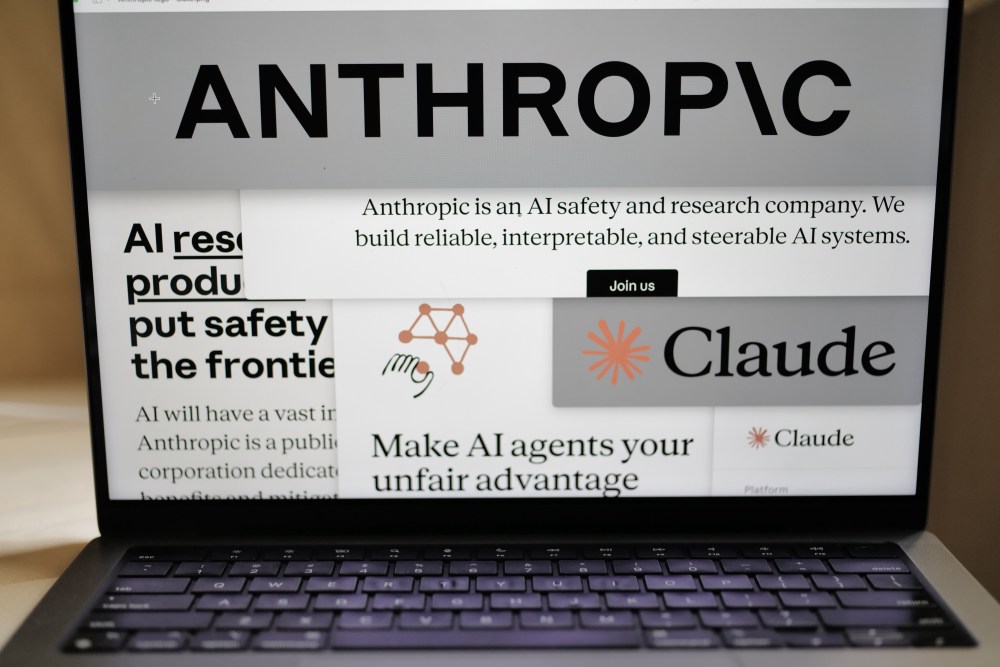
FILE - Pages from the Anthropic website and the company's logos are displayed on a computer screen in New York, Feb. 26, 2026. (AP Photo/Patrick Sison, File)

The announcement came as some leading figures in AI, led in large part by Anthropic CEO Dario Amodei, are calling for a slowdown in the technology’s development over safety concerns.

As leaders consider pacing AI’s development, “we should do everything possible to minimize the gap between what frontier labs know and what the public knows,” the company said in a blog post. “This means better measuring the development of AI, reporting on it publicly, and giving society an opportunity to decide how to use this information.”

The company said that models accelerating their own development could make it “more challenging for humans to understand or control these systems.” It argued that sharing these metrics could lead to better understanding of how close leading AI labs are to reaching recursive self-improvement, or a model’s ability to autonomously build its successor.

Anthropic also urged other AI developers to share similar metrics on a regular basis, encouraging the use of a public methodology so the numbers could be compared over time, and potentially across labs.

It was unclear from Anthropic’s disclosure how close the company believes it is to achieving recursive self-improvement, but the pace at which Claude has increasingly contributed to research and development is notable. The portion of work Claude “leads,” or does in large part while remaining under human supervision, was none in February. Six months later, it was leading a quarter of research and development work, reaching that benchmark in August.

The company also shared details of agent oversight measures it has in place, noting that there were approximately 30,000 agents doing research and engineering work as of August. Oversight measures are crucial for seeing how often agent misbehavior is detected by monitoring systems, the company said. Anthropic recently committed to setting up external third-party evaluators who will be embedded within the company to monitor safety efforts.

An Anthropic researcher kicked off much of the recent dialogue around AI safety when he resigned last week with a dire warning about the threats the technology poses to humanity. Amodei, OpenAI CEO Sam Altman, Elon Musk and other tech leaders have since supported the idea of slowing down development, but other tech leaders and President Donald Trump have pushed back.


Report Error Submit a Tip

More Stories

Klein has burned bridges with PM, Gillingham says

Joyanne Pursaga 3 minute read Preview

Klein has burned bridges with PM, Gillingham says

Joyanne Pursaga 3 minute read Yesterday at 5:51 PM CDT

One mayoral candidate accused another of writing a column so critical it could compromise his ability to work with the federal government.

Read
Yesterday at 5:51 PM CDT

Near-future U.S. the setting for surreal dual-world storyline

Reviewed by Morley Walker 4 minute read Preview

Near-future U.S. the setting for surreal dual-world storyline

Reviewed by Morley Walker 4 minute read 2:01 AM CDT

It’s not every day you encounter a seriously intended literary novel that attempts to dramatize a mind-bending physics theory like quantum entanglement.

But then the B.C.-born-and-raised Emily St. John Mandel is not your everyday Canadian literary writer.

In her late 40s, she has lived in the U.S. for her entire writing career. She is best known for her 2014 dystopian novel Station Eleven, about a Shakespearean acting troupe navigating a pandemic-ravaged America.

Her new outing, her seventh, Exit Party, shares DNA with detective and sci-fi genres more than with conventional literary fiction.

Read
2:01 AM CDT

Puzzles Palace

1 minute read Monday, Jul. 27, 2026

To solve our puzzles, please subscribe with this special offer: |

A life’s story: activist, educator, organizer knew the true meaning of community

Janine LeGal 7 minute read Preview

A life’s story: activist, educator, organizer knew the true meaning of community

Janine LeGal 7 minute read 3:00 AM CDT

Somewhere between a love for sharing stories and a love of community connections, Michael (Mike) Maunder lived his life. Giving voice to people and neighbourhoods was a passion for the natural-born community organizer.

An author, teacher and principal, Maunder lived in a one-bedroom apartment in West Broadway and devoted himself to community development, education and neighbourhood renewal.

He maintained a connection with Augustine United Church, whose commitment to social justice he appreciated, volunteered at the Sandy-Saulteaux Spiritual Centre, and found comfort in a Buddhist prayer community.

Maunder died on July 15 at the age of 80.

Read
3:00 AM CDT

Give-and-take relationship of Roman leaders takes centre stage in Harris’s historical fiction

Reviewed by Kathryne Cardwell 4 minute read Preview

Give-and-take relationship of Roman leaders takes centre stage in Harris’s historical fiction

Reviewed by Kathryne Cardwell 4 minute read 2:01 AM CDT

British novelist Robert Harris’s latest work is a reflection on tyranny, corruption and betrayal among all-powerful political leaders.

You might be forgiven for thinking it’s a contemporary thriller — it’s actually historical fiction set in ancient Rome.

A former BBC journalist, Harris debuted as a novelist in 1992 with Fatherland, an alternative history where Nazi Germany won the Second World War.

Since then, the prolific author has become best-known for his works of historical fiction, especially his ancient Rome trilogy released from 2006-2015 and the novel Conclave, which was published in 2016 and was made into the film of the same name in 2024.

Read
2:01 AM CDT

Grieving child builds backyard rocket ship

Harriet Zaidman 4 minute read 2:01 AM CDT

I Built a Rocket Ship (Kids Can Press, 32 pages, hardcover, $22) by Winnipegger Anna Lazowski is a tender story for children ages 4-8 about a little girl trying to make sense of her mother’s death. The child engages in conversation with her late mom, agreeing and disagreeing about things said as she carries objects (and of course, the cat) to the backyard. There, she is building a rocket ship she will pilot into the skies to find her mom again.

Jennica Lounsbury’s varied perspectives show the range of emotions the little girl experiences.

● ● ●

Northwoods Lullaby by Mary Casanova (University of Minnesota Press, 32 pages, hardover, $25) is a bedtime book for readers up to age eight, perfect to bring a busy, happy day to a close. Just like children who are listening to adults reading the book, all the animal babies are being tucked into their nests and burrows by loving parents: “Thump and scamper,/nimble clover./ Soon it’s time to rest. Baby loon/ nestles in/as Papa floats along.”