Doctors warn seniors about multiple meds
Treatments for a wide variety of conditions can open the door to negative drug interactions
Advertisement
Read this article for free:
or
Already have an account? Log in here »
To continue reading, please subscribe:

Digital Subscription
One year of digital access for only $205*
- Enjoy unlimited reading on winnipegfreepress.com
- Read the E-Edition, our digital replica newspaper
- Access News Break, our award-winning app
- Play interactive puzzles
*First annual payment billed as $205.00 + GST for one year. This annual subscription will automatically renew at $233.00 + GST every 52 weeks (10% off the regular annual price of $259.35). Offer available to new and qualified returning subscribers only. Cancel any time.
To continue reading, please subscribe:
Add Free Press access to your Brandon Sun subscription for only an additional
$1 for the first 4 weeks*
- Enjoy unlimited reading on winnipegfreepress.com
- Read the E-Edition, our digital replica newspaper
- Access News Break, our award-winning app
- Play interactive puzzles
*Your next Brandon Sun subscription payment will increase by $1.00 and you will be charged $17.95 plus GST for four weeks. After four weeks, your payment will increase to $24.95 plus GST every four weeks.
Read unlimited articles for free today:
or
Already have an account? Log in here »
Hey there, time traveller!
This article was published 15/10/2019 (2546 days ago), so information in it may no longer be current.
Rick Simpson needs his drugs.
His medication for Parkinson’s disease, that is.
Without taking it to boost levels of the neurotransmitter dopamine in his brain, the 67-year-old retired public servant struggles to move.
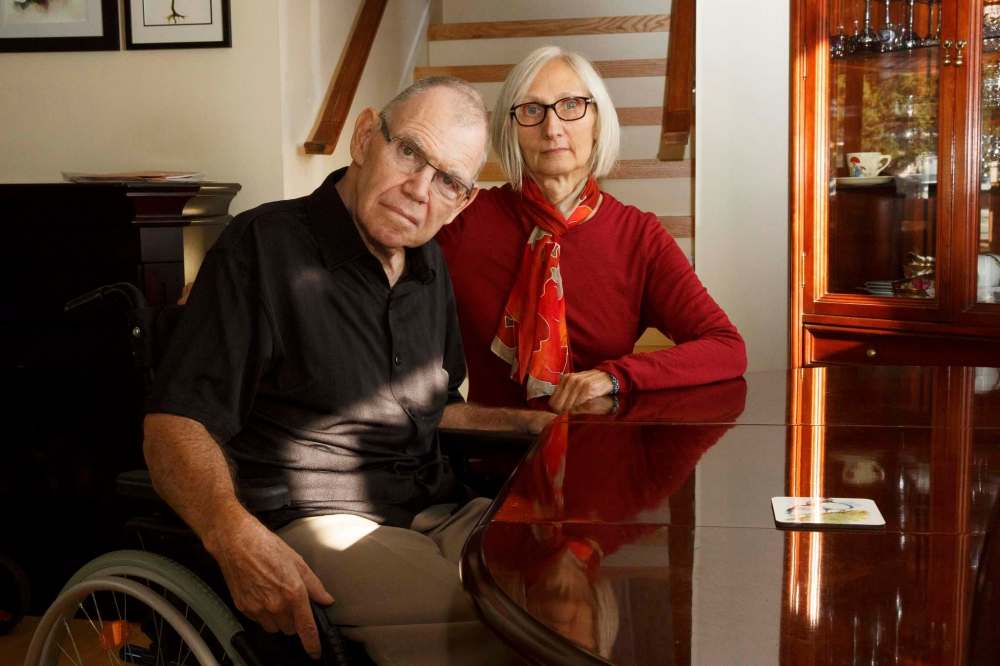
His muscles become rigid, his balance wobbly and his limbs often cold to the touch.
“Especially first thing in the morning, it takes him five minutes to get out of bed because his feet don’t move,” says his wife and caregiver, Bette Palmquist, 63.
His medication is beneficial, but it is also time-sensitive.
If he misses a dose, the symptoms quickly return.
What’s more, the Parkinson’s medication, levodopa, is often taken several times daily.
So missing a dose can happen easily, particularly when the responsibility falls on patients who often experience clouded thinking, one of the illness’s common symptoms.
That’s one reason why Parkinson Canada launched a campaign called Act on Time — a resource for patients, caregivers and health-care providers to better manage medication needs.
Lorri Apps, managing director of Parkinson Canada in Manitoba, says timely doses of levodopa greatly reduce symptoms and improve quality of life.
But the campaign addresses other equally important issues, including one extending beyond patients with the illness.
And that’s the challenge of drug management, or more precisely polypharmacy — taking multiple drugs for multiple conditions.
“We’ve long recognized this as an issue and spent two years developing this program so people with Parkinson’s aren’t running into issues with… contradictory medications.”
This problem, however, applies to more Canadians than the approximately 55,000 who live with Parkinson’s.
A 2018 study by Canadian Institute for Health Information found two in three Canadians age 65 and older take at least five different medications, while one in four take at least 10, putting them at higher risk for negative drug interactions and other unwanted side effects.
“There’s a lot of polypharmacy going on,” says Dr. Barry Campbell, medical director of the geriatric psychiatry program at St. Boniface Hospital.
“Elderly people represent about 15 per cent of the population, and yet they’re taking about 30 per cent of the medication.”
Campbell, a geriatric psychiatrist who treats dementia patients, says many individuals he works with suffer from multiple health problems and consequently may take many different medications.
That can lead to patients and caregivers struggling to manage medications, ensuring they are taken at the right time, as well as understanding how one drug can potentially negatively affect another.
Although Campbell is quick to note prescription drugs are beneficial, as meds are layered on top of one another, doctors and patients must ask whether more is indeed better.
Jamie Falk, a clinical pharmacist and an assistant professor of clinical family medicine at the University of Manitoba, also has concerns about rising polypharmacy among seniors.
Falk is among many health-care experts who belong to the Canadian Deprescribing Network, which aims to ensure Canadians take only medications they truly need.
He notes individuals most at risk of over-medication are those with serious illnesses — such as Parkinson’s or dementia — who are often of advanced age and have other conditions treated with medications.
“Part of the problem is we have different clinical practice guidelines for each condition,” he says, adding these protocols are often developed “in silos.”
Consequently, patients might receive a drug for Parkinson’s, which they need, along with medications to prevent heart attack and stroke, for example.
Yet science supporting preventive medication often pertains to long-term health problems, and these drugs may be less beneficial for an elderly patient facing a shorter lifespan compared with the general population, Falk says.
But the potential negative side effects from these meds — which may include dangerously low blood pressure and blood glucose — may be more concerning, he argues.
That’s because these conditions cause dizziness, which can lead to falls, and among seniors falls are the leading reason for hospitalization, according to the Canadian Deprescribing Network.
And the prognosis is often dire.As many as 30 per cent of people who fracture a hip — the most common break from a fall — die within a year, the organization says.
Falling is indeed a going concern for patients of Dr. Sean Udow, co-director of the Movement Disorder Clinic, which treats Manitobans with Parkinson’s.
“People with Parkinson’s are naturally prone to low blood pressure when they stand, and if you don’t get enough blood to the brain, you faint.”
Additionally, levodopa lowers blood pressure while, at the same time, patients may be taking blood pressure-lowering medications, prescribed by another doctor long before the Parkinson’s diagnosis.
Udow says eChart Manitoba helps eliminate the problem of contraindicating medications, an online database of prescribed medications for every Manitoban.
But information is limited. “All you know is the prescription has been filled.”
Consequently, a discussion with patients about medications is critical, Udow says, adding he frequently deprescribes drugs treating high blood pressure for Parkinson’s patients.
He further notes much of the “quarterbacking of care” is done by family doctors, often challenged for time and resources to get the full picture of patients’ treatment plans.
Recognizing this, the health region and the province have moved toward a multidisciplinary approach for individuals with chronic illness. Over the past few years, for instance, the Winnipeg Regional Health Authority’s My Health Teams initiative has brought together family doctors, occupational therapists, nurse practitioners, social workers and specialists to provide multidisciplinary care for about 261,000 people.
Among their roles is a drug review assessing affordability, dosage and even whether to deprescribe, writes Doug Thidrickson, clinical pharmacist with My Health Team in an email to the Free Press.
Under care of a team or not, Udow and others advise patients and their families to be proactive.

“Stay informed, ask your doctors questions, bring lists of the medications… and concerns, and bring a family member or friend,” he says.
Certainly, Simpson and Palmquist abide by that advice now more than ever after Simpson recently fell, broke his hip and spent many weeks in hospital.
“After he got out, his family doctor looked at his medications and cancelled everything except the Parkinson’s medication,” Palmquist says, adding among those prescriptions was blood pressure medication.
“She said, ‘It just gets too complicated, and you probably don’t even need this stuff anymore.’ So our life is much, much simpler nowadays.”
joelschles@gmail.com