Sound affects
Soothing noises of nature can amplify well-being

Advertisement
Read this article for free:
or
Already have an account? Log in here »
To continue reading, please subscribe:

Digital Subscription
One year of digital access for only $205*
- Enjoy unlimited reading on winnipegfreepress.com
- Read the E-Edition, our digital replica newspaper
- Access News Break, our award-winning app
- Play interactive puzzles
*First annual payment billed as $205.00 + GST for one year. This annual subscription will automatically renew at $233.00 + GST every 52 weeks (10% off the regular annual price of $259.35). Offer available to new and qualified returning subscribers only. Cancel any time.
To continue reading, please subscribe:
Add Free Press access to your Brandon Sun subscription for only an additional
$1 for the first 4 weeks*
- Enjoy unlimited reading on winnipegfreepress.com
- Read the E-Edition, our digital replica newspaper
- Access News Break, our award-winning app
- Play interactive puzzles
*Your next Brandon Sun subscription payment will increase by $1.00 and you will be charged $17.95 plus GST for four weeks. After four weeks, your payment will increase to $24.95 plus GST every four weeks.
Read unlimited articles for free today:
or
Already have an account? Log in here »
Hey there, time traveller!
This article was published 19/04/2021 (1990 days ago), so information in it may no longer be current.
It’s no secret that being in nature is good for you. Walking in a park boosts your well-being, sunlight can put an extra spring in your step and being near water can be ever-so-calming.
But it’s not just what you see that impacts your health — new research shows even the sounds of nature are good for you.
In a recently-published paper in Proceedings of the National Academy of Sciences, scientists found that listening to nature-made noise, such as birds chirping and rain falling, may decrease pain and stress, improve cognitive function and enhance your mood.

For years, evidence has suggested that spending time outdoors in nature is good for our health. This research was typically done from a visual perspective.
For people with varying forms of vision impairment, the sounds of nature have long been linked to both gratification and rejuvenation.
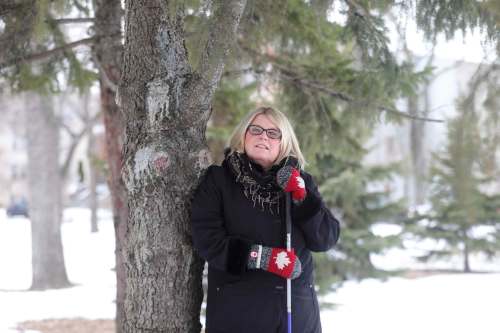
Doris Koop is executive director of the Vision Impaired Resource Network (VIRN), a Winnipeg-based not-for-profit organization that offers peer support, mentoring and training to people who are vision impaired. She has been vision impaired since birth.
“Natural sound is of great significance to me and the community who come to VIRN. It helps put a smile on your face when you hear the sounds of nature,” Koop says.
Koop is legally blind with about five per cent vision in her right eye and about three per cent in her left. She had several surgeries when she was young to help correct her vision to the point where she could wear glasses. Although her glasses help, they’re not enough for her to be able to drive a car or read a newspaper.
“Sounds play a huge part in me navigating both indoors and outdoors. I honestly don’t think about how much it plays a part until I have to cross a street and listen for vehicles. The sounds help me feel more comfortable as to where I am,” she says. “I always tell people that my saving grace is that I have very good colour definition.”
According to the 2017 Canadian Survey on Disabilities, 1.5 million Canadians 15 years of age or older have vision impairment.
It has long been thought that individuals who lose one of their senses will gain enhanced abilities in another, especially if that sense is lost early in life. Even back in the 18th century, philosopher Denis Diderot wrote about a blind mathematician who could distinguish real coins from fake ones just by touching them.
“I would like to say, yes, that people who lose their vision or are born with a vision impairment gain more enhanced sensitivity to hearing or other senses. But it is not the case,” Koop says. “What happens is we learn how to use our other senses to help us navigate our surroundings or we use them to distinguish what is around us.”
Koop agrees that it may appear as though people who are vision impaired have heightened senses.
“But the truth is we have just learned how to do our best with what we have. And we help others do the same,” she says. “There are some individuals that have amazing hearing and they have trained themselves to get around through sounds that bounce off surfaces and they do a great job. But that is pretty rare and unique.”
Koop stresses the need to build confidence in people who are vision impaired so they can lead fully inclusive and productive lives.
“It’s so important for us to help others understand that we are pretty much the same as everyone else, we just have to do some things a little differently,” she says.
The community at VIRN has a very hands-on experience when it comes to the sounds of nature, Koop says.
“We (VIRN) love to get outdoors,” she says. “We have several active-living programs like cycling, paddling, city descriptive walking tours, voyageur boat rides and a few visits each year to FortWhyte Alive to do ‘Birding by Ear.’”
Why people respond well to certain sounds isn’t totally clear, but there are some theories. It’s possible that we’re drawn to water because of the critical role it plays in survival, the researchers wrote, so knowing we’re near a water source has calming effects.
The experts also point out water features are often used in landscapes to mask noise and make urban greenspaces more pleasant.
“I’m so intrigued by the sound of water and all the sounds it creates. I’m searching for just the right water fountain sound to put in my backyard. My favourite nature sounds are gentle waves of water on the shore.”– Doris Koop, executive director of the Vision Impaired Resource Network (VIRN)
“I’m so intrigued by the sound of water and all the sounds it creates. I’m searching for just the right water fountain sound to put in my backyard,” Koop says. “My favourite nature sounds are gentle waves of water on the shore.”
Many of us also consider nature sounds to be less threatening than the clatter of human-made noise.
“The sounds of nature have long generated powerful reactions in human beings,” writes Rachel Buxton, one of the study’s lead authors and a research associate in the department of biology at Carleton University in Ottawa. “Sounds confer a sense of place, connect people to nature and increasing evidence suggests that natural sounds are important for human health and well-being.”
Research in a growing scientific field called ecotherapy has shown a strong correlation between time spent in nature and reduced anxiety and depression. And interacting with natural spaces also offers other therapeutic benefits — calming nature sounds and even outdoor silence can lower blood pressure and stress levels.
The study research team also analyzed sounds collected at 68 national parks across the U.S. These parks have some of the most immaculate soundscapes and can bolster public health, they say.
But parks need to be protected from interfering noise caused by surrounding urban areas.
The authors believe their research suggests preserving national parks and their natural soundscapes benefit both ecosystem conservation and public health.
“Soundscape” is a term coined by Canadian composer R. Murray Schafer, who also authored a book about it — it’s our sonic environment. He explains that soundscape is the extensive collection of noises with which we all live. Starting with the earliest sounds of nature, Schafer says that we have continuously experienced a growing complexity of our sonic surroundings.
The research study also sheds light on which sounds produce specific benefits. For example, soundscapes that included birds had the largest effect on lowering stress and annoyance while water sounds elicited positive emotions.
“When the weather is nice, I get up in the morning and usually do a walk around my yard to check how everything is doing and then sit and listen for my favourite chirping of robins,” Koop says.
Buxton notes the irony of conducting the study when so many people have been cooped up inside and dealing with increased stress.
“In so many ways, the COVID-19 pandemic has emphasized the importance of nature for human health.”– Rachel Buxton, research associate in the department of biology at Carleton University
“In so many ways, the COVID-19 pandemic has emphasized the importance of nature for human health,” she writes. “As traffic has declined during quarantine, many people have connected with soundscapes in a whole new way — noticing the relaxing sounds of birds singing just outside their window. How remarkable that these sounds are also good for our health.”
The research also comes at a time when experts say the pandemic is escalating a mental health crisis with a growing number of people reporting depression and anxiety.
Over the last year, Koop says the vision impairment community, like so many others, is feeling isolated and spending more time indoors.
“VIRN spends a great deal of time talking about ways to just get outside and go for a walk to relieve that heavy closed-in feeling. We have to be creative as it isn’t always easy for everyone but we know it really helps,” she says.
But you don’t need to go camping or hiking to reap the benefits of nature. While working from home, you could even open your windows to hear birds singing or take a moment to be quiet and give your brain a refresher.

“When I have had a stressful day or I need to calm myself down, I find going outdoors makes everything so much better,” Koop says.
Pandemic monotony is real, particularly now, as lockdowns drag on. Creating that everyday outdoor habit can help you feel more relaxed and rejuvenated.
Checking in with Mother Nature not only gives you and your mind a mental escape, it also surrounds you with natural sounds, smells and a change in temperature — all things that can offer a much-needed mental refresher.
sabrinacarnevale@gmail.com
@SabrinaCsays
Sabrina Carnevale is a freelance writer and communications specialist, and former reporter and broadcaster who is a health enthusiast. She writes a twice-monthly column focusing on wellness and fitness.
Our newsroom depends on a growing audience of readers to power our journalism. If you are not a paid reader, please consider becoming a subscriber.
Our newsroom depends on its audience of readers to power our journalism. Thank you for your support.
Sabrina Carnevale is a freelance writer and communications specialist, and former reporter and broadcaster who is a health enthusiast. She writes a twice-monthly column focusing on wellness and fitness.
Our newsroom depends on a growing audience of readers to power our journalism. If you are not a paid reader, please consider becoming a subscriber.
Our newsroom depends on its audience of readers to power our journalism. Thank you for your support.
Advertisement Advertise With Us
Advertisement Advertise With Us