An album in search of Earth Day hope
Eco-artist Sam Baardman will showcase his new music, photos and videos
Advertisement
Read this article for free:
or
Already have an account? Log in here »
To continue reading, please subscribe:

Digital Subscription
One year of digital access for only $205*
- Enjoy unlimited reading on winnipegfreepress.com
- Read the E-Edition, our digital replica newspaper
- Access News Break, our award-winning app
- Play interactive puzzles
*First annual payment billed as $205.00 + GST for one year. This annual subscription will automatically renew at $233.00 + GST every 52 weeks (10% off the regular annual price of $259.35). Offer available to new and qualified returning subscribers only. Cancel any time.
To continue reading, please subscribe:
Add Free Press access to your Brandon Sun subscription for only an additional
$1 for the first 4 weeks*
- Enjoy unlimited reading on winnipegfreepress.com
- Read the E-Edition, our digital replica newspaper
- Access News Break, our award-winning app
- Play interactive puzzles
*Your next Brandon Sun subscription payment will increase by $1.00 and you will be charged $17.95 plus GST for four weeks. After four weeks, your payment will increase to $24.95 plus GST every four weeks.
Read unlimited articles for free today:
or
Already have an account? Log in here »
Hey there, time traveller!
This article was published 15/04/2023 (1264 days ago), so information in it may no longer be current.
For 53 years, Earth Day has served as a reminder to commit time and resources to looking after and protecting our environment. One billion people mark the annual event on April 22 with a wide range of activities co-ordinated among countries around the world.
For more than 30 years, Sam Baardman has been bringing local attention to climate change and other environmental issues, while exploring the power and beauty of nature through his music and art.
The Winnipeg-based singer-songwriter and visual artist will release his fourth full-length album, a collection of eco-songs, and headline a full-band show at the West End Cultural Centre on April 22, complementing this year’s Earth Day theme of Invest in Our Planet.

RUTH BONNEVILLE / WINNIPEG FREE PRESS
‘What does hope mean in today’s world?’ asks Sam Baardman. ‘It has something to do with being open to the mystery of things, being able to change in ways that we can’t predict.’
After a long stint in academia, Baardman decided to put his art first. In the late ’90s he released his first two albums, which included songs that aimed an environmental lens on issues such as the destruction of the Amazon forest, acid rain and the ozone layer.
“Any observer of the human condition has to take into account our situation, how we are situated in this big beautiful world that we are living in,” says Baardman, who has been engaged in ecological artmaking for many years.
The human impact of environmental issues became even more central to Baardman’s life when in 2006, while living on the Red River, he co-founded the River on the Run Artist Collective, a group of visual artists and poets working together to address the global water crisis.
“We started to talk about the degradation of the river basin and, by extension, Lake Winnipeg. We spend all of our time mostly talking about water issues and making art. We all use different art forms, operating collectively and collaboratively,” explains Baardman, adding that the collective has exhibited environmental art via public installation, non-traditional settings and art galleries.
A near-death experience a few years ago fuels Baardman’s desire to connect with the natural world. While walking along the Red River in January, he fell through the ice.
“I think about hearing the ice crack,” he recalls. “It was -20 C. I went down through the ice like a sack of potatoes. My arms went out. I was dangling in a hole in the ice; the force of the river was unimaginable. I was hyperventilating. The current was so fast. I knew that I was dead in that moment. That’s it, I’m finished.
“By some miracle I pushed up and the edges of the ice held. I came out of the hole like a seal; I kind of rolled to the bank. I took my frozen body back home and my thoughts would wander. I needed to do something.”
A week later Baardman went to Lake Winnipeg alone in the elements with his camera and set the shutter to fire every 10 seconds. Stepping in front of the camera, naked and vulnerable, he created a range of self-portraits resulting in his series titled Immersion.
“It brought me to a new place of coming to terms with nature, in a different kind of relationship with the natural world, a personal reconciliation,” he says. “I think what I was really trying to do was immerse myself in nature. I wanted a radical kind of contact, a completely culture-free meeting between myself as a human and the natural world that I lived in.
“It was about changing my relationship at a deeply emotional level.”
In early 2020, Baardman, still in his 50s at the time, had a stroke that left him barely able to walk, and unable to make music.
Determined to recover, he found his way back to music and art over the next year, writing new lyrics and continuing to advance the conversations about how to better care for our planet.
RUTH BONNEVILLE / WINNIPEG FREE PRESS
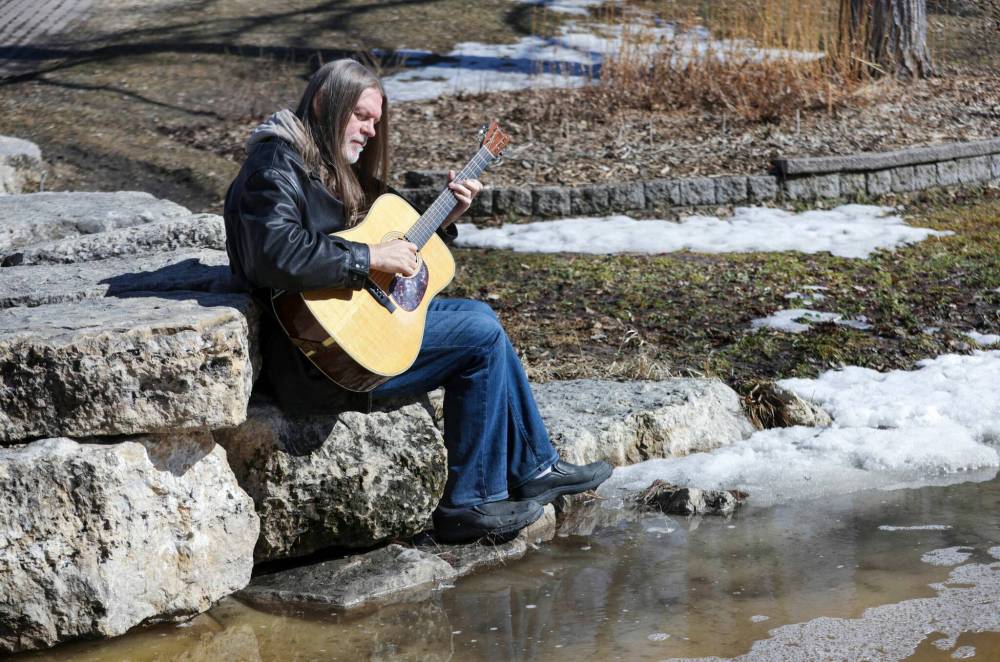
“Hopefully, I can write about those things poetically that get people to maybe see those issues in ways they haven’t seen them before, question what they think they know, activate an emotional and intellectual response at the same time,’ says Sam Baardman, next to the creek at Kildonan Park.
Last year, while exhibiting and performing at an Art, Activism and Advocacy conference, Baardman met with a scientist from Global Water Futures (GWF), a university-based program involving hundreds of researchers who are studying the effects of climate change on water systems across the world.
“GWF had collaborated with environmental artists in the past, and they arranged for me to spend two weeks last October at the Coldwater Laboratory in the Rockies, as well as northern Saskatchewan, to speak with scientists about their climate-related work,” Baardman says.
“I travelled with GWF scientists to their observatories atop mountains, deep inside alpine forests, up on a glacier, and onto the northern Prairie. It was an extraordinary experience. They can see this crisis more clearly than any of us and they understand more deeply than anyone what trouble we are in.”
The result of that experience is Baardman’s new album, Athabasca, which includes songs that celebrate nature, and others that deal with over-consumption, climate change and our addiction to immediate gratification.

“The title track was written after climbing the fast-disappearing Athabasca Glacier with Dr. John Pomeroy, the director of GWF and one of the world’s leading hydrologists. Dr. Pomeroy is Canada Research Chair in water resources and climate change and he gave me an amazing inside view of the state of climate science and the state of our dying glaciers.
“We are killing the life-support systems of the planet and, quite frankly, we don’t really know what there is to do about that. This causes a deep hopelessness and cynicism, anger, sorrow, mourning and all of those emotions.
“I think we need to maintain hope; hope is different than naive optimism,” he says. “What does hope mean in today’s world? I think it simply means that it’s what we hang onto in order to keep going. It has something to do with being open to the mystery of things, being able to change in ways that we can’t predict.
“Hopefully, I can write about those things poetically that get people to maybe see those issues in ways they haven’t seen them before, question what they think they know, activate an emotional and intellectual response at the same time.”
The Earth Day show will also feature some of Baardman’s videography and photography work.