‘She’s an inspiration’
Barbie collector looking forward to film

Advertisement
Read this article for free:
or
Already have an account? Log in here »
To continue reading, please subscribe:
Digital Subscription
One year of digital access for only $1.44 a week*
- Enjoy unlimited reading on winnipegfreepress.com
- Read the E-Edition, our digital replica newspaper
- Access News Break, our award-winning app
- Play interactive puzzles
*Billed as $5.77 plus GST every four weeks. After 52 weeks, price increases to the regular rate of $19.95 plus GST every four weeks. Offer available to new and qualified returning subscribers only. Cancel any time.
To continue reading, please subscribe:
Add Free Press access to your Brandon Sun subscription for only an additional
$1 for the first 4 weeks*
- Enjoy unlimited reading on winnipegfreepress.com
- Read the E-Edition, our digital replica newspaper
- Access News Break, our award-winning app
- Play interactive puzzles
*Your next Brandon Sun subscription payment will increase by $1.00 and you will be charged $17.95 plus GST for four weeks. After four weeks, your payment will increase to $24.95 plus GST every four weeks.
Read unlimited articles for free today:
or
Already have an account? Log in here »
Hey there, time traveller!
This article was published 20/07/2023 (1192 days ago), so information in it may no longer be current.
She’s been a pilot and an aerobics instructor. A nurse, a robotics engineer, a video game developer, a ballerina, a veterinarian and even a NASCAR driver, to name just a few of the jobs she’s held.
In her 64 years her hair has been coiffed into countless styles and shades, her figure shaped and reshaped into at least nine body types, in approximately 35 skin tones.
In 1965, four years before Neil Armstrong, she “walked on the moon” and in February 2022, she went to space for real, when she visited the International Space Station (ISS) to tour a plant-growth facility with NASA astronauts.
MIKAELA MACKENZIE / WINNIPEG FREE PRESS
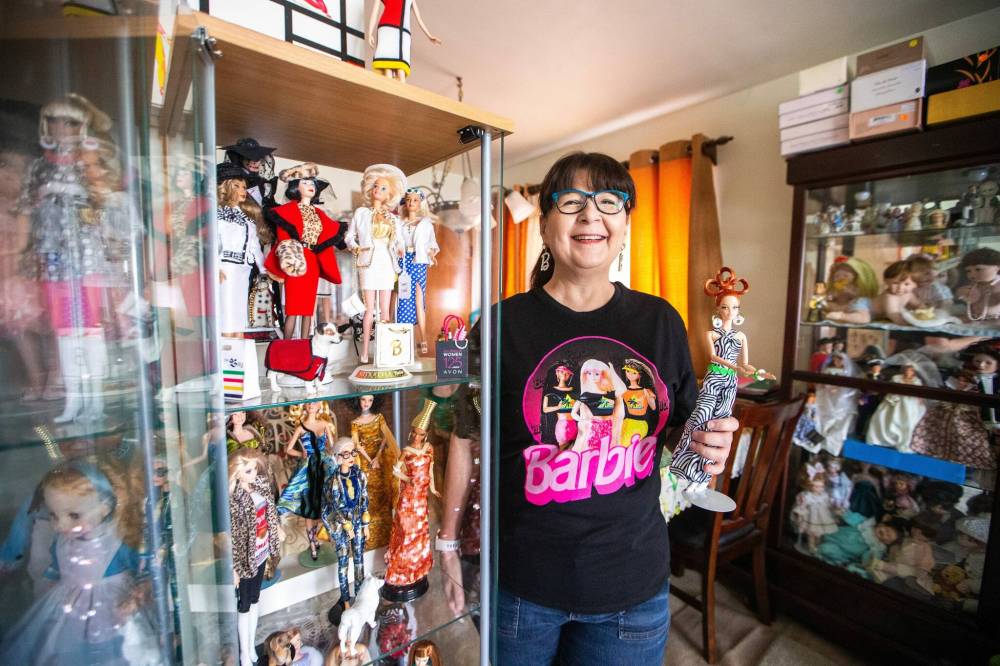
Lucy Cook, president of the Manitoba Dolls Club, has a special connection to Barbie.
Barbara Millicent (Barbie) Roberts is quite the woman — and that’s why Lucy Cook has always loved her.
“I think she keeps up with the times,” says Cook, who is in her 60s. “She made girls aware that they could be anything they wanted to be if they put their mind to it. I feel like she’s an inspiration.”
Cook’s first ever Barbie, which she received as a Christmas present, was actually a Midge doll, Barbie’s best friend.
“I would have been about four or five and it must have been Christmas,” she says. “I usually got a new doll then and it was out under the tree. My older sister Janet would have got the Barbie and I would have got Barbie’s best friend.”
The doll has had her fair share of controversy.
There was the “Math class is tough” 1992 Teen Talk Barbie, the 1963 babysitter Barbie, complete with diet book titled Don’t Eat, and the more recent drama when the 2010 sticker book featuring Computer Engineer Barbie showed her downloading a computer virus, ultimately having to seek help from the “boys.”
Once considered an anti-feminist doll peddling oppressive expectations of women, today’s Barbie has expanded her world to embrace the diversity of modern life.
Not one toy has had as many iterations or gone through as complete an image overhaul as Barbie has.
For Cook, Barbie has always been a comfort. As a youngster, the dolls made her feel safe because often, especially at night, her home was filled with fighting and domestic violence.
“My father battled alcoholism for most of his life,” she recalls. “As a small child, there was not much I could do when my parents fought, other than cower in my bed and look at my dolls.
“My dolls had such happy faces and when I focused on them, I could disassociate from the violence and imagine I was somewhere else.”
Growing up in Fort Garry, the quiet Cook and her sister created elaborate make-believe scenarios for their dolls, dressing them up in different outfits made by their mother.
MIKAELA MACKENZIE / WINNIPEG FREE PRESS
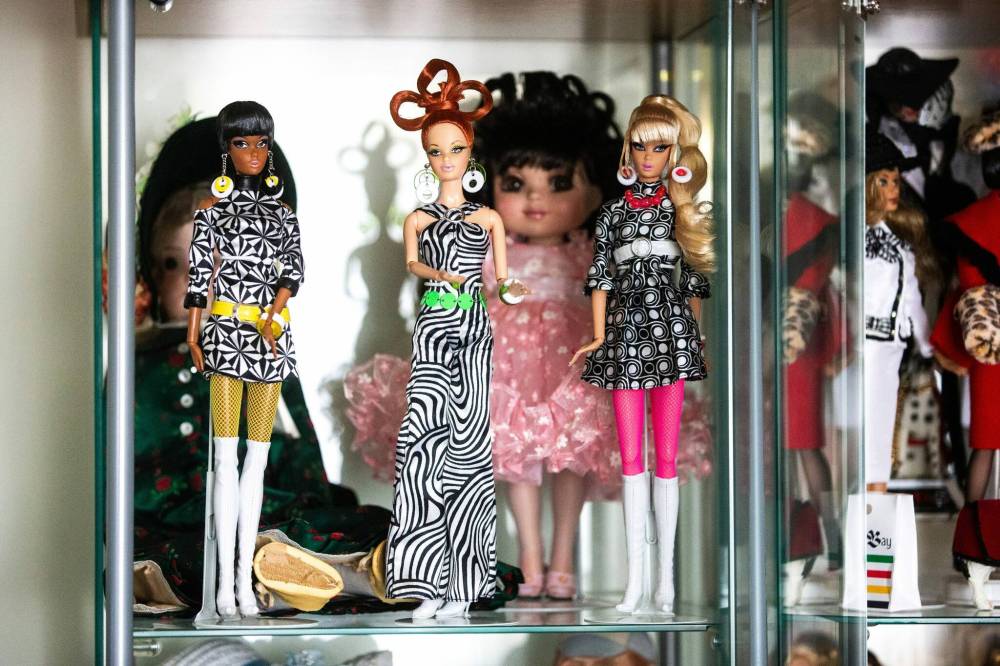
Lucy Cook rotates her favourite Barbies in her six display cases.
“My mother was a fantastic seamstress and she would sew doll clothes for us. I remembered some beaded gowns she sewed and I would pretend Barbie was going to a fancy ball,” Cook says.
Her love for Barbie never waned and she continued playing with them even as she grew older. One day, after coming home from school, she headed to her bedroom to play with the dolls but there were none to be seen. Her parents had boxed them up and given them away to friends with younger daughters.
“When I was not playing, my dolls were always placed sitting in a row along the wall on top of my bed. I realized they were gone as soon as I entered the room and looked at the bed.”
Cook, nine at the time, was devastated.
“They told me they felt I was too old to play with the dolls. My dolls were always very precious to me as a little girl. They had given them away without letting me know.”
The memory of the event stayed with her.
When she became a mother to daughters who were starting to transition from baby dolls to Barbie figurines, Cook started collecting the toys again.
“When my first daughter was four, my desire was to get dolls that I had as a little girl, to be able to show her and have her play with them. I bought a Bubble Cut Barbie from around 1964 and then Midge from also around that time.”
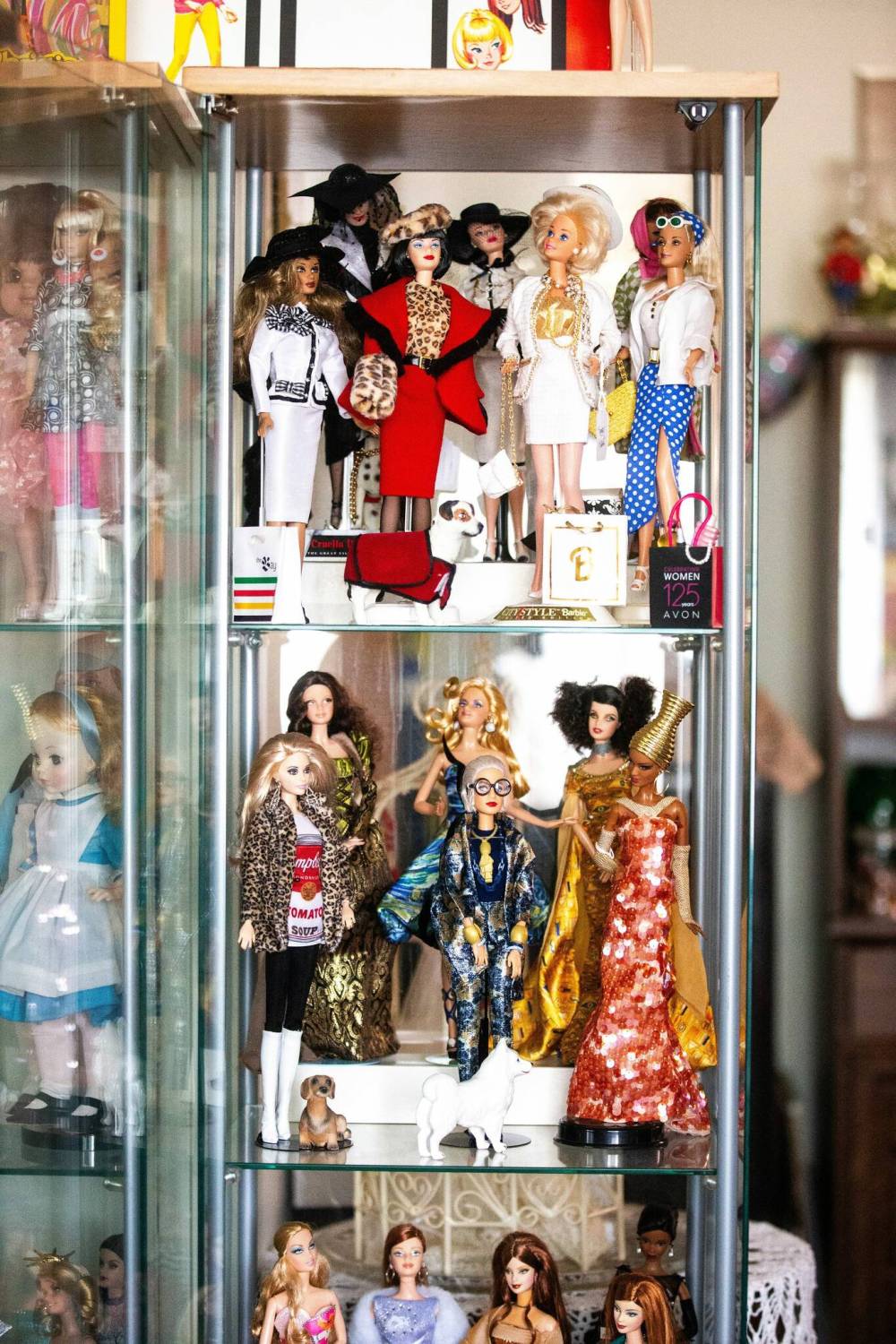
Today Cook, who is the president of the Manitoba Doll Club, has approximately 800 dolls in her collection; around 200 of them are Barbies. She rotates her collection, making sure some of her favourites are displayed on the six display cabinets in her living room.
The retired electronic enrolment analyst adds at least 10 Barbies a year to her trove; she admits she used to buy more when she first started collecting them.
Nowadays she limits her doll shopping, focusing on the exclusive releases rather than purchasing every single new Barbie.
MIKAELA MACKENZIE / WINNIPEG FREE PRESS
Cook has 200 Barbies in her collection.
One of her favourite Barbies is a Carolina Herrera Bridal Barbie doll from 2005, designed by the New York-based Venenzuelan fashion designer.
As a devoted fan, Cook has already bought her tickets to Greta Gerwig’s Barbie movie (out in cinemas today) and is eager to add the the dolls featured in the film to her collection.
“I have ordered the Disco Barbie (Margot Robbie) and Ken (Simu Liu) from the Mattel Collectibles website and once received they will be displayed in my living room,” she says.
Cook started documenting her collection six years ago, but hasn’t got a complete list of all the dolls she has. Most of them are kept in storage boxes, with 176 on display in her living room.
“My desire to collect has always been there but it had always been pushed down as life events happen. But it’s always there in the back of your mind. I think for me it’s like they can take me to another world. The message Barbie gives is a positive one: You can be whatever or whoever you want to be once you put your mind to it.”
av.kitching@winnipegfreepress.com

AV Kitching is an arts and life writer at the Free Press. She has been a journalist for more than two decades and has worked across three continents writing about people, travel, food, and fashion. Read more about AV.
Every piece of reporting AV produces is reviewed by an editing team before it is posted online or published in print — part of the Free Press‘s tradition, since 1872, of producing reliable independent journalism. Read more about Free Press’s history and mandate, and learn how our newsroom operates.
Our newsroom depends on a growing audience of readers to power our journalism. If you are not a paid reader, please consider becoming a subscriber.
Our newsroom depends on its audience of readers to power our journalism. Thank you for your support.
Related Articles
‘Am I crossing picket lines if I see a movie?’ and other Hollywood strike fan questions answered




Advertisement Advertise With Us
Advertisement Advertise With Us