Landline a lifeline
Phone conversations revisit AIDS crisis in pioneering gay production
Advertisement
Read this article for free:
or
Already have an account? Log in here »
To continue reading, please subscribe:

Digital Subscription
One year of digital access for only $205*
- Enjoy unlimited reading on winnipegfreepress.com
- Read the E-Edition, our digital replica newspaper
- Access News Break, our award-winning app
- Play interactive puzzles
*First annual payment billed as $205.00 + GST for one year. This annual subscription will automatically renew at $233.00 + GST every 52 weeks (10% off the regular annual price of $259.35). Offer available to new and qualified returning subscribers only. Cancel any time.
To continue reading, please subscribe:
Add Free Press access to your Brandon Sun subscription for only an additional
$1 for the first 4 weeks*
- Enjoy unlimited reading on winnipegfreepress.com
- Read the E-Edition, our digital replica newspaper
- Access News Break, our award-winning app
- Play interactive puzzles
*Your next Brandon Sun subscription payment will increase by $1.00 and you will be charged $17.95 plus GST for four weeks. After four weeks, your payment will increase to $24.95 plus GST every four weeks.
Read unlimited articles for free today:
or
Already have an account? Log in here »
Hey there, time traveller!
This article was published 24/11/2023 (1027 days ago), so information in it may no longer be current.
Whenever Eric Plamondon finds himself in a different city, the artist from St. Boniface always migrates toward a queer bookstore, scanning the shelves for works he’s never heard of written by authors whose work he’s yet to meet.
A few years ago, one title screamed out to him: Jerker, written by the pioneering gay playwright Robert Chesley.
Plamondon, a multi-disciplinary artist, dove into the one-act play and was enraptured by the clarity of Chesley’s voice. Set in 1985, amidst the AIDS epidemic, Jerker, or the Helping Hand was unlike anything Plamondon had read before, a frank depiction of two gay men who engage in a charged relationship across San Francisco’s telephone lines over the course of 20 conversations.
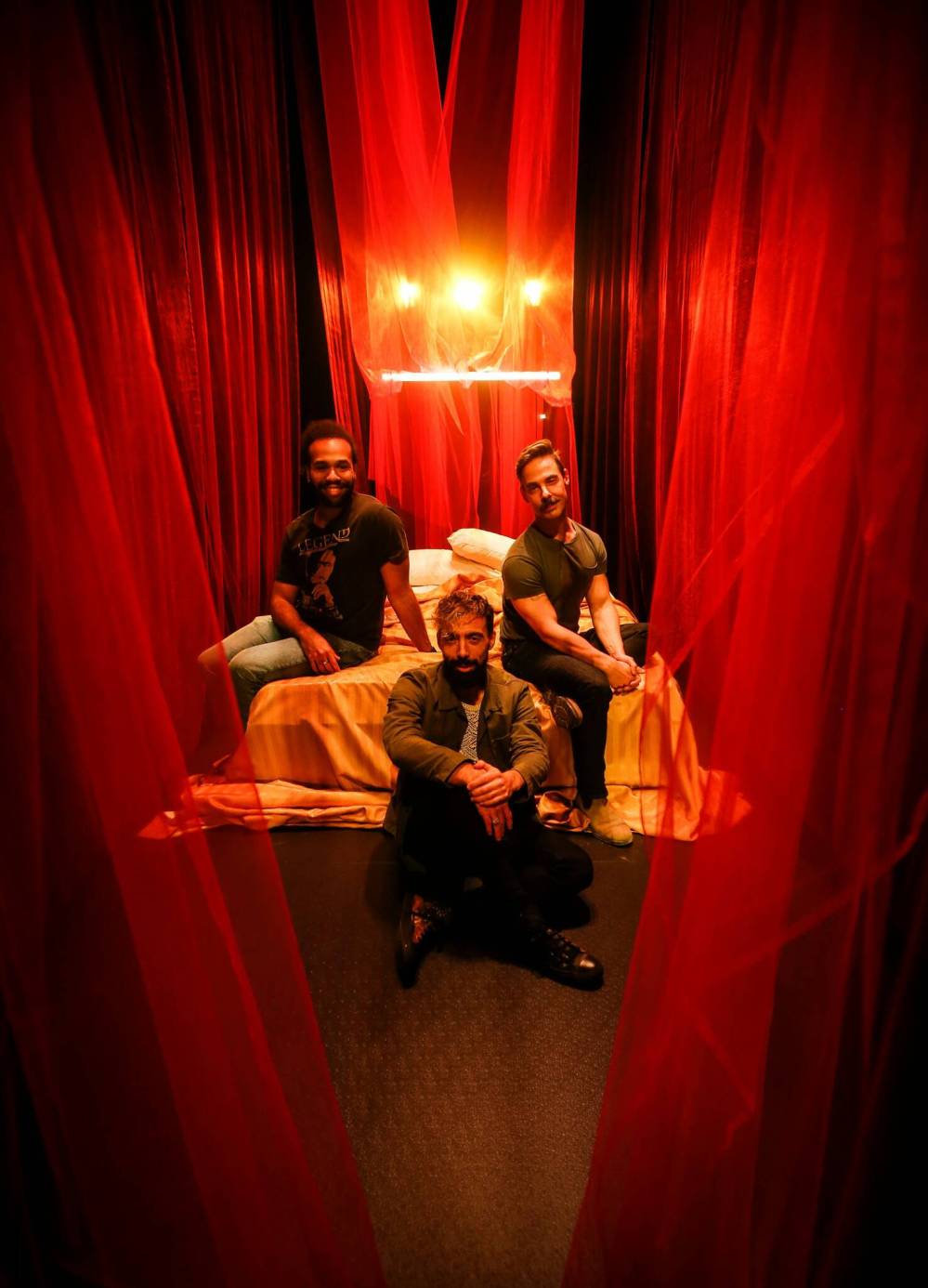
JOHN WOODS / WINNIPEG FREE PRESS
Not phoning it in: Palucheur director Eric Plamondon (centre) with actors David Bélizaire (left) and Sébastien Bertrand.
His first feelings were of exultation.
“The play starts and it hits hard and raw, but it was a pure pleasure to read because it is rare as a gay man to come across something that’s so unapologetically gay in how it’s written,” he says.
It was graphic without being exploitative and sexual without being sanitized. As a play featuring two men simulating phone sex, Jerker presented homosexual intimacy as a normal, healthy and life-saving act for its only two characters, Mike and JR.
Glad as he was to have found Chesley’s masterwork, Plamondon’s next feelings were of doubt.
“At the time I read this show, it made a huge impression, but then I said, ‘No f—-ing way is this ever getting mounted in Winnipeg. Thank you for the read, Robert, but I am never going to see this show (in my hometown).’”
Plamondon filed the idea away, but it refused to be forgotten. When the pandemic began, leaving friends and lovers the world over connecting via FaceTime and Zoom, the 42-year-old recognized a possibility that Jerker might still be as relevant as it was when it debuted in New York in 1986.
Last year, when Théâtre Cercle Molière artistic director Geneviève Pelletier asked Plamondon if he had any plays in his back pocket, he didn’t hesitate. And to Pelletier’s credit, Plamondon says, neither did she.
“The fact that they support this and said, ‘Please dare to take this risk,’ is not lost on me,” he says.
Plamondon set to work adapting Jerker into French, immersing himself in the language of a writer who refused to contort the lives of his generation into anything less than the naked truth, even when some audiences would rather shut their eyes and blow the whistle.
● ● ●
When Jerker debuted in 1986 at New York’s Celebration Theatre, Chesley was 43, a graduate of Oregon’s Reed College who had been out of the closet for little more than a decade.
He had spent his career writing short plays, essays and theatre criticism, while also composing music. A proud gay man, he founded the 3-Dollar Bill Theatre in New York City and, according to an obituary published by his alma mater, often pinned a pink triangle on a black background to his clothing, harkening back to the symbol gay people were required to wear in Nazi Germany.
“He was a revolutionary playwright,” says his close friend and fellow playwright Victor Bumbalo. “He put things on the stage we hadn’t seen before.”
Night Sweat, produced in 1984, is often credited as the first play dealing with AIDS to be staged in New York.
He was committed to depicting homosexual relationships, unencumbered by societal censorship, Bumbalo says.
“He was an adventuresome writer, and never did it for shock value,” says Bumbalo, who was in the audience when Jerker and all of Chesley’s other plays premièred.
“It all came from him.”
When the show finished, Bumbalo remembers a feeling of overwhelming joy and recognition in the theatre.
“It was quite wonderful, that play. It really captured a time and a place. The freedom of sexuality was revolutionary then, and still is today.”
The theme of the show, and of his work as a playwright, was not AIDS, but fear, Chesley said.
And while audiences in the queer theatre scene saw his work as vital, it struggled to catch on in a mainstream still dominated by homophobia and stigma.
When L.A.’s KPFK produced Jerker as a radio play, the FCC asked the justice department to prosecute; the charges were eventually dropped, but it was clear that Chesley had struck a nerve.
That 1986 production of Jerker — directed by Michael Kearns and starring David Stebbins and Joe Fraser — was mounted at a time when Bumbalo says it was common for gay men in New York or San Francisco to attend at least one funeral per month for someone who had died from AIDS.
“The actors infused Jerker’s première with profound empathy,” Kearns wrote in a 2022 article on Medium. “They weren’t pretending, they were being.”
“Life was tragically mirroring art. Or was art tragically mirroring life?”
By 1991, Kearns had tested positive for HIV, while Fraser, 35, Stebbins, 33, and Chesley, 47, had each died from complications due to AIDS.
• • •
The history and historicity of the piece is a major reason Plamondon wanted to mount it at TCM as Palucheur. It’s also why actors David Bélizaire and Sébastien Bertrand were so quick to answer the call.

“Once you get past the shocking things you get to say or do as an actor on stage, it all becomes normalized, and then you can dig at the emotional heart of the play,” says Ottawa’s Bertrand, 47. “We always try to remember that at its core, it’s about two people building a connection when doing so was difficult, almost impossible.”
“And dangerous,” says Bélizaire, 25, originally from Gatineau, Que. “This is the first play I have had to go so deep into myself.”
The cast and crew have been working with a queer elder to further understand the era Chesley documented in order to depict it with gratitude and compassion while maintaining the voice that made Chesley an unsung hero to a generation of queer playwrights.
“When you hear those stories of people who did and didn’t survive, you can’t help but feel their light,” says Plamondon, who is also directing the production. “And if I feel it in me, that makes me unafraid. What we’re offering is an artistic experience with a full historical charge.”
ben.waldman@winnipegfreepress.com