Take 2 dance steps and call me in the morning
Ballroom, tango, waltz and beyond are good for everyone, but especially for the elders on the dance floor

Advertisement
Read this article for free:
or
Already have an account? Log in here »
To continue reading, please subscribe:

Digital Subscription
One year of digital access for only $205*
- Enjoy unlimited reading on winnipegfreepress.com
- Read the E-Edition, our digital replica newspaper
- Access News Break, our award-winning app
- Play interactive puzzles
*First annual payment billed as $205.00 + GST for one year. This annual subscription will automatically renew at $233.00 + GST every 52 weeks (10% off the regular annual price of $259.35). Offer available to new and qualified returning subscribers only. Cancel any time.
To continue reading, please subscribe:
Add Free Press access to your Brandon Sun subscription for only an additional
$1 for the first 4 weeks*
- Enjoy unlimited reading on winnipegfreepress.com
- Read the E-Edition, our digital replica newspaper
- Access News Break, our award-winning app
- Play interactive puzzles
*Your next Brandon Sun subscription payment will increase by $1.00 and you will be charged $17.95 plus GST for four weeks. After four weeks, your payment will increase to $24.95 plus GST every four weeks.
Read unlimited articles for free today:
or
Already have an account? Log in here »
Hey there, time traveller!
This article was published 29/01/2024 (963 days ago), so information in it may no longer be current.
Edna Toy fell in love with dancing when she was five. She would watch from the sidelines, enraptured, as her father twirled her mother on the dance floor of the Hong Kong nightclub where her parents were regulars.
It was a treat for her, this chance to see them both dolled up, her mother in a glamorous cocktail dress and her father in his sharp suit, the duo gracefully gliding under the shimmery disco lights.
Entranced, Toy would watch, sipping on a bottle of pop, the music making its way into her bones, her entire being suffused with joy. Watching them dance made her want to dance. She was well and truly bitten by the dance bug.
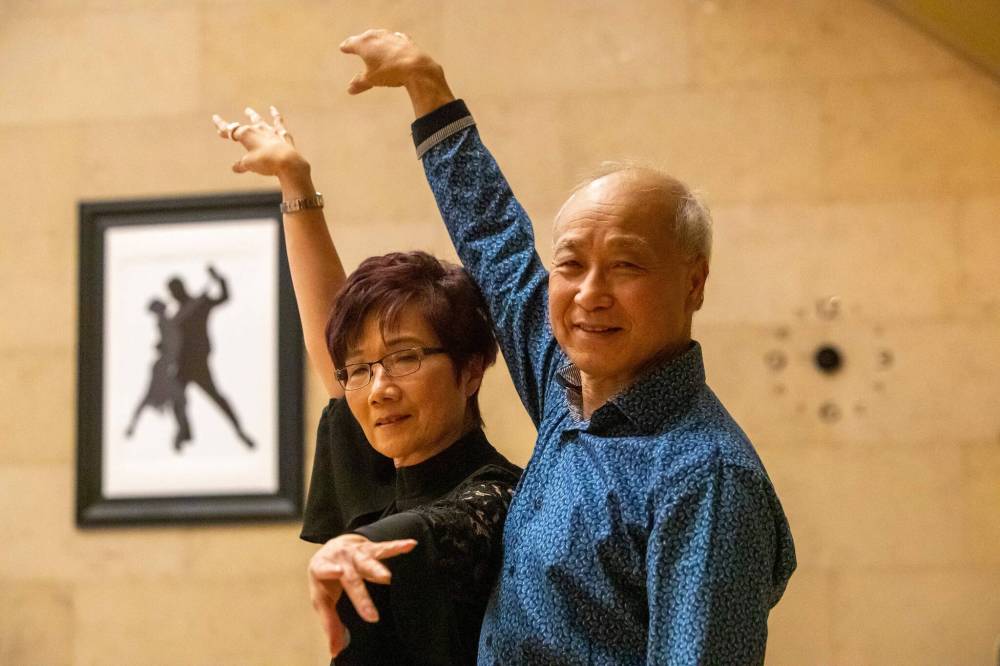
“They had this special place they would go to and sometimes they would take me; it would be a special treat. They would go a little earlier than usual so I could come with them and leave earlier, so we didn’t have too late of a night,” Toy, 70, says with a laugh.
“Seeing them dancing like that made me want to move around.”
That love never really left her, but later as a young mother to twin boys, Toy had her hands full, so she tucked it away deep inside her.
Today, she and her husband, Dennis, are regular dancers, making sure their Friday nights are reserved for ballroom classes at Ted Motyka Dance Studio on Main Street.
There they and 30 others spin, step and twirl in perfect rhythm, each couple swept away in the ecstasy of movement. She says she feels free when she dances, unfettered by the daily pressures of life.
“When you go dancing, you don’t do anything else except dance. Any worries or stress won’t be in the dance because you are concentrating so much on the music and the movement itself that you will feel more relaxed,” she says.
Toy and her husband have been dancing together for 38 years. Their journey started in 1986 at the late Bill Daum’s Ballroom Club. In October 2000, they decided to try out Motyka’s studio, learning from Ted and his wife, Margaret.
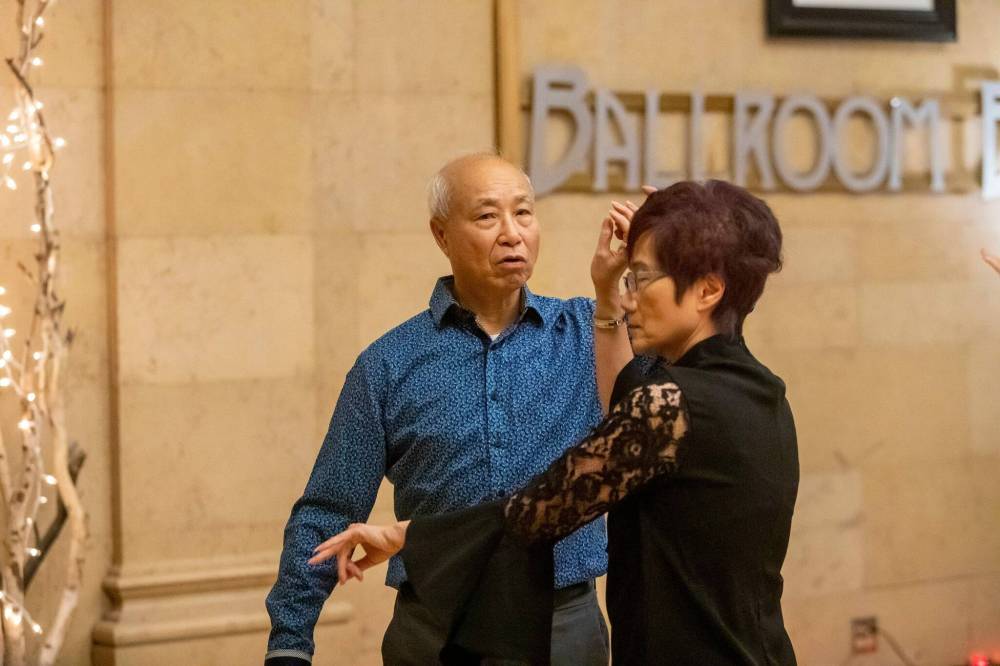
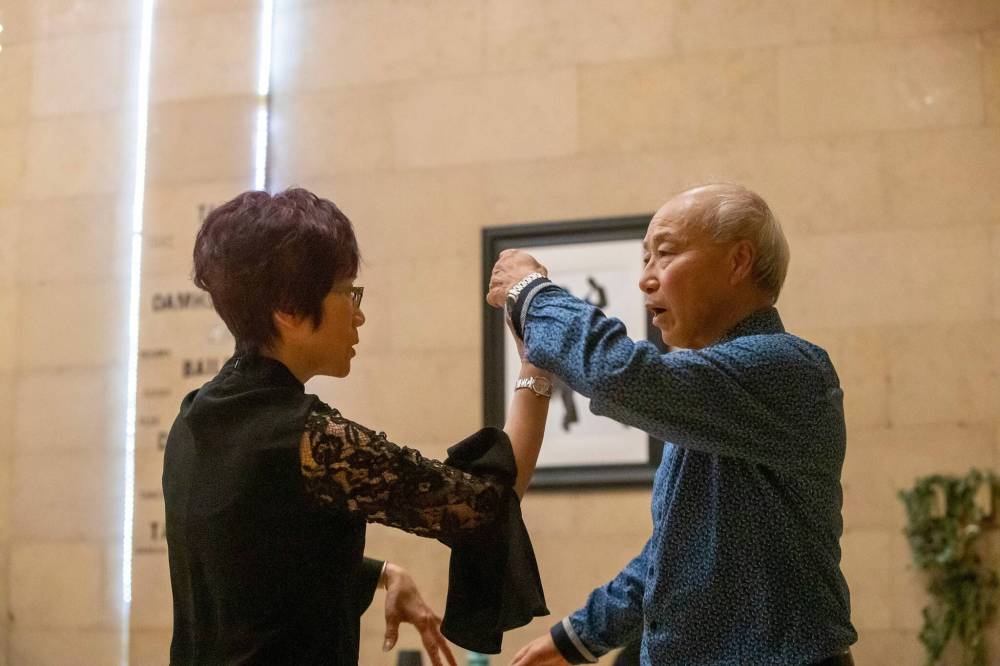
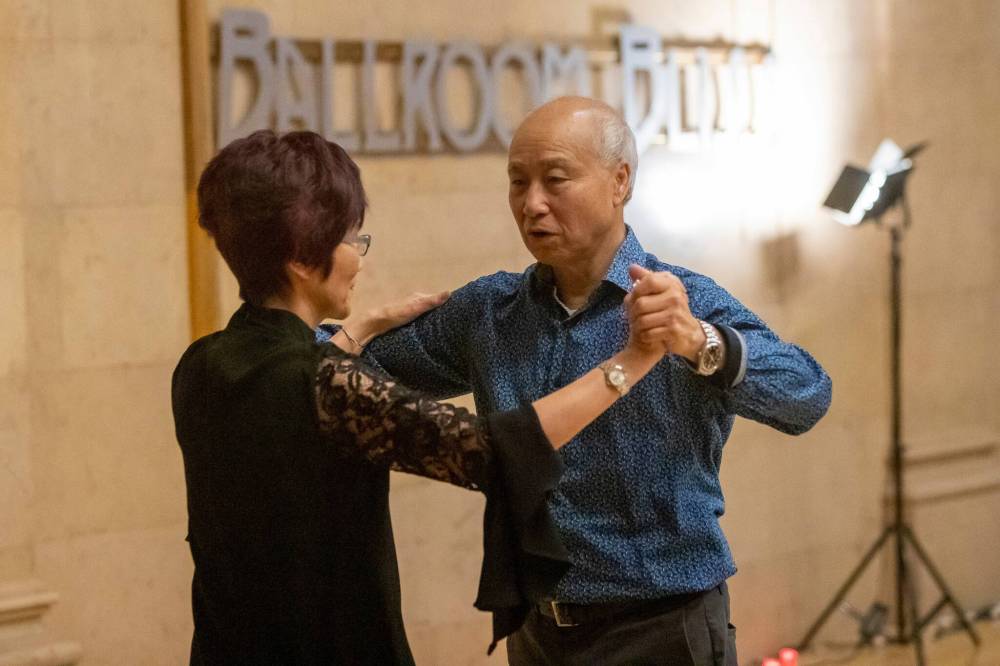
The Toys are experts in nine dances in International Ballroom Dancing, regularly doing the waltz, foxtrot, quickstep, Viennese waltz and tango, which make up the standard division of ballroom dancing, as well as dances in the Latin division, which include rumba, cha-cha, samba and jive.
“There is also the pasodoble in the Latin division but that doesn’t apply to us. That one is too showy for us,” Toy says.
She is more involved than most. On Wednesday she dances for 21/2 hours, helping a friend who is an instructor. On Fridays she’s at the studio with Dennis, starting with the one-hour 8 p.m. class and staying on for the social dance afterwards. On Saturdays, after choir practice, she teaches a 30-minute Latin exercise class.
She dances at home with her husband, too, in their basement where they have a little dance floor they use for practice. It has strengthened their relationship — even when they argue, they still go to lessons together, she confides with a laugh.
“When we are dancing, we forget about our differences, we forget about everything and it’s just togetherness. You have to work together in a dance,” she says.
The dancers at Motyka’s studio have a special relationship with Ted and Margaret. The couple, who opened the studio in 1992, are originally from Poland and came to Winnipeg in the 1980s.
There are classes almost every day of the week. On Monday’s there’s West Coast swing, taught by Debra Ward; on Wednesdays, Regan Hirose and Harold Rancano of Danceworld take over the studio for salsa and bachata classes; and on Thursdays and Saturdays there is Irish dancing taught by Maire McDonnell Prokopowich.
Fridays feature International Ballroom dancing from 8 to 9 p.m., followed by a dance social until 11:30 p.m.
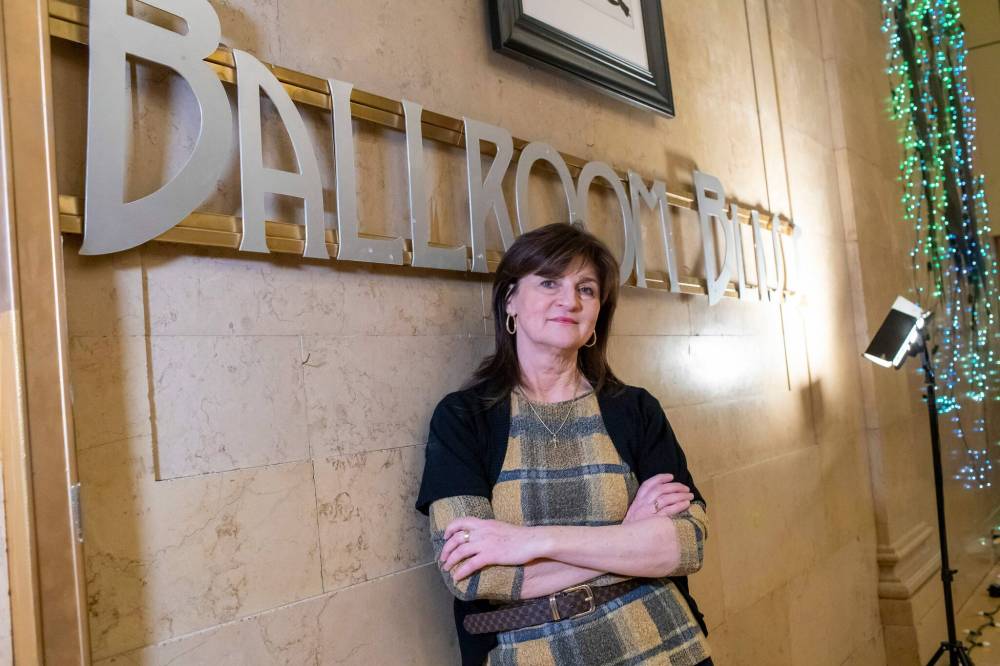
“Social dancing is open to everybody,” Margaret Motyka says. “You don’t have to dance here to attend the dance social.”
The studio operates a drop-in, pay-as-you-come policy, with a $12 charge for an hour’s lesson in ballroom dancing. Those who attend the class often stay on for the social; dancers are of all ages and all skill levels, from younger people who have never done ballroom before to seniors who are at varying levels of expertise.
“We make it easy for people to dance. There is no registration required, and you don’t have to bring a partner. It’s very easy for you if you want to start; we don’t want it to be like a private club,” Motyka says.
Marina Smoluk and her husband, Verne, have been dancing together since the 1970s. The couple, who have four children, would make sure they made time for themselves when their children were younger, booking a babysitter on the nights when they wanted to dance.
“We are certified hang-gliders and we also scuba dive, but both those things are dependent on location and weather conditions,” Smoluk says.
“You have to go away to do that, but ballroom dancing was something we could enjoy together. It’s a good activity for couples: it’s well-rounded and it can be challenging — you are constantly thinking, listening to the music and making the dance fit to the timings of the music as you learn the steps.
“It’s like a sport, really, because you have so much to learn.”
They started by learning ballroom before moving on to salsa dancing followed by the Argentine tango.
Smoluk credits dancing with keeping her fit, both mentally and physically. She hasn’t felt a decline in her mental faculties, doesn’t experience any form of memory loss and the challenge of learning new dances helps her continuously develop new skills, she says.
She also enjoys the social aspect that comes with dancing in a group setting.
“Dance is a form of exercise, and we all know that in most cases some exercise is better than none. Seniors that do more exercise have been shown to have higher cognitive function than seniors that don’t exercise.”– Dr. Phillip Gardiner, professor emeritus, faculty of kinesiology and recreation management at the University of Manitoba
“Dance is a form of exercise, and we all know that in most cases some exercise is better than none,” says Dr. Phillip Gardiner, professor emeritus, faculty of kinesiology and recreation management at the University of Manitoba.
“Seniors that do more exercise have been shown to have higher cognitive function than seniors that don’t exercise.”
Gardiner points out that dance is beneficial to the joints and the circulatory system. It also helps build and maintain muscle mass.
“The social component is very important in all this as well — going to exercise by yourself in a room is not the same as dancing with a group of people and interacting with them,” he adds.
Rudolf Klassen, 66, also enjoys the social aspect of dancing. He started learning in 2007 and considers it a “charming” way to have fun.
In September, Klassen and his wife, Carla, danced the Viennese waltz together at the Moulin Rouge in Paris; he says it was one of his most memorable dances.
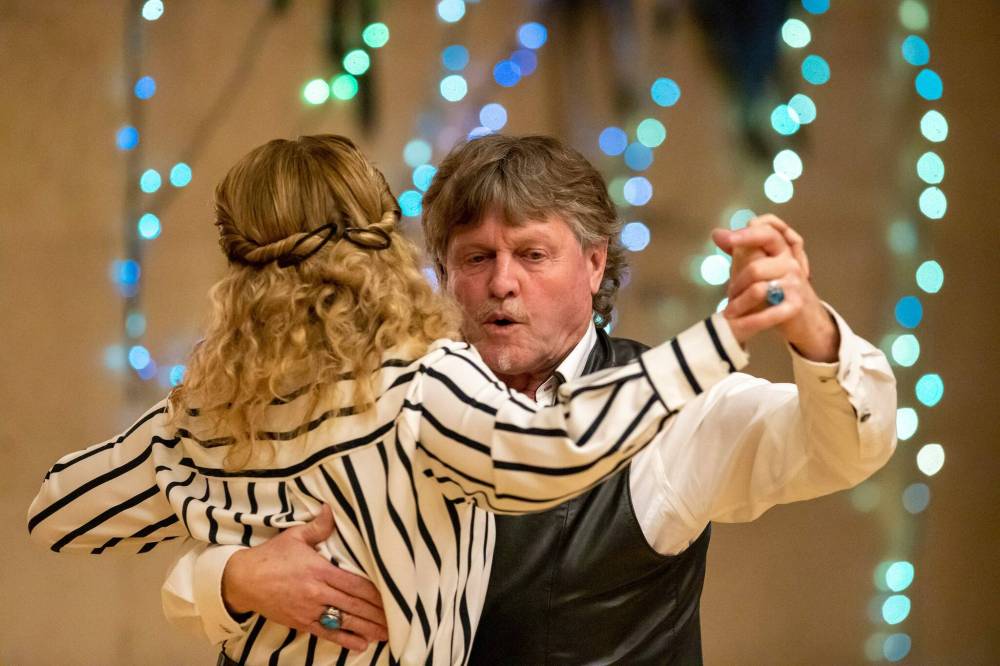
The couple dance two to three times a week at Motyka’s, Shirley’s Dance Studio and the Silver Spike Saloon in Transcona.
Occasionally they dance in their living room at home, too.
“In my culture — I am of Mennonite heritage — in the churches dancing was considered a sin, but dancing has given me a deeper appreciation of life. It keeps me absolutely fit, it has given me confidence,” he says.
“I used to be very shy, but dancing has changed me. Our social life has blossomed because of the amazing dance community.”
Dancing has been shown to be beneficial for mental health, physical health and brain health. Practising dance moves sharpens your intellect, improves balance and stimulates serotonin and endorphin production, the two “feel-good” hormones known to reduce stress, boost self-esteem and improve mood.
“Anything to do with any kind of movement is helpful to brain health and overall cognition,” says Karin Whalen, manager of community outreach at the Wellness Institute, which offers bachata and salsa lessons on Friday nights.
“Dancing has so many benefits because when you are dancing you have to focus on learning the movements as you listen to the music. Music itself, for a lot of people, can elicit calm feelings and the combination of doing a physical activity accompanied by music while socializing with others, it’s an overall great thing to do to thwart cognitive decline.”
Ballroom dancing is not just for seniors, Smoluk stresses. Younger people, especially those who are single and looking for something different to do, should try hitting the dance floor, she says.
“This is a safe space where you can go out for the evening, have a good time dancing and leave for home, with no pressure, no questions asked. Nobody is going to hit on you, no one is going to bug you and there will always be people willing to work with you if you want to dance,” she says.
“It’s a space where everybody will make you feel welcome.”
av.kitching@winnipegfreepress.com
AV Kitching is an arts and life writer at the Free Press. She has been a journalist for more than two decades and has worked across three continents writing about people, travel, food, and fashion. Read more about AV.
Every piece of reporting AV produces is reviewed by an editing team before it is posted online or published in print — part of the Free Press‘s tradition, since 1872, of producing reliable independent journalism. Read more about Free Press’s history and mandate, and learn how our newsroom operates.
Our newsroom depends on a growing audience of readers to power our journalism. If you are not a paid reader, please consider becoming a subscriber.
Our newsroom depends on its audience of readers to power our journalism. Thank you for your support.
AV Kitching is an arts and life writer at the Free Press. She has been a journalist for more than two decades and has worked across three continents writing about people, travel, food, and fashion. Read more about AV.
Every piece of reporting AV produces is reviewed by an editing team before it is posted online or published in print — part of the Free Press‘s tradition, since 1872, of producing reliable independent journalism. Read more about Free Press’s history and mandate, and learn how our newsroom operates.
Our newsroom depends on a growing audience of readers to power our journalism. If you are not a paid reader, please consider becoming a subscriber.
Our newsroom depends on its audience of readers to power our journalism. Thank you for your support.
Advertisement Advertise With Us
Advertisement Advertise With Us