Simplicities of life captured in German filmmaker’s latest

Advertisement
Read this article for free:
or
Already have an account? Log in here »
To continue reading, please subscribe:

Digital Subscription
One year of digital access for only $205*
- Enjoy unlimited reading on winnipegfreepress.com
- Read the E-Edition, our digital replica newspaper
- Access News Break, our award-winning app
- Play interactive puzzles
*First annual payment billed as $205.00 + GST for one year. This annual subscription will automatically renew at $233.00 + GST every 52 weeks (10% off the regular annual price of $259.35). Offer available to new and qualified returning subscribers only. Cancel any time.
To continue reading, please subscribe:
Add Free Press access to your Brandon Sun subscription for only an additional
$1 for the first 4 weeks*
- Enjoy unlimited reading on winnipegfreepress.com
- Read the E-Edition, our digital replica newspaper
- Access News Break, our award-winning app
- Play interactive puzzles
*Your next Brandon Sun subscription payment will increase by $1.00 and you will be charged $17.95 plus GST for four weeks. After four weeks, your payment will increase to $24.95 plus GST every four weeks.
Read unlimited articles for free today:
or
Already have an account? Log in here »
Hey there, time traveller!
This article was published 23/02/2024 (941 days ago), so information in it may no longer be current.
‘Analog is back,” announces a youngster in this radiantly lovely Tokyo-set drama from German director Wim Wenders, who co-scripts with Takuma Takasaki.
For Hirayama, our middle-aged central character, analog never left.
A cleaner of public toilets, Hirayama (famed Japanese actor Kôji Yakusho, known for Tampopo and Shall We Dance?) spends his days listening to cassette tapes of Lou Reed, Patti Smith and Otis Redding. He takes photographs with a film camera. He reads books by William Faulkner and Aya Koda. He watches not a screen but the world around him, with a benevolent, slightly bemused gaze.
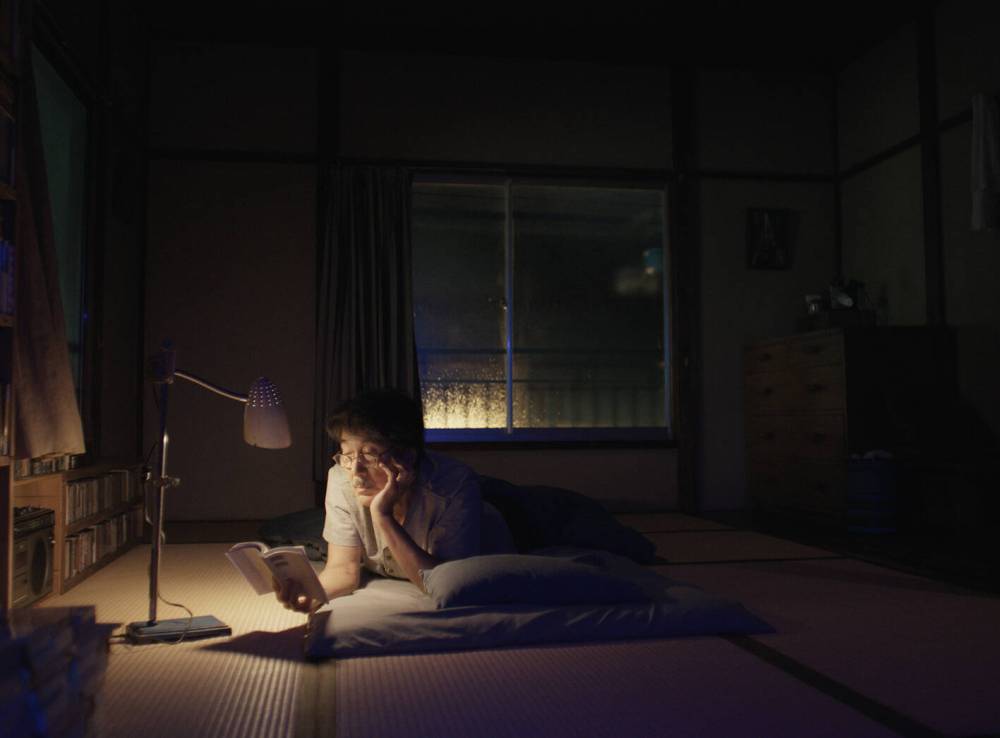
NEON
Hirayama (Kôji Yakusho) lives a simple life in Perfect Days.
Perfect Days (in Japanese, with English subtitles) asks its audience to experience this lo-fi, slow-paced world along with Hirayama, to share in his patience, concentration and care.
So, we follow him through his daily routines. Hirayama wakes before dawn to the sound of the street sweeper, brushes his teeth, gets into his uniform, buys coffee from a vending machine and then drives into central Tokyo to start his round of cleaning.
There is an unusual amount of attention given to Hirayama’s labour.
“Why do you put so much into a job like this?” his motormouthed younger colleague Takashi (Tokio Emoto) asks, especially when “it just gets dirty again.” But it seems to be the process itself that has meaning for Hirayama — and for Wenders, who shows a lot of mopping up and wiping down.
Then there are Hirayama’s post-work rituals — a visit to the public bathhouse, dinner at his regular food kiosk and some reading.
As he lies down on his sleeping mat, we see glimpses of memories and dreams rendered in imagistic patterns of light and shadow, a self-conscious art-house touch that feels slightly out of place.
In this empathetic but unsentimental meditation on ordinary life, Wenders is clearly drawing on Japanese master Yasujiro Ozu. Just as we start leaning into the repetition of Hirayama’s everyday life — even his days off have a set rhythm — his rituals are altered, just slightly. It’s in these moments, which Wenders handles with quiet lucidity, that we get some oblique sense of how Hirayama has come to this modest, contained life, through choice and circumstance.
These subtle indications — it would be overstating it to call them revelations — are also grounded in the mostly silent performance of Yakusho, whose lived-in face embodies his character’s accumulation of time, age and experience.
“A great worker, not a great talker,” says Takashi of his older colleague The first time we hear Hirayama speak is when he is comforting a lost child in a park. To the adults around him, at least initially, he has less to say.
But while Hirayama is solitary, he’s not entirely alone. There’s always his city.
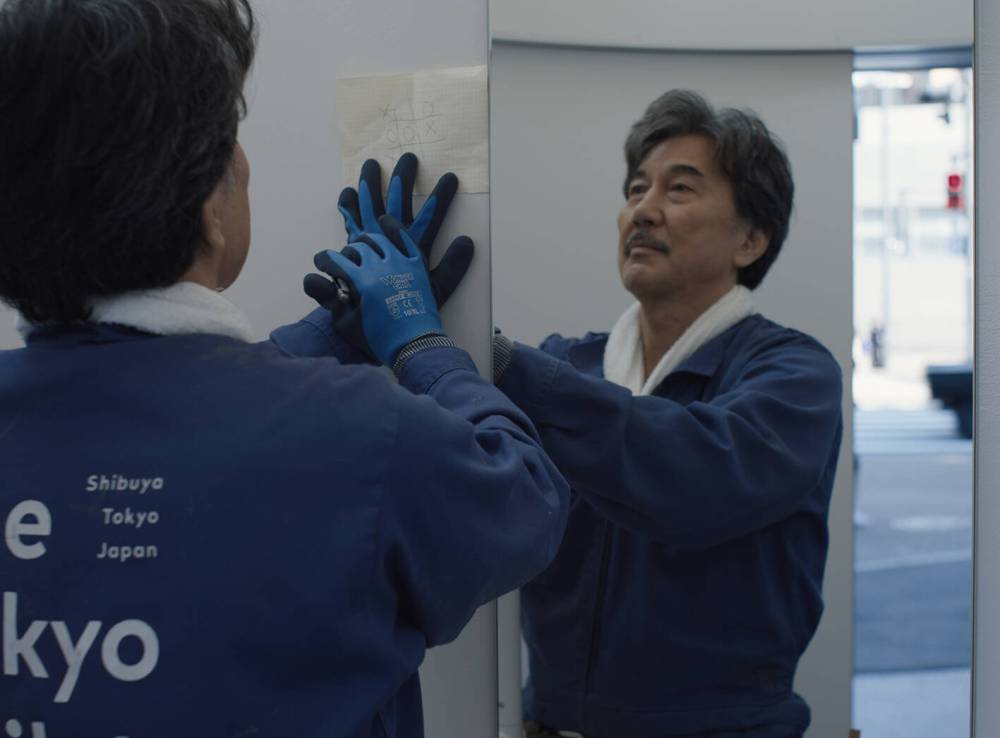
NEON
Kôji Yakusho cleans public toilets in the understated film Perfect Days.
Wenders has always had a distinct and poetic sense of place, whether that’s Berlin or Paris, Texas. Here we see repeated shots of the SkyTree, the spectacular structure that dominates the Tokyo skyline, but mostly we see the city’s parks and its actual trees, its narrow byways and crowded intersections and underground malls, and, especially, its public toilets.
(Heads up, Winnipeg: Perfect Days just happens to be a cinematic manifesto for what well-designed, well-maintained public washrooms can contribute to a city and to human dignity in general.)

Wenders conveys what it means to be a small part of the life of a big city. We see the value in the familiar landmarks that greet Hirayama as he drives to work or bikes through his neighbourhood. We see the small comforts he gets from encounters with people whose names he might not even know but who are part of his daily or weekly rounds.
There’s the young man at the public bathhouse who greets him every time he comes. The guy at the food kiosk who brings him a glass of water, saying, “For your hard work.” The second-hand bookstore clerk who always has an opinion on his purchase. (“Patricia Highsmith knows everything about anxiety.”) The regulars at the bar where he goes on his day off.
And there’s Hirayama’s music. Often his song choices reflect what is happening in his day, a notion that takes on profound significance in an astonishing final scene that features a sustained close-up on Hirayama as he drives and listens to the great Nina Simone.
Maybe we aren’t told a lot about Hirayama in this deliberately understated film, but in this moment — so good it makes you hold your breath — we know what we need to know.
alison.gillmor@winnipegfreepress.com
Studying at the University of Winnipeg and later Toronto’s York University, Alison Gillmor planned to become an art historian. She ended up catching the journalism bug when she started as visual arts reviewer at the Winnipeg Free Press in 1992.
Our newsroom depends on a growing audience of readers to power our journalism. If you are not a paid reader, please consider becoming a subscriber.
Our newsroom depends on its audience of readers to power our journalism. Thank you for your support.
Movie review
Perfect Days
Starring Koji Yakusho
● McGillivray
● PG, 123 minutes
★★★★ out of five
OTHER VOICES
A beautifully observed paean to caretaking — both physical and philosophical — the movie is led, with sublime joy, by the great Japanese actor Kôji Yakusho.
— Robert Abele, Los Angeles Times
Without Yakusho, it would still be the German filmmaker’s strongest narrative feature in 30 years… With him, this small, unassuming tale turns into the kind of earthshaking character study that reminds us why we go to the movies in the first place.
— David Fear, Rolling Stone
Hirayama says little throughout the course of Wenders’ quiet, quotidian film. Little happens. Yet Yakusho’s warm presence speaks volumes in a film where less can mean profoundly more.
— Jake Coyle, The Associated Press
Perfect Days is a poem of extraordinary subtlety and beauty.
— Alissa Wilkinson, Vox
Studying at the University of Winnipeg and later Toronto’s York University, Alison Gillmor planned to become an art historian. She ended up catching the journalism bug when she started as visual arts reviewer at the Winnipeg Free Press in 1992.
Our newsroom depends on a growing audience of readers to power our journalism. If you are not a paid reader, please consider becoming a subscriber.
Our newsroom depends on its audience of readers to power our journalism. Thank you for your support.
Advertisement Advertise With Us
Advertisement Advertise With Us