Infinite and resonant
Circular work at WAG-Qaumajuq embraces the whole of warmth, strength and life

Advertisement
Read this article for free:
or
Already have an account? Log in here »
To continue reading, please subscribe:
Digital Subscription
One year of digital access for only $1.44 a week*
- Enjoy unlimited reading on winnipegfreepress.com
- Read the E-Edition, our digital replica newspaper
- Access News Break, our award-winning app
- Play interactive puzzles
*Billed as $5.77 plus GST every four weeks. After 52 weeks, price increases to the regular rate of $19.95 plus GST every four weeks. Offer available to new and qualified returning subscribers only. Cancel any time.
To continue reading, please subscribe:
Add Free Press access to your Brandon Sun subscription for only an additional
$1 for the first 4 weeks*
- Enjoy unlimited reading on winnipegfreepress.com
- Read the E-Edition, our digital replica newspaper
- Access News Break, our award-winning app
- Play interactive puzzles
*Your next Brandon Sun subscription payment will increase by $1.00 and you will be charged $17.95 plus GST for four weeks. After four weeks, your payment will increase to $24.95 plus GST every four weeks.
Read unlimited articles for free today:
or
Already have an account? Log in here »
Hey there, time traveller!
This article was published 27/07/2024 (820 days ago), so information in it may no longer be current.
WHAT IT IS:
Warm Heart Wheel: My Medicine Series (2022-23) is a mixed-media work by Winnipeg-based artist Lita Fontaine. Now on view at WAG-Qaumajuq, it’s part of Winyan, a solo show mixing recent and foundational works by the 66-year-old Fontaine, who is of Anishinaabe, Dakota and Métis descent.
MIKAELA MACKENZIE / FREE PRESS FILES Artist Lita Fontaine (left) and assistant curator Marie-Anne Redhead with Warm Heart Wheel: My Medicine Series.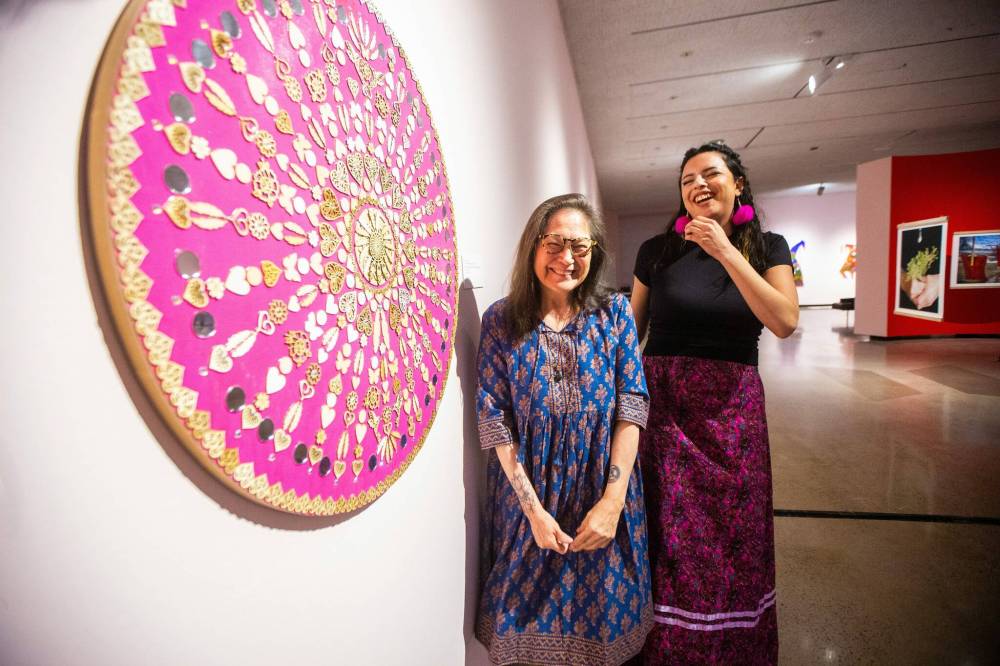
WHAT IT’S ABOUT:
As soon as you enter Winyan (the title is a Dakota word for “woman”), you’ll hear what sounds like a heartbeat — rhythmic, reassuring, resonant — without really knowing where it’s coming from.
It’s only when you move into the exhibition’s second room that you trace it to a ceremonial drum, part of a large installation work titled Woman’s Drum (4th Resurrection). A touchstone in Fontaine’s work she’s returned to again and again, the drum embodies many of her lifelong concerns, including Indigenous feminism and environmentalism. Its beat can be heard as the heartbeat of Mother Earth.
MIKAELA MACKENZIE / FREE PRESS FILES Fontaine’s lively patterns on a vivid pink background nod to the connection between the human heart and the natural world.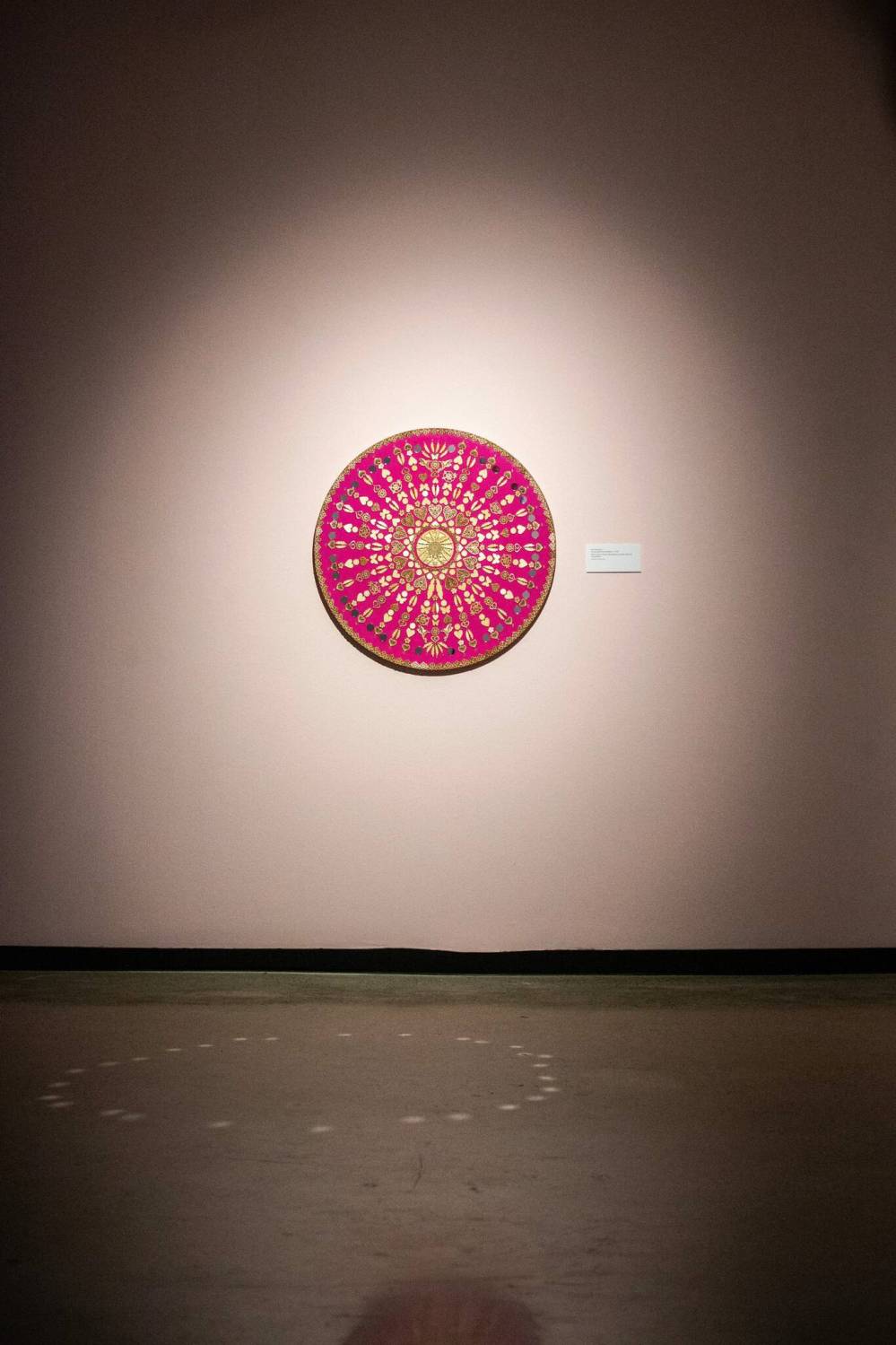
Warm Heart Wheel, a smaller work that hangs on the wall nearby, also references the heart, both in its title and in its repeating motifs. In this piece, gold hearts — some solid shapes, others having a delicate filigree — alternate with leaves, flowers, butterflies and birds. Creating patterns of energy against a vivid pink background, these images suggest the connection between the human heart and the natural world.
The work’s radiating lines are dynamic and vibrant, but they’re contained within the calm symmetry of the circle.
Through time and across cultures, the circle is used as a symbol of wholeness and completeness. In Indigenous cultures, the medicine wheel goes back millennia, expressed through sacred objects and Earth forms. Within the circle, which has no beginning or ending, the wheel offers balance through the knowledge of the spiritual, physical, mental and emotional realms.
In Warm Heart Wheel, the larger circle is echoed by smaller mirrored circles within. On the morning I visited the gallery, light caught these small circles and cast their reflections onto the floor, forming an ephemeral second round.
Warm Heart also responds to the circle works around it, in a show in which Fontaine uses repeated shapes with varying colours to develop and explore subtle themes and variations.
Fontaine’s choice of pink feels deliberate. The hue is associated with femininity — and is often dismissed as frothy for that reason — but is reclaimed here as a colour of warmth and strength and life.
WHY IT MATTERS:
In the text that accompanies Fontaine’s work, Marie-Anne Redhead, assistant curator of Indigenous & contemporary art at WAG-Qaumajuq, suggests the artist’s celebration of embellishment, decoration and colour is joyful and beautiful but also powerful. A misogynist culture might view these things as frivolous or vain, but in the work of Lita Fontaine they are a form of resistance, expressing a moving, matrilineal inheritance that becomes a way of surviving — and thriving — even in difficult circumstances.
Studying at the University of Winnipeg and later Toronto’s York University, Alison Gillmor planned to become an art historian. She ended up catching the journalism bug when she started as visual arts reviewer at the Winnipeg Free Press in 1992.
Our newsroom depends on a growing audience of readers to power our journalism. If you are not a paid reader, please consider becoming a subscriber.
Our newsroom depends on its audience of readers to power our journalism. Thank you for your support.
A Closer Look
In our new monthly series, A Closer Look, Free Press contributor Alison Gillmor will look at a work of visual art. Examining everything from historical oil paintings to contemporary videos, she’ll ask what these artworks can tell us now, about our lives and our world.
Studying at the University of Winnipeg and later Toronto’s York University, Alison Gillmor planned to become an art historian. She ended up catching the journalism bug when she started as visual arts reviewer at the Winnipeg Free Press in 1992.
Our newsroom depends on a growing audience of readers to power our journalism. If you are not a paid reader, please consider becoming a subscriber.
Our newsroom depends on its audience of readers to power our journalism. Thank you for your support.
Related Articles
Get up close and personal to comprehend true depth of Riopelle’s vision

Advertisement Advertise With Us
Advertisement Advertise With Us