Connecting with their roots
Winnipeg-based Kara Magazine aims to teach African-Canadians about the continent of their ancestors
Advertisement
Read this article for free:
or
Already have an account? Log in here »
To continue reading, please subscribe:

Digital Subscription
One year of digital access for only $205*
- Enjoy unlimited reading on winnipegfreepress.com
- Read the E-Edition, our digital replica newspaper
- Access News Break, our award-winning app
- Play interactive puzzles
*First annual payment billed as $205.00 + GST for one year. This annual subscription will automatically renew at $233.00 + GST every 52 weeks (10% off the regular annual price of $259.35). Offer available to new and qualified returning subscribers only. Cancel any time.
To continue reading, please subscribe:
Add Free Press access to your Brandon Sun subscription for only an additional
$1 for the first 4 weeks*
- Enjoy unlimited reading on winnipegfreepress.com
- Read the E-Edition, our digital replica newspaper
- Access News Break, our award-winning app
- Play interactive puzzles
*Your next Brandon Sun subscription payment will increase by $1.00 and you will be charged $17.95 plus GST for four weeks. After four weeks, your payment will increase to $24.95 plus GST every four weeks.
Read unlimited articles for free today:
or
Already have an account? Log in here »
Hey there, time traveller!
This article was published 31/07/2024 (750 days ago), so information in it may no longer be current.
Vibrant colours and striking patterns of traditional African clothing filled the room as a new magazine exploring the world’s second-largest, and often least-understood, continent launched in Winnipeg.
Kara Magazine covers a broad spectrum of topics, from food and history to fashion and tourism. “Kara talks about all of Africa — from our food to our history, to the heroes, to music, to movies. It just helps a typical Canadian African child know about their roots because when you know about yourself and value yourself, you can preach it to other people,” editor in chief Abiodun Adetu says.
“The launch went well,” he says of the July 28 event with its “Touch of Ankara” dress code. “We desire to educate our kids, African kids, about the continent. There’s a big gap — our kids really don’t know anything about their roots, Kara helps them understand where they’re from.”

NIC ADAM / FREE PRESS
Abiodun Adetu is the editor in chief of the new African-Canadian Kara Magazine.
The magazine is more than just a publication; it’s a platform for young African Canadians to showcase their talents and achievements, says Adetu. It features interviews with young adults excelling in different fields, from sports to IT. “One of the major things we do at Kara is highlight the successes of our young people,” she says. “These interviews, done by young kids, project their accomplishments to the world.”
A distinctive aspect of Kara is that it is primarily written by teenagers and young adults aged 21 and below. “They are telling their version of Africa that they have come to learn and would like their other mates to learn about,” says Adetu.
Among these young writers is 14-year-old Ayotanreti, who contributed to the fashion column.
“When she (Adetu) came to me to ask me to be part of the magazine, she gave me multiple options on what I could do. Then she suggested the fashion magazine option,” Ayotanreti says.“I was like, ‘Oh, this is something I’m interested in.’”
Her column focuses on integrating traditional African clothing into contemporary styles, making it accessible and appealing to teenagers. “I hope that teens, especially immigrant teens like myself, get inspired by this to wear their cultural clothing outside,” she says. “Working on this story gave me an opportunity to show how you can style it in a stylish and fun way.”
Ayotanreti says she hopes to write more stories for the magazine. “I don’t do writing professionally, I mostly do it for myself in my personal time. So this is something really new for me and it’s exciting,” she says.
The magazine also sets out to unravel Africa’s vibrant cultural tapestry and challenge common misconceptions. “In the whole of Canada, we want to help the general public learn about the African culture. Most people, when they talk about Africa, think it’s one tiny country or a small place without development,” says Adetu. “Basically, we want to project Africa in a positive light, putting our story out there by ourselves and bringing out the good in us.”

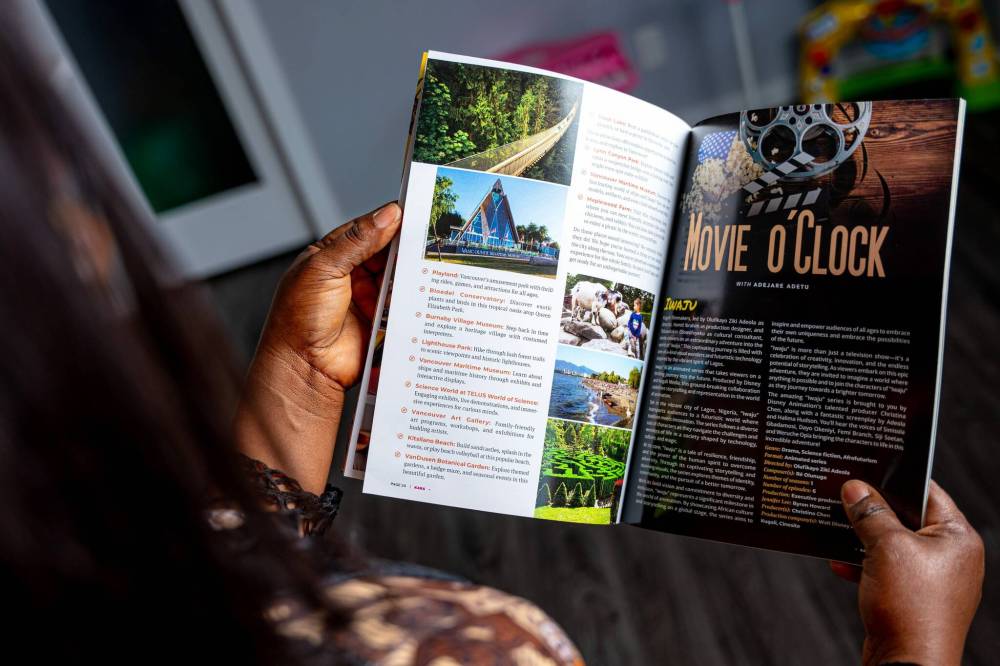
Kara Magazine’s content is as diverse as the continent it represents. It includes a food section with recipes, such as the ever debated jollof rice (a rice dish from West Africa), and a history section that features stories of African heroes such as Queen Tassi Hangbe, who ruled the Dahomey kingdom in the early 18th century. “We also have a map of Africa that tells us what country is where. It’s about helping kids and adults learn and know Africa so that they can place value on us,” Adetu says.
NIC ADAM / FREE PRESS
The magazine’s mission is to educate young African Canadians about their roots.
The tourism segment whisks readers away on virtual adventures through Africa’s stunning landscapes and bustling cities. The first edition offers a captivating tour of South Africa, uncovering hidden gems that even surprised the contributors. “My son was amazed by all the incredible things he discovered about South Africa in the magazine,” Adetu says. “I even learnt a few things too. It’s a wonderful way to help both contributors and readers to uncover and appreciate the continent’s rich diversity.”
Looking ahead, Adetu hopes Kara Magazine will become a staple in Canadian homes, schools and libraries. “We want to see it in our libraries, in schools, in stores, in the hands of important stakeholders like the premier or the prime minister,” she says. “We want to make sure it goes round and is able to impact everyone it comes across.”
For those eager to get their hands on a copy of Kara Magazine, it will be available at the Ghanaian Pavilion during Folklorama. “We are working with distributors to get the magazine in stores, but for now, you can find it at Folklorama once it starts,” Adetu says.
thandi.vera@freepress.mb.ca