Off beat
Musical whodunit lacks intrigue, substance

Advertisement
Read this article for free:
or
Already have an account? Log in here »
To continue reading, please subscribe:

Digital Subscription
One year of digital access for only $205*
- Enjoy unlimited reading on winnipegfreepress.com
- Read the E-Edition, our digital replica newspaper
- Access News Break, our award-winning app
- Play interactive puzzles
*First annual payment billed as $205.00 + GST for one year. This annual subscription will automatically renew at $233.00 + GST every 52 weeks (10% off the regular annual price of $259.35). Offer available to new and qualified returning subscribers only. Cancel any time.
To continue reading, please subscribe:
Add Free Press access to your Brandon Sun subscription for only an additional
$1 for the first 4 weeks*
- Enjoy unlimited reading on winnipegfreepress.com
- Read the E-Edition, our digital replica newspaper
- Access News Break, our award-winning app
- Play interactive puzzles
*Your next Brandon Sun subscription payment will increase by $1.00 and you will be charged $17.95 plus GST for four weeks. After four weeks, your payment will increase to $24.95 plus GST every four weeks.
Read unlimited articles for free today:
or
Already have an account? Log in here »
Hey there, time traveller!
This article was published 04/04/2025 (549 days ago), so information in it may no longer be current.
Joe Kinosian and Kellen Blair’s Murder for Two begins with a surprise party thrown for renowned author Arthur Whitney, whose birthday present is a bullet through the forehead.
Who would do such a thing to “everybody’s favourite local patriarch?”
Could it have been Whitney’s wife, a prima donna once-removed from Macon, Ga. (Melanie Whyte)? His true-crime-obsessed niece Steph (Melanie Whyte)? His snippety neighbours Murray and Barb (Melanie Whyte and Melanie Whyte)? His mucousy psychiatrist (Melanie Whyte)? Or perhaps the impish members of a boys’ choir, hired as the evening’s entertainment (Melanie Whyte, Melanie Whyte and Melanie Whyte)?
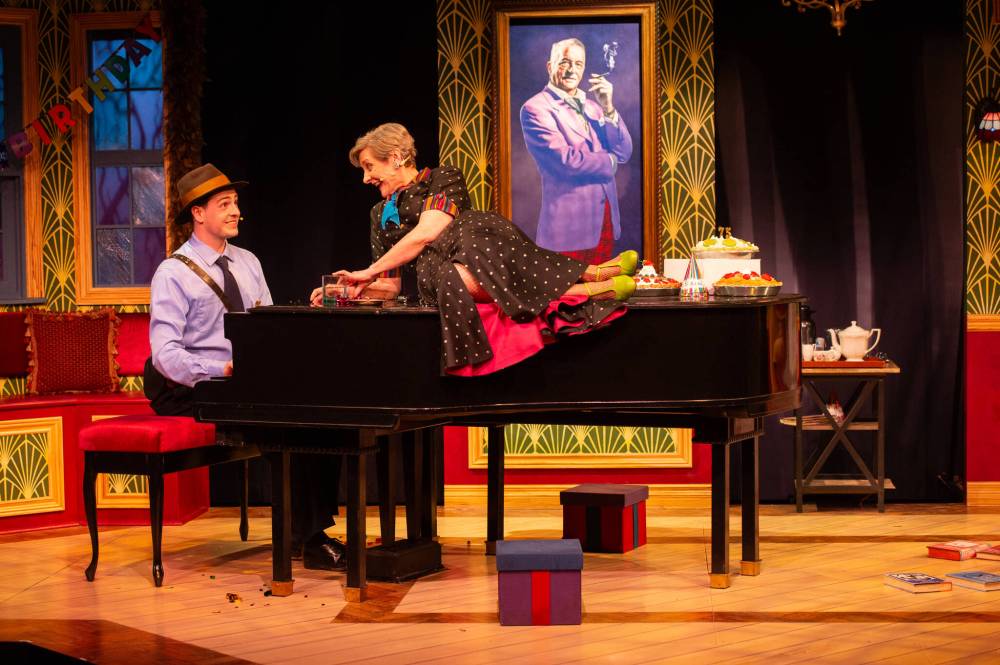
DYLAN HEWLETT PHOTO
Duncan Cox and Melanie Whyte play a dizzying array of characters while also playing the piano in the musical murder mystery Murder for Two.
That’s what Marcus Moscovitz (Duncan Cox) wants to know. But Moscovitz — whose own case history is blurry, bloodied and underdeveloped — is just a small-time New England police officer: the ring tethered to his belt jangles with only two very minor keys.
Written in 2010, Murder for Two predates more contemporary fare like Knives Out and Only Murders in the Building, which might explain why a show Charles Isherwood of the New York Times called in 2013 “an ingenious miniature musical in the form of a snazzy vaudevillian double act” seems a tad short on intrigue in more modern times.
Kelly Thornton, Royal Manitoba Theatre Centre’s artistic director, told the audience on opening night that she likes to bracket her seasons — the most recent of which began with the inspired comic performance of The Play That Goes Wrong — with “stupid-funny.”
Despite Cox and Whyte’s adroit character work and admirable fulfilment of double duty as their own grand-piano accompanists, enjoyment of this light-hearted, energetic musical will likely depend on how much “stupid-funny” audience members can take before the laughs reach the point of diminished returns.
However, to be fair, this balagan — a Hebrew word translating roughly to disorder — is chaotic by design, and the barrage of script gags can either nip at audience patience or astonish through starry-eyed commitment to the silliest of bits.
Kinosian and Blair’s book, directed with campy flair by Chase Winnicky, frequently pokes fun at the ridiculousness of the two-hander conceit, often deployed more in service of theatre economics than of story, as well as the murder-mystery category. Both subgenres follow a seemingly immutable set of standard protocols, and Winnicky has a ball setting Cox and Whyte into conversation with the audience, warning about cellphone ringers and encouraging applause.
The original script calls for simplicity, with the piano as the sole piece of furniture; however, set designer Adam Parboosingh elects here to elongate the territory outwards and upwards, stretching the action across the stage at the Warehouse.
This choice expands the playground for Cox and Whyte, whose movements were directed by Rebekah Jones. However, some areas of the set, notably the outdoor lamp-post and mailbox, feel underutilized, while others are at times severely underlit, given the audience’s extra-wide field of vision.
It’s a smart decision to situate the central action on a riser, giving audience members a frequent, visually accessible reminder that the performers are indeed the ones pumping the pedals and tickling the ivories. Directed by Paul Rodermond, the music is buzzy and serves the actors’ kineticism.

The performers are given every opportunity to share their prodigious vocal talents, especially when Cox is called on to sing the higher notes overtop of Whyte’s lower ones. It’s indisputable that these actors have impressive range, and to their credit, they keep the energy in the Warehouse sky-high throughout the 105-minute (no intermission) runtime.
Whyte in particular brings it when playing the nine-year-old Timmy and his whistling colleague Yonkers, pronounced “Yonkaz,” a pair of children from nearby Badonkaville who’ve lived through grotesquery after hilarious grotesquery.
Kinosian and Blair’s script, however, is paradoxically slowed down by its own frantic pace, stuffed with as much filler as it is killer.
But one thing you can’t accuse this production of doing is pretending to be something it isn’t. The motive here is guileless farce and harmless diversion, nothing more and nothing less.
ben.waldman@winnipegfreepress.com
Ben Waldman is a National Newspaper Award-nominated reporter on the Arts & Life desk at the Free Press. Born and raised in Winnipeg, Ben completed three internships with the Free Press while earning his degree at Ryerson University’s (now Toronto Metropolitan University’s) School of Journalism before joining the newsroom full-time in 2019. Read more about Ben.
Every piece of reporting Ben produces is reviewed by an editing team before it is posted online or published in print — part of the Free Press‘s tradition, since 1872, of producing reliable independent journalism. Read more about Free Press’s history and mandate, and learn how our newsroom operates.
Our newsroom depends on a growing audience of readers to power our journalism. If you are not a paid reader, please consider becoming a subscriber.
Our newsroom depends on its audience of readers to power our journalism. Thank you for your support.
Murder for Two
Royal Manitoba Theatre Centre, Tom Hendry Warehouse
To Apr. 19
Three out of five
Ben Waldman is a National Newspaper Award-nominated reporter on the Arts & Life desk at the Free Press. Born and raised in Winnipeg, Ben completed three internships with the Free Press while earning his degree at Ryerson University’s (now Toronto Metropolitan University’s) School of Journalism before joining the newsroom full-time in 2019. Read more about Ben.
Every piece of reporting Ben produces is reviewed by an editing team before it is posted online or published in print — part of the Free Press‘s tradition, since 1872, of producing reliable independent journalism. Read more about Free Press’s history and mandate, and learn how our newsroom operates.
Our newsroom depends on a growing audience of readers to power our journalism. If you are not a paid reader, please consider becoming a subscriber.
Our newsroom depends on its audience of readers to power our journalism. Thank you for your support.
Advertisement Advertise With Us
Advertisement Advertise With Us