Immersive film allows humans to hear like orcas

Manitoba Museum’s latest exhibition invites visitors to dive deep into the waters of the Salish Sea and immerse themselves in the world of the endangered southern resident killer whales.

Read this article for free:


or

Already have an account? Log in here »

To continue reading, please subscribe:

Subscribe and receive a limited-edition Free Press branded hat or tote.

Digital Subscription

One year of digital access for only $205*

  • Enjoy unlimited reading on winnipegfreepress.com
  • Read the E-Edition, our digital replica newspaper
  • Access News Break, our award-winning app
  • Play interactive puzzles

*First annual payment billed as $205.00 + GST for one year. This annual subscription will automatically renew at $233.00 + GST every 52 weeks (10% off the regular annual price of $259.35). Offer available to new and qualified returning subscribers only. Cancel any time.

To continue reading, please subscribe:

Add Free Press access to your Brandon Sun subscription for only an additional

$1 for the first 4 weeks*

  • Enjoy unlimited reading on winnipegfreepress.com
  • Read the E-Edition, our digital replica newspaper
  • Access News Break, our award-winning app
  • Play interactive puzzles
Start now

*Your next Brandon Sun subscription payment will increase by $1.00 and you will be charged $17.95 plus GST for four weeks. After four weeks, your payment will increase to $24.95 plus GST every four weeks.

Hey there, time traveller!
This article was published 03/06/2025 (441 days ago), so information in it may no longer be current.

Manitoba Museum’s latest exhibition invites visitors to dive deep into the waters of the Salish Sea and immerse themselves in the world of the endangered southern resident killer whales.

The augmented-reality experience Critical Distance is a 15-minute animated film that launches its Canadian tour in Winnipeg for Ocean Week 2025, and will be showing at the Science Gallery until Aug. 31.

The film, on tour with Nature Canada in association with the Alliance of Natural History Museums of Canada, makes a strong case for ocean conservation, says Scott Mullenix from Nature Canada.

MIKE DEAL / FREE PRESS
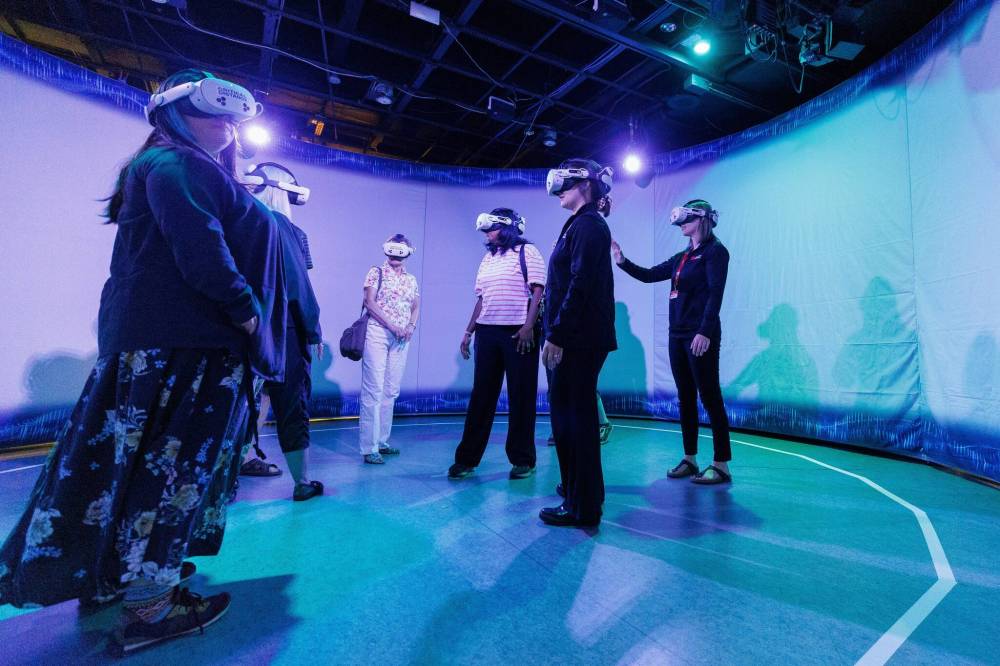
                                A group of participants watch Critical Distance via AR goggles at the Manitoba Museum.
MIKE DEAL / FREE PRESS

A group of participants watch Critical Distance via AR goggles at the Manitoba Museum.

“Some people get pretty emotional going through the experience. We want to take that emotion and engagement and turn it into something useful for the orca pod and the ocean that Nature Canada is trying to protect. We thought a great way to do that would be to have visitors understand the different roles they can play,” he says.

MIKE DEAL / FREE PRESS
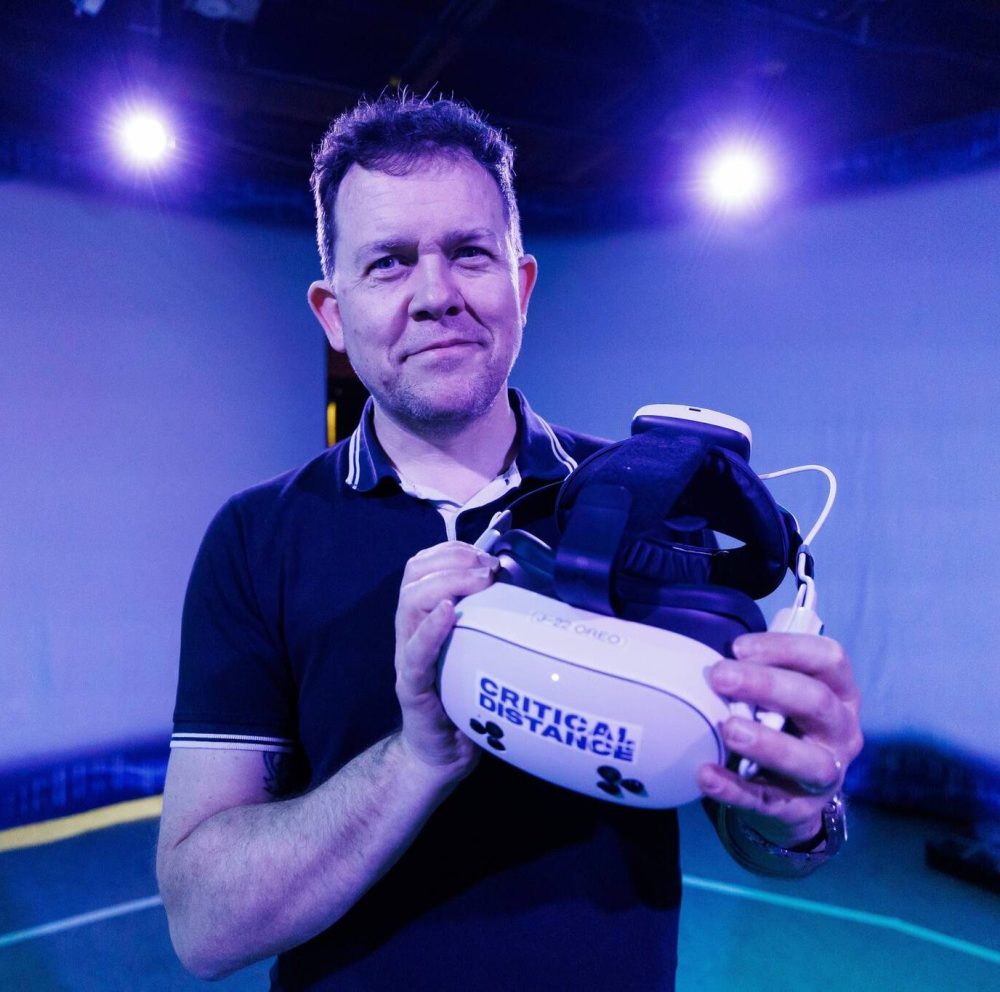
                                Adam May is co-creator of Critical Distance.
MIKE DEAL / FREE PRESS

Adam May is co-creator of Critical Distance.

The immersive short focuses on the J Pod, one of three pods in the acoustic clan who are residents of the waters. The audience follows eight-year-old orca Kiki and her family as they navigate the challenges thrown up by human activity.

Sound is vital to the orca whales, who use echolocation to communicate, and sound pollution is threatening the pod’s ability to hunt, bond and navigate.

The term “critical distance” refers to the point in space where direct sound, such as an orca’s call, is equal in intensity to reverberant or background noise.

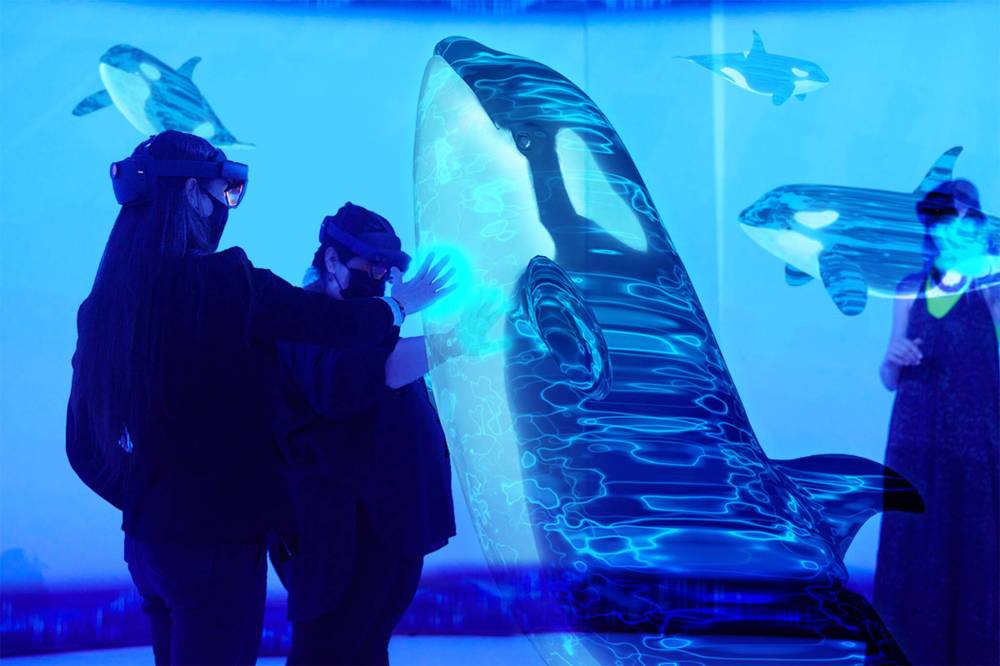
Placed in the middle of the pod, viewers hear and see the clicks, whistles and calls the members of the pod use to communicate with each other.

These vocalizations are typically effective across long distances in a natural ocean environment, but the orcas, who live beneath a busy shipping area, struggle to make themselves heard.

“Some people get pretty emotional going through the experience. We want to take that emotion and engagement and turn it into something useful.”–Scott Mullenix

Human activity, especially from boats, ships and underwater construction, has introduced significant noise pollution into marine habitats.

This background noise effectively reduces the critical distance, which means orcas have to be much closer to each other before their calls are distinguishable from the surrounding noise.

Submerged underwater with Kiki, the contrast in the varying sounds different vessels make become obvious – paddle boats barely make a splash, but motorboats and trawlers jar the quiet, littering the water with their loud vibrations.

Sounds are translated into visuals so the audience can see what the orcas hear; it’s a simple but effective method to experience the world from an entirely different perspective.

After the AR animation, visitors are invited to join the movement to protect Canada’s ocean by connecting directly with ocean conservation experts through Nature Canada’s Ask the Experts section.

MIKE DEAL / FREE PRESS
                                Critical Distance participants are fully immersed in the orca’s experience.
MIKE DEAL / FREE PRESS

Critical Distance participants are fully immersed in the orca’s experience.

Visitors can ask whatever they want about orcas, threats to the Salish Sea or the ocean in general. Their questions will be sent to experts who include Adam Olsen, lead negotiator and member of Tsartlip First Nation; Julia Laforge, protected areas policy manager at Nature Canada; and Rebecca Brushett, marine planning and engagement co-ordinator at Ecology Action Centre, who will reply with answers.

The hope is that the experience will encourage people to lobby for change to protect one of the country’s most endangered marine mammals — at last count, there were fewer than 80 southern resident killer whales in the Salish Sea.

av.kitching@freepress.mb.ca

AV Kitching

AV Kitching
Reporter

AV Kitching is an arts and life writer at the Free Press. She has been a journalist for more than two decades and has worked across three continents writing about people, travel, food, and fashion. Read more about AV.

Every piece of reporting AV produces is reviewed by an editing team before it is posted online or published in print — part of the Free Press‘s tradition, since 1872, of producing reliable independent journalism. Read more about Free Press’s history and mandate, and learn how our newsroom operates.

Our newsroom depends on a growing audience of readers to power our journalism. If you are not a paid reader, please consider becoming a subscriber.

Our newsroom depends on its audience of readers to power our journalism. Thank you for your support.


Report Error Submit a Tip

More Stories

A grand jeté of climate-change denial

Gwynne Dyer 5 minute read Preview

A grand jeté of climate-change denial

Gwynne Dyer 5 minute read 2:00 AM CDT

The first hurricane to hit Hawaii in 34 years. The Mediterranean on fire from Spain to Greece. ‘Heat domes’ one after another for months on end in Europe and North America. Thousands of excess deaths. A record El Niño piled on top of an average global temperature up from +1.2 C five years ago. Predicted high for this year: +1.7 C.

Surely they’ll get it now, you think — but no, they won’t. It once seemed sensible to think that when the climate damage gets bad enough and the trend line becomes impossible to ignore, ‘they’ (meaning the climate change deniers and their fellow travellers) will finally accept that the threat is real and urgent action is necessary.

A few of them will, but most will not.

It is becoming clear that as the old position of flat disbelief in climate science becomes untenable, the preferred response among former deniers is to admit that climate change is big, dangerous and already well underway — but to insist that it is already too late and nothing can be done about it now.

Read
2:00 AM CDT

Letters, Aug. 18

7 minute read 2:01 AM CDT

In support of real engineering

Jerry Storie’s op-ed Take advantage of hydroelectric potential and Laura Cameron’s op-ed Lasting legacy or pining for a pipe dream, both in the Free Press Aug. 17, provide quite different perspectives on what should be done to provide reliable power to Manitoba residents in the future.

Mr. Storie advocates construction of more hydroelectric projects rather than new natural gas generated capacity to offset looming power shortages. He argues that these hydroelectric projects will benefit Manitoba for the next century, and observes there will be significant increases in the demand for electricity in upcoming years. He is not wrong in any of these observations. However, hydroelectric developments are very capital intensive and have long lead development periods. Natural gas generation can be brought on line far more quickly with less investment. And perhaps Mr. Storie’s minimization of the environmental impacts of these developments deserves more scrutiny. Any First Nations impacted by development deserve to be consulted and participate in any benefits. Having said this, Mr. Storie is a former minister responsible for Manitoba Hydro, and thus has a fairly deep understanding of the issues at hand.

Laura Cameron advocates against construction of the LNG pipeline and terminal at Churchill, citing “the technical challenges of building a pipeline over thawing permafrost; the prohibitive cost of ice-breaking tankers that move LNG through the Arctic; and a forecasted global oversupply of LNG and uncertain long-term export markets.” These would all be persuasive arguments if Ms Cameron possessed any credentials indicating an expertise in engineering or economics. She does not. The balance of Ms Cameron’s op-ed focuses on ways for Manitoba to reduce its carbon footprint while taking a few shots at the proposed LNG pipeline to B.C. Her opposition to the pipeline to Churchill is almost a Trojan horse.

Pair of banks abandoning Brandon’s downtown

Abiola Odutola 3 minute read Preview

Pair of banks abandoning Brandon’s downtown

Abiola Odutola 3 minute read 2:01 AM CDT

BRANDON — Two of Canada’s major banks are set to relocate from their longstanding downtown Brandon locations in October.

BMO will close its branch on Rosser Avenue and move to a new location on Park Avenue while Royal Bank of Canada’s Rosser branch will be consolidated with the existing RBC branch on 18th Street.

Neither bank owns its downtown property or could say what will happen to the buildings after they vacate.

BMO spokesperson Jeff Roman described the bank’s move to Park Avenue as an investment in the Brandon community.

Read
2:01 AM CDT

Liquor authority fines True North $12K after minors with fake ID served at Jets White Out party

Nicole Buffie 5 minute read Preview

Liquor authority fines True North $12K after minors with fake ID served at Jets White Out party

Nicole Buffie 5 minute read Yesterday at 6:17 PM CDT

True North Sports and Entertainment was hit with a $12,000 fine for serving minors with fake IDs during a Winnipeg Jets White Out street party in 2025.

The company was fined by the Liquor, Gaming & Cannabis Authority of Manitoba on May 13, 2025 after liquor inspectors attended the May 9 street party and witnessed two two minors in possession of and consuming liquor. One was visibly intoxicated, according to a compliance order dated May 15, 2025.

Both minors had security-issued “18+” wristbands and were using identification that was expired and “clearly not their image.”

The compliance order, provided to the Free Press by the LGCA, said inspectors also noticed inadequate identification checking by security before issuing the wristbands, which identify the people wearing them as being of legal drinking age.

Read
Yesterday at 6:17 PM CDT

City crews cleaning up drug paraphernalia, weapons having some impact on inner-city life

Malak Abas 7 minute read Preview

City crews cleaning up drug paraphernalia, weapons having some impact on inner-city life

Malak Abas 7 minute read Yesterday at 5:49 PM CDT

A three-person crew, employed by the city as part of its recently expanded proactive cleanup program, allowed the Free Press to follow along last week while they worked to make the Freight House Recreation Centre's property safe to play in.

Read
Yesterday at 5:49 PM CDT

Volunteer helps keep Nellie McClung’s legacy alive

Tiago Resko 4 minute read Preview

Volunteer helps keep Nellie McClung’s legacy alive

Tiago Resko 4 minute read Yesterday at 6:00 AM CDT

Growing up with ties to the community of Manitou, Gillian Potvin has found great inspiration in the traces of Nellie McClung’s legacy.

The 39-year-old has spent nearly a decade channelling that inspiration back into the community by being a key part of the Nellie McClung Museum of Canada’s marketing and events planning since it opened at 55 Main St., in the southern Manitoba town in 2017.

Utilizing her skills in marketing and digital design for the museum is her way of thanking the woman who fought for the rights she has today and continuing her legacy.

“She helped women to be identified as persons and that’s huge,” she said of the woman born in 1873 and considered one of Canada’s most prominent suffragists. “It’s easy to take for granted some of these rights we now have as women, but there would have been a big fight back in the day to change the things that have always been.”

Read
Yesterday at 6:00 AM CDT