The art of healing Innovative program lets hospital patients choose a painting for their room
Read this article for free:
or
Already have an account? Log in here »
To continue reading, please subscribe:

Digital Subscription
One year of digital access for only $205*
- Enjoy unlimited reading on winnipegfreepress.com
- Read the E-Edition, our digital replica newspaper
- Access News Break, our award-winning app
- Play interactive puzzles
*First annual payment billed as $205.00 + GST for one year. This annual subscription will automatically renew at $233.00 + GST every 52 weeks (10% off the regular annual price of $259.35). Offer available to new and qualified returning subscribers only. Cancel any time.
To continue reading, please subscribe:
Add Free Press access to your Brandon Sun subscription for only an additional
$1 for the first 4 weeks*
- Enjoy unlimited reading on winnipegfreepress.com
- Read the E-Edition, our digital replica newspaper
- Access News Break, our award-winning app
- Play interactive puzzles
*Your next Brandon Sun subscription payment will increase by $1.00 and you will be charged $17.95 plus GST for four weeks. After four weeks, your payment will increase to $24.95 plus GST every four weeks.
Read unlimited articles for free today:
or
Already have an account? Log in here »
Hey there, time traveller!
This article was published 10/10/2025 (349 days ago), so information in it may no longer be current.
Amid the beating of monitors, the tangle of IV tubes, the threadbare gowns and uncomfortable institutional beds, it’s rare for patients to find moments of peace in a hospital setting.
However, a new art program at St. Boniface Hospital, which focuses on holistic healing, is hoping to serve as a salve to the stressed, to provide comfort to the afflicted.
On this day, a space has been reserved on one patient’s wall where a member of the hospital’s carpentry team, along with the hospital’s art curator, will turn up to hang a painting.
MIKE DEAL / FREE PRESS
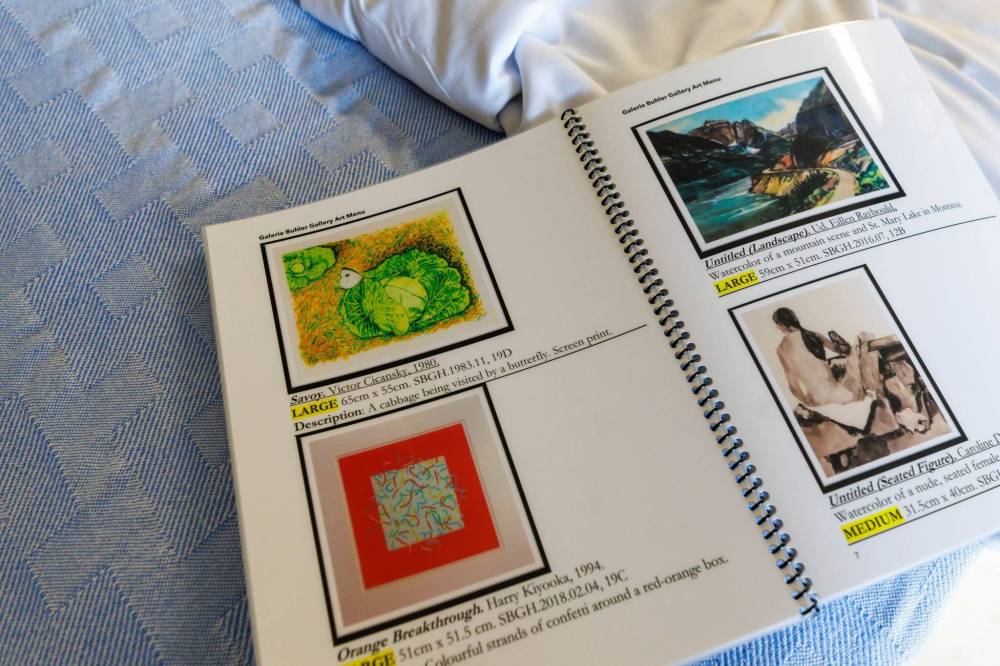
St. Boniface Hospital patients can choose a piece of art they would like to have hanging on the wall of their room from the patient art menu.
The patient has chosen the art they want from the patient art menu; it will remain until they are discharged. Should they tire of the painting, they can select another artwork.
While the project is still in its early stages, it has been well received by patients, members of staff and hospital management.
Spearheaded by hannah_g, the collection’s curator at the hospital’s on-site Galerie Buhler Gallery, the patient art menu took shape in December 2024, and was co-curated with Julia Jennings, an intern from the MA in Cultural Studies program at the University of Winnipeg. The catalogue features 16 paintings by Manitoba artists on a variety of styles and subjects, ranging from natural landscapes to more abstract pieces.
“Here, the art is actually working. It’s doing heavy lifting.”
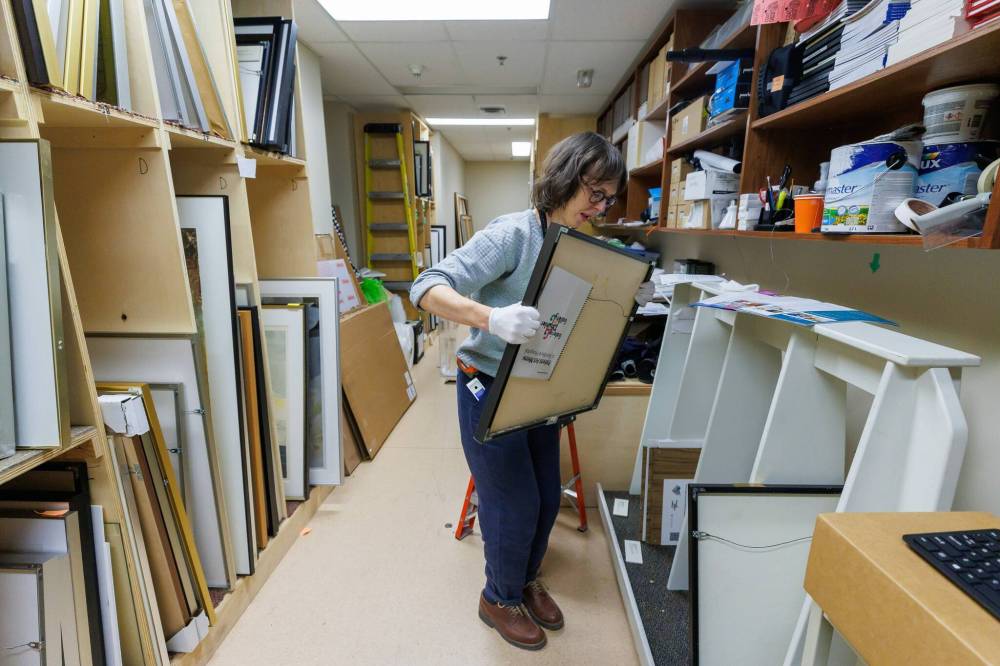
The paintings were selected from the hospital’s art collection, which contains more than 400 works.
The program offers patients a sense of autonomy. In an environment where they have very little say in how their day unfolds, the ability to choose a work of art for their space comes as a welcome relief.
For hannah_g (an artist and author born Hannah Godfrey), it also gets the hospital’s collection out of storage and onto walls.
The guiding ethos of her curatorial practice is rooted in her desire to not just care for the collection, but to share works she finds exciting, beautiful or challenging.
“Art can reflect experience, it can give people a means of expressing what they’re going through,” she says. “It can offer different perspectives on profound experiences. Art can distract — that’s one of the most useful things in the hospital. It just distracts you from events that can be very sad or even very happy.
MIKE DEAL / FREE PRESS
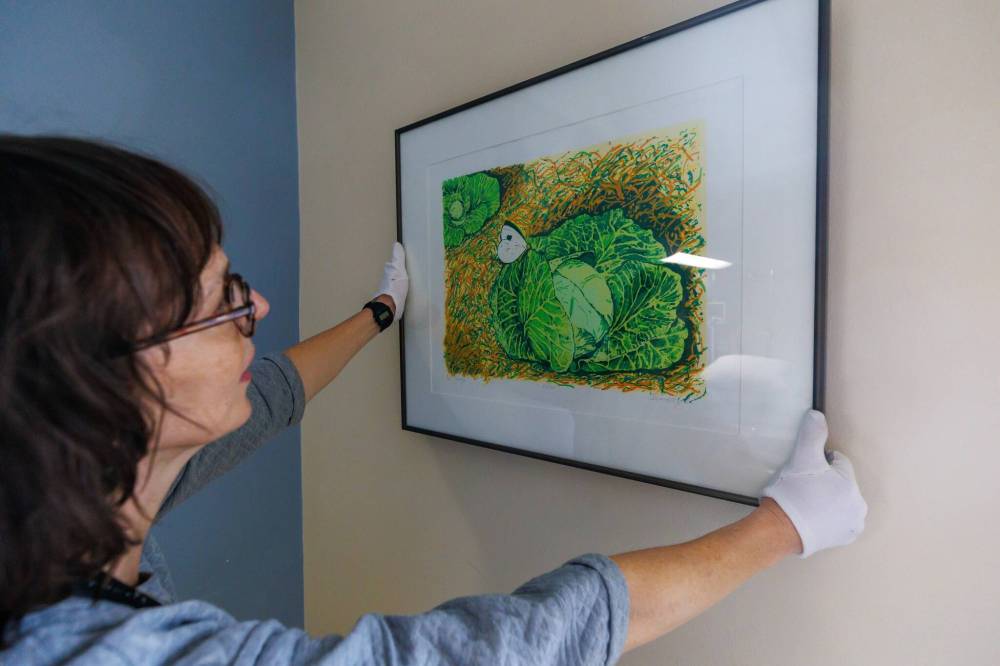
hannah_g, curator of the Galerie Buhler Gallery at St. Boniface Hospital, prepares to hang a piece of art — Savoy by Victor Cicansky (1980) — in a patient’s room.
“Here, the art is actually working. It’s doing heavy lifting.”
She believes both galleries and hospitals can be transformative, sacred spaces.
“In some ways there’s lots of crossovers between the work of a hospital and the work of the gallery,” she says. “Hospitals are really magical places where healing happens; a hospital can totally transform someone’s life and health. And art is able to offer different perspectives on profound experiences. It can have real benefits, it can positively impact how people feel.”
St. Boniface patients, visitors and staff have always been able to enjoy the hospital’s impressive collection of art, whether they are standing for an elevator, sitting in the waiting area or popping in to check out the latest exhibition in the Galerie Buhler Gallery. But for patients stuck in their beds, sometimes for months on end, enjoying art has remained somewhat inaccessible.
Until now.
“I think it’s phenomenal,” says Sandra Torchia, the hospital’s director of health services, mental health, renal health, palliative and spiritual care programs.
“With the patient art menu, we’re transcending all the barriers for patients and families and staff who can’t come down to benefit from the art. We’ve removed those barriers, bringing art and the healing to the bedside, which is wonderful.”
Torchia also believes art is medicine, another form of treatment that can support physical and mental well-being.
“Art helps decrease stress, anxiety and pain levels,” she says. “It helps with self-reflection and purpose; it gives people hope, connection and meaning. It gives you resilience, motivating you to continue on better pathways towards feeling better.”
MIKE DEAL / FREE PRESS
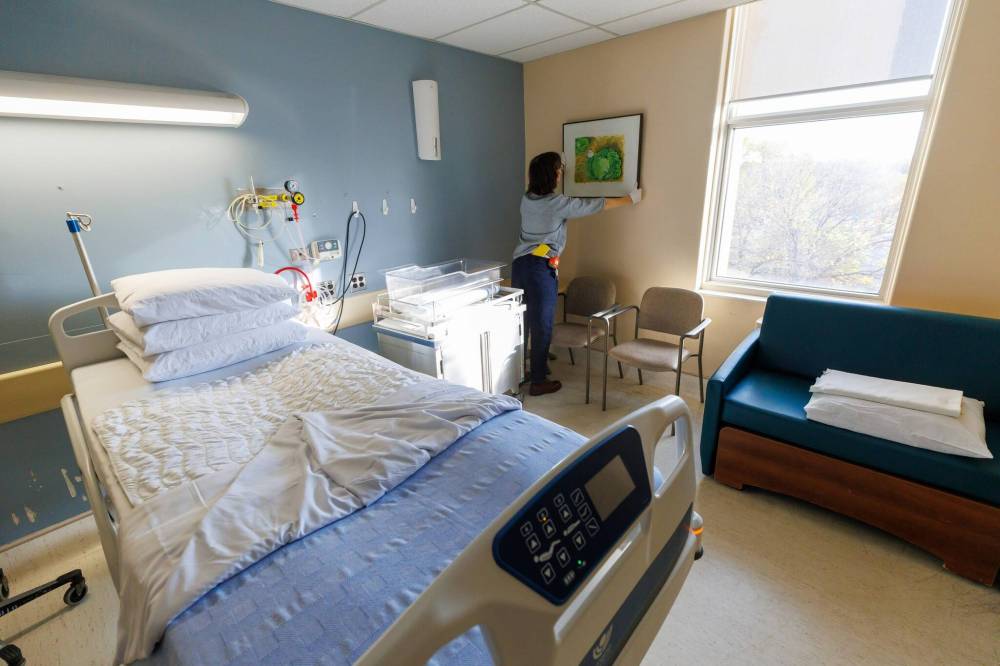
As part of St. Boniface Hospital’s art menu program, hannah_g hangs a painting called Savoy by Victor Cicansky (1980) in a patient’s room.
While art in this context is not new — in 1859, Florence Nightingale acknowledged the importance of art in medicine, writing in Notes on Nursing, “Little as we know about the way in which we are affected by form, by colour and light, we do know this, that they have an actual physical effect. Variety of form and brilliancy of colour in the objects presented to patients are actual means of recovery” — there are currently no other medical institutions in the province offering a program like this one.
“Art helps decrease stress, anxiety and pain levels.”
Not every long-term patient is offered the option to have art in their room.
Decisions are made based on a number of criteria, including length of stay and medical condition, before the patient is presented with the laminated ringbound menu.
Size is also a concern. Depending on the space available, the painting will be hung on the wall next to or at the foot of the bed, to make sure it is visible from where the patient is lying.
Hospital rooms filled with a plethora of life-saving equipment and medical paraphernalia might leave little space for paintings to be seen. It’s something hannah_g has to bear in mind when selecting more art for the program.
“The size will inform some of my acquisitions,” she says. “I’d like to have a few more pieces … and I made an acquisition specifically for the menu because it’s small and and compact.”
The hope is to introduce the program to the McEwen Building, where mental-health services are offered. Here, the paintings will have to be modified so these patients can benefit from the program in a safe manner, as framed or glass-fronted artworks cannot be displayed.
It’s a quandary, but one hannah_g is motivated to solve. She is currently considering if some of the works can be reproduced onto vinyl wallpaper that can be glued on the walls.
MIKE DEAL / FREE PRESS
Buhler Gallery curator hannah_g checks out some of the more than 400 artworks in storage at St. Boniface Hospital.
“It’s a project I am hoping to start towards the end of the year,” she says. “I would want to get the artists’ permission to do that because it is their artwork and maintaining the integrity of that is important.”

hannah_g initially approached Katie North, the hospital’s manager of health services, with the idea of an art menu. North, who had worked on previous projects with the curator, says the program can make a real difference in patient outcomes.
The pair are interested in studying the effects art can have on hospital patients and have applied for funding for an in-depth research project to examine how art can influence healing positively.
North says there’s anecdotal evidence that patients and visitors alike enjoy the pieces on the walls and in the gallery, and there is high demand for the art menu, but she would like to see a research-based report that gives feedback on how the collection impacts staff and patients.
“This is something that we want to explore further,” North says. “Art can potentially alter a mindset to a more positive outlook, which can improve patient outcomes. It gives patients a little bit more of a sense of belonging, it can make them feel less like they are in a medical facility, isolated from nature and from things that remind them of home.”
av.kitching@freepress.mb.ca

AV Kitching is an arts and life writer at the Free Press. She has been a journalist for more than two decades and has worked across three continents writing about people, travel, food, and fashion. Read more about AV.
Every piece of reporting AV produces is reviewed by an editing team before it is posted online or published in print — part of the Free Press‘s tradition, since 1872, of producing reliable independent journalism. Read more about Free Press’s history and mandate, and learn how our newsroom operates.
Our newsroom depends on a growing audience of readers to power our journalism. If you are not a paid reader, please consider becoming a subscriber.
Our newsroom depends on its audience of readers to power our journalism. Thank you for your support.
Related Articles
A lifetime of life experience only a phone call away
History
Updated on Saturday, October 11, 2025 9:55 AM CDT: Corrects name in photo cutline
Updated on Tuesday, October 14, 2025 11:15 AM CDT: Clarifies the collection was co-curated with Julia Jennings