Trojan force
Christopher Nolan crafts modern epic, brings wartime saga home

Advertisement
Read this article for free:
or
Already have an account? Log in here »
To continue reading, please subscribe:

Digital Subscription
One year of digital access for only $205*
- Enjoy unlimited reading on winnipegfreepress.com
- Read the E-Edition, our digital replica newspaper
- Access News Break, our award-winning app
- Play interactive puzzles
*First annual payment billed as $205.00 + GST for one year. This annual subscription will automatically renew at $233.00 + GST every 52 weeks (10% off the regular annual price of $259.35). Offer available to new and qualified returning subscribers only. Cancel any time.
To continue reading, please subscribe:
Add Free Press access to your Brandon Sun subscription for only an additional
$1 for the first 4 weeks*
- Enjoy unlimited reading on winnipegfreepress.com
- Read the E-Edition, our digital replica newspaper
- Access News Break, our award-winning app
- Play interactive puzzles
*Your next Brandon Sun subscription payment will increase by $1.00 and you will be charged $17.95 plus GST for four weeks. After four weeks, your payment will increase to $24.95 plus GST every four weeks.
Read unlimited articles for free today:
or
Already have an account? Log in here »
Months before this week’s release of Christopher Nolan’s adaptation of The Odyssey, the film was already being criticized for being too “woke,” insufficiently manly, overly casual and not faithful enough to the original 2,800-year-old poem.
There was a lot of online griping about the historical inaccuracy of the armour, the helmets and the boats. (These accusations about lack of realism being made, mind you, against a story that also includes a one-eyed, man-eating giant, a six-headed sea monster and a sorceress who can turn men into pigs.)
If you’re willing to approach it on its own terms, Nolan’s cinematic epic is magnificent, moving and visually astonishing. And — putting to one side those quibbles about period-specific Bronze Age breastplates — his take ends up being “realistic” in a much more profound sense: even sequences reaching toward mythic heights remain grounded in fundamental and enduring human questions about love and loyalty, death and war, time and age.
Worrying about fidelity to the original also seems by-the-by. The Odyssey is a foundational text that weaves through centuries of re-imaginings in literature and art. Even the comparatively brief history of cinema offers up several adaptations, from a 1905 silent short by Georges Méliès, to a (sadly) unrealized Ray Harryhausen Claymation version in the 1990s, to the Coen Brothers’ antic musical O Brother, Where Art Thou? from 2000.
Nolan, who directs and adapts the screenplay, is in some ways modernizing the work. Our hero’s journey back from war is more explicitly about what 21st-century people would call PTSD. The British filmmaker (Oppenheimer) also brings in several very Nolanesque trademarks — obsessiveness, a preference for practical effects, a penchant for playing around with time and braiding together multiple narratives (a tendency he shares with Homer).
Odysseus (Matt Damon), the king of Ithaca, has helped win the 10-year Trojan War with his cunning “gift” of a giant horse, which finally smuggled Greek soldiers past Troy’s fortified city walls.
There will be no triumphant homecoming, however. Odysseus’s journey back to Ithaca will become another decade-long ordeal that ends in uncertain welcome.
Back at home, Odysseus’s wife, Penelope (Anne Hathaway), is weary from fending off the scores of suitors who have encamped at the royal palace. Presuming Odysseus dead, they are drinking and feasting and generally making pests of themselves, the pestiest being the devious Antinous (Robert Pattinson).
Odysseus and Penelope’s son Telemachus (Tom Holland), meanwhile, is on his own journey, searching for the father he cannot remember.
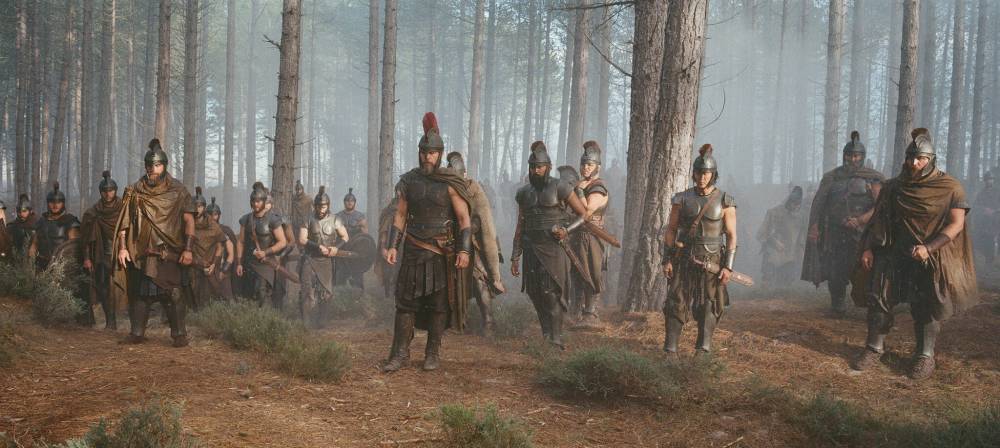
Matt Damon (centre) as Odysseus has to make his way home in The Odyssey
There’s a lot going on, as Nolan explores The Odyssey as a coming-of-age plot, a love story, a war saga and a traveller’s tale.
The film is massive, both in scale (it was filmed entirely in Imax and really cries out to be seen on a big screen) and in length (it’s almost three hours long). It looks incredible, with its rocky cliffsides and windswept beaches and wine-dark seas, its deep, nocturnal interiors lit only by braziers.
Another key aspect of the theatre experience is the polarizing, wall-of-sound score Nolan favours, this one from Ludwig Goransson.
All this grandness is anchored by very human performances. Damon often reads as stolid and all-American, but here he turns in a subtle, deliberately low-key portrayal of a very complicated hero. His Odysseus is a dedicated leader and a decent man, but he’s also possessed by a fatal carelessness, a germ of self- destructiveness.
In Nolan’s unusual interpretation of the scene in which Odysseus is lashed to the mast because he insists on hearing the Sirens’ songs, Damon achieves some unexpected existential heft.
Hathaway handles her tricky part deftly, playing Penelope as a woman who cannot wield power directly but must use what weapons she can. Holland’s portrayal of Telemachus makes him believable both as a young fatherless kid and a potential king.
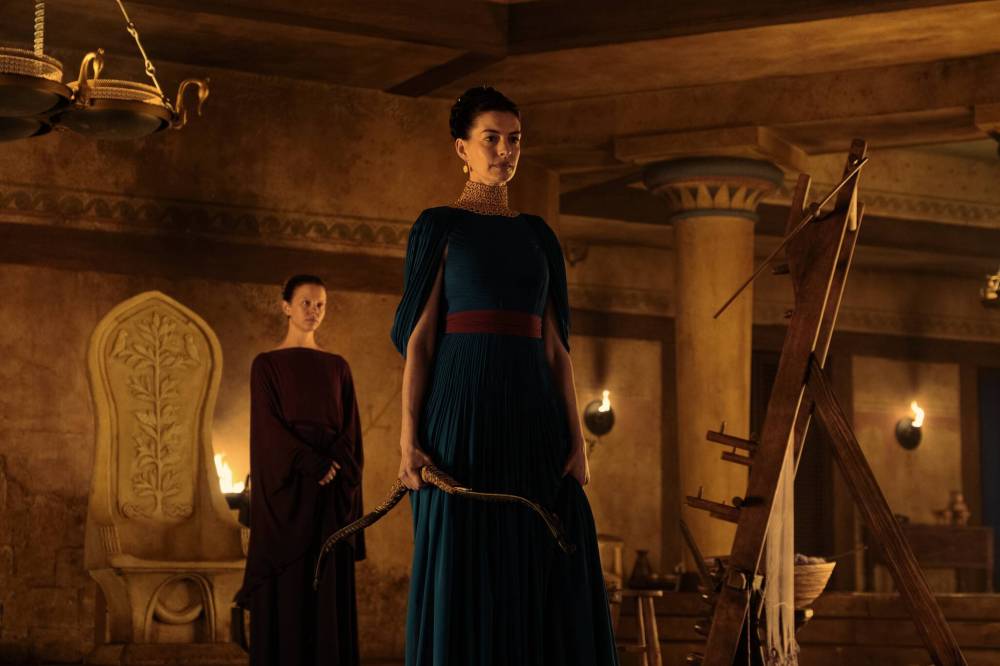
Melinda Sue Gordon / Universal Pictures
From left: Mia Goth and Anne Hathaway await Odysseus at home.
Along with these stars, the ensemble cast includes Lupita Nyong’o, Elliot Page, Himesh Patel, Samantha Morton, Charlize Theron and John Leguizamo, among others, all delivering intelligent, committed performances.
Their roles are small but often crucial, as Nolan makes some meta (and, again, very Homeric) commentary on storytelling itself. In this retelling, very slight shifts open up intriguing spaces for different interpretations, suggesting the way one sees these narratives might depend on one’s viewpoint — slave or aristocrat, man or woman, god or monster.
Nolan rejects CGI when he can and relies on down-to-earth practical effects. The Trojan Horse looks glorious from a distance, for instance, but when we finally go inside, we get a very palpable, physical sense of the sweat and stink and crush of these frightened men. The scene with the gigantic murderous cyclops involves animatronics and puppeteering and actor Bill Irwin, Nolan crafting an eerie, evocative horror sequence using shadows and flame.
One brief lapse is a scene in which Nolan uses awkward animatronics for Argos, Odysseus’s faithful dog. (I know several dogs who could have pulled this off.)

The film can be uneven and oddly paced, but it’s never dull. It hits Nolan’s strengths (ambition, originality, craft) and avoids many of his weaknesses (pointlessly complicated cleverness).
It’s mostly humourless, but it’s never lifeless or heavy. Even at its most vast, it feels vivid and human and almost painfully sincere.
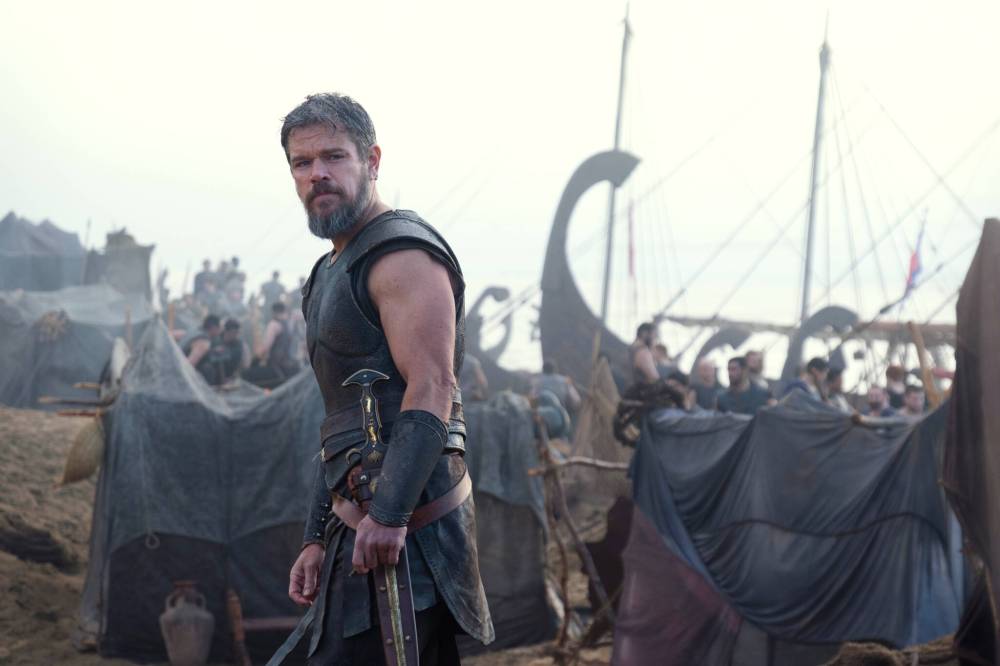
Matt Damon turns in a low-key portrayal of a complicated hero.
Finally, Nolan’s work digs deep down into those elements of The Odyssey that keep speaking to us across oceans of time, even in very different forms, but it also feels personal, even compulsive.
Nolan has been thinking about making this movie for 20 years, about as long as Odysseus’s wartime saga, and here he finally, triumphantly, brings it home.
arts@winnipegfreepress.com
Studying at the University of Winnipeg and later Toronto’s York University, Alison Gillmor planned to become an art historian. She ended up catching the journalism bug when she started as visual arts reviewer at the Winnipeg Free Press in 1992.
Our newsroom depends on a growing audience of readers to power our journalism. If you are not a paid reader, please consider becoming a subscriber.
Our newsroom depends on its audience of readers to power our journalism. Thank you for your support.
Movie review
The Odyssey
Starring: Matt Damon, Anne Hathaway and Tom Holland
● Garden City, Grant Park, McGillivray, Kildonan, Polo Park, St. Vital
● 172 minutes, 14A
★★★★ out of five
Other voices
Studying at the University of Winnipeg and later Toronto’s York University, Alison Gillmor planned to become an art historian. She ended up catching the journalism bug when she started as visual arts reviewer at the Winnipeg Free Press in 1992.
Our newsroom depends on a growing audience of readers to power our journalism. If you are not a paid reader, please consider becoming a subscriber.
Our newsroom depends on its audience of readers to power our journalism. Thank you for your support.
Related Articles
A look inside Christopher Nolan’s ‘The Odyssey’ by the numbers

Advertisement Advertise With Us
Advertisement Advertise With Us