What to know: 70mm? IMAX? Dolby? Christopher Nolan breaks down his favorite big screen formats
Advertisement
Read this article for free:
or
Already have an account? Log in here »
To continue reading, please subscribe:

Digital Subscription
One year of digital access for only $205*
- Enjoy unlimited reading on winnipegfreepress.com
- Read the E-Edition, our digital replica newspaper
- Access News Break, our award-winning app
- Play interactive puzzles
*First annual payment billed as $205.00 + GST for one year. This annual subscription will automatically renew at $233.00 + GST every 52 weeks (10% off the regular annual price of $259.35). Offer available to new and qualified returning subscribers only. Cancel any time.
To continue reading, please subscribe:
Add Free Press access to your Brandon Sun subscription for only an additional
$1 for the first 4 weeks*
- Enjoy unlimited reading on winnipegfreepress.com
- Read the E-Edition, our digital replica newspaper
- Access News Break, our award-winning app
- Play interactive puzzles
*Your next Brandon Sun subscription payment will increase by $1.00 and you will be charged $17.95 plus GST for four weeks. After four weeks, your payment will increase to $24.95 plus GST every four weeks.
Read unlimited articles for free today:
or
Already have an account? Log in here »
Christopher Nolan has been dreaming of IMAX since he was a kid. The Oscar-winning filmmaker behind “Oppenheimer,” “Inception,” and the “Dark Knight” Batman films had a formative experience seeing nature documentaries at the Museum of Science and Industry in Chicago and always wondered what it would be like to make a major Hollywood movie in that way.
“The Odyssey” is the culmination of that dream: It’s the first feature shot entirely on IMAX film.
An IMAX first
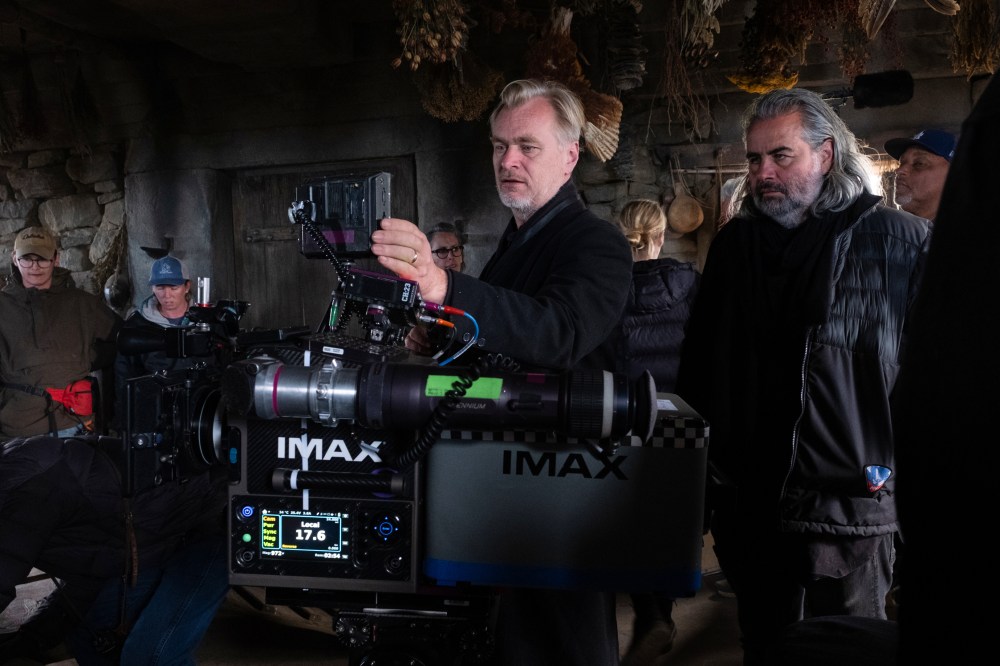
Nolan has been inching toward this landmark for many years, but the cameras were simply too noisy to use for dialogue heavy scenes. After “Oppenheimer,” the timing was right to push for development of a camera muffler that they call “the blimp.” The new IMAX camera was named The Keighley, after longtime IMAX executives Patricia and David Keighley. The film is dedicated to David, who died three weeks after finishing his work on “The Odyssey.”
The new system was not without its challenges. Encased in the blimp, the camera weighed 300 pounds. The film also needed to be reloaded every two-and-a-half to three minutes. And they had to establish a mirror system to allow the actors to see one another around the large camera while shooting a scene. It was all done with the same goal: Giving moviegoers “something special,” Nolan said. “They’re looking for something new and exciting, and that’s what we’re trying to offer.”
For audiences, there are more than a few options to see the film in movie theaters starting Friday. But it can get a little overwhelming trying to parse through all the premium large formats out there, including IMAX 70 mm, 70 mm, IMAX digital, 35 mm, Dolby Cinema and more.
Knowing that even those words can get overwhelming and technical, Nolan, in an interview with The Associated Press in 2023, broke down his favorite formats, explaining why it matters and even where he likes to sit so that audiences don’t feel like they need a film school degree before settling on a theater.
“You rarely get the chance to really talk to moviegoers directly about why you love a particular format and why if they can find an IMAX screen to see the film on, that’s great,” Nolan said. “It really is just a great way of giving people an experience that they can’t possibly get in the home.”
The Big Picture
Nolan’s three previous films, “Dunkirk ,”
“Tenet” and “Oppenheimer,” were filmed entirely on large format film stock, meaning a combination of IMAX 65 mm and Panavision 65 mm (think David Lean/ “Lawrence of Arabia”), that’s then projected in 70mm.
“The sharpness and the clarity and the depth of the image is unparalleled,” Nolan said. “The headline, for me, is by shooting on IMAX 70 mm film, you’re really letting the screen disappear. You’re getting a feeling of 3D without the glasses. You’ve got a huge screen and you’re filling the peripheral vision of the audience. You’re immersing them in the world of the film.”
He’s been shooting with IMAX cameras since “The Dark Knight,” which opened with a shot in IMAX 70mm.
“Every time we screened that, we would get a gasp,” he said. “It’s just a helicopter shot. But the format is truly stunning. And it was truly something no one had seen before.”
On a technical level, the IMAX film resolution is almost 10 times more than a 35 mm projector and each frame has some 18,000 pixels of resolution versus a home HD screen that has 1,920 pixels.
Why is it shot on 65 mm and projected in 70mm?
The 5 mm difference goes back to when that extra space on the film had to be reserved for the soundtrack. With digital sound, that’s unnecessary and it is “purely a visual enhancement,” Nolan explained.
Do the different formats impact how the film is shot?
Starting with “The Dark Knight,” they developed a system that they call “center punching the action” so that nothing is lost.
“We have to plan very carefully because by shooting an IMAX film, you capture a lot of information,” he said. “Your movie is going to translate very well to all the formats because you’re getting the ultimate amount of visual information. But there are different shapes to the screen — what we call aspect ratios. What you have to plan is how you then frame your imagery so that it can be presented in different theaters with equal success.”
Cinematographer Hoyte van Hoytema is also always aware of the “frame lines for the different theaters” when looking through the camera.
On the biggest presentations, IMAX 1.43:1 (the massive square screen) the screen essentially disappears for the audience. For other formats like 35 mm, digital and CinemaScope, the top and the bottom get cropped.
“From a creative point of view, what we’ve found over the years is that there’s no compromise to composition,” he said.
Nolan’s favorite theatrical formats
For Nolan, the “best possible experience” is the IMAX 70 mm film presentations.
These are also among the rarest, playing in only 32 theaters in the U.S. and Canada, and, in the case of popular locations like the AMC Universal CityWalk in Los Angeles and the AMC Lincoln Square in New York, are virtually sold out for weeks. Other locations showing the format include the Cinemark 17, in Dallas, the Regal King of Prussia, near Philadelphia and the Esquire IMAX in Sacramento.
“The fascination of IMAX for me was always that it was the best that celluloid film ever got. The real reason for its high quality is it’s a massive film negative. It’s a huge roll of film that runs through the projector at hundreds of miles an hour,” he said.
There are also 70 mm prints (“a fabulous presentation,” Nolan said) going out to theaters around the world.
“The two formats are sort of different and I love them both,” he said.
IMAX digital, laser and exhibitor PLF options
The vast majority of moviegoers in North America will have easier access to digital presentations. These include IMAX digital, which can sometimes mean a laser projected image and other times involves a retro formatted screen, and what’s called “exhibitor PLF,” meaning large format screen and projection systems developed by individual theater chains (like Regal RPX, Cinemark XD and Cineplex UltraAVX). When in doubt, look for an “X” in the name.
But don’t dismay: It’ll still look great, according to Nolan, whose team works for months to digitize the original film element for other formats to ensure the best experience on every screen.
“This is the exciting thing about shooting an IMAX film: When you scan it for the digital format, you’re working with the absolute best possible image that you could acquire, and that translates wonderfully to the new projector formats like the laser projectors in a lot of IMAX locations, the Dolby Cinema locations, which have a wonderful, high-contrast laser projector,” he said.
Nolan said the “IMAX impact” over the last 20 to 30 years has resulted in more theaters paying more attention to presentation, from projection to sound, which has been “great for filmmakers.”
Where are the best seats?
Well, that comes down to personal preference but here’s where Nolan likes to sit.
“When I’m in a theater that’s CinemaScope ratio, I like to be right near the front, middle of the third row,” he said. “When I’m in a stadium, IMAX 1.43:1, then I actually like to be a little behind the center line right up at the middle. So, a little further back.”
___
A version of this story was originally published on June 4, 2023. It has been updated to reflect the release of “The Odyssey” and the technological innovations that allowed them to shoot the whole movie on IMAX film.
Related Articles
Christopher Nolan crafts modern epic, brings wartime saga home
Advertisement Advertise With Us
Advertisement Advertise With Us