Tracing South Asian community’s influence in Manitoba

Advertisement

Advertise with us

When Pamela Rebello arrived in Winnipeg from India in 1968, following a few years in Cleveland, Ohio, she forged a path led by determination and courage with the vision to contribute to the province.

Read this article for free:


or

Already have an account? Log in here »

To continue reading, please subscribe:

Subscribe and receive a limited-edition Free Press branded hat or tote.

Digital Subscription

One year of digital access for only $205*

  • Enjoy unlimited reading on winnipegfreepress.com
  • Read the E-Edition, our digital replica newspaper
  • Access News Break, our award-winning app
  • Play interactive puzzles

*First annual payment billed as $205.00 + GST for one year. This annual subscription will automatically renew at $233.00 + GST every 52 weeks (10% off the regular annual price of $259.35). Offer available to new and qualified returning subscribers only. Cancel any time.

To continue reading, please subscribe:

Add Free Press access to your Brandon Sun subscription for only an additional

$1 for the first 4 weeks*

  • Enjoy unlimited reading on winnipegfreepress.com
  • Read the E-Edition, our digital replica newspaper
  • Access News Break, our award-winning app
  • Play interactive puzzles
Start now

*Your next Brandon Sun subscription payment will increase by $1.00 and you will be charged $17.95 plus GST for four weeks. After four weeks, your payment will increase to $24.95 plus GST every four weeks.

When Pamela Rebello arrived in Winnipeg from India in 1968, following a few years in Cleveland, Ohio, she forged a path led by determination and courage with the vision to contribute to the province.

Those attributes could be found among many of the individuals who made up the first South Asian diaspora in Manitoba.

“We relied on each other,” says Rebello of the small group of newcomers who adjusted to a new home and way of life. Holding on to their cultural identity and values was key to that transition as well as dealing with feelings of isolation.
JOHN WOODS / FREE PRESS
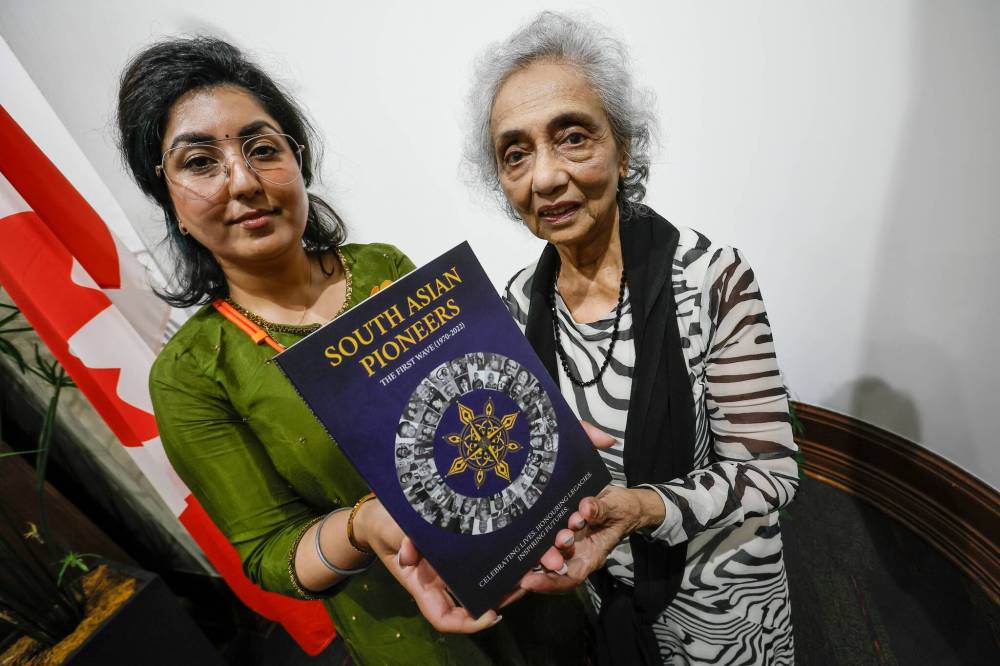
Simran Bhinder, project lead, left, and Pamela Rebello, hope the perspectives found in the book will help the broader community gain better understanding of the South Asian diaspora.
JOHN WOODS / FREE PRESS

Simran Bhinder, project lead, left, and Pamela Rebello, hope the perspectives found in the book will help the broader community gain better understanding of the South Asian diaspora.

Rebello, along with other community leaders, took their interest in fostering South Asian culture a step further by establishing the India School of Dance, Music & Theatre in 1980.

Her story and how she contributed to Manitoba’s multicultural fabric are featured in a book called South Asian Pioneers: The First Wave (1970-2022).

“We asked, how would we like to acknowledge the first group of people who really contributed to make anything happen … They were the stakeholders because we had no one and had to depend on each other,” says Rebello, school executive director and Order of Manitoba recipient, on how the book came to fruition.

The book, launched in June at a ceremony at the Manitoba legislature, documents personal histories of individuals who made up the province’s earliest wave of South Asians — from the hardships they faced to the resilience they displayed and the desire to be successful. The pioneers came from India, Sri Lanka, Africa, Pakistan, along with Trinidad and Guyana.

Arriving more than five decades ago, they became pillars in Manitoba’s South Asian community by contributing significantly to academia, public service, government, health care, business, arts and culture, community building and volunteerism. Following a change to Canadian immigration policy in the 1960s, many South Asians sought out Manitoba as their new home. While many came with skills and education in hand, some ventured here in pursuit of higher education and professional studies.

“The year 2022 represents a natural milestone, marking over five decades of community building while allowing sufficient historical perspective to document their stories and contributions,” says Simran Bhinder, who led the book project.
JOHN WOODS / FREE PRESS
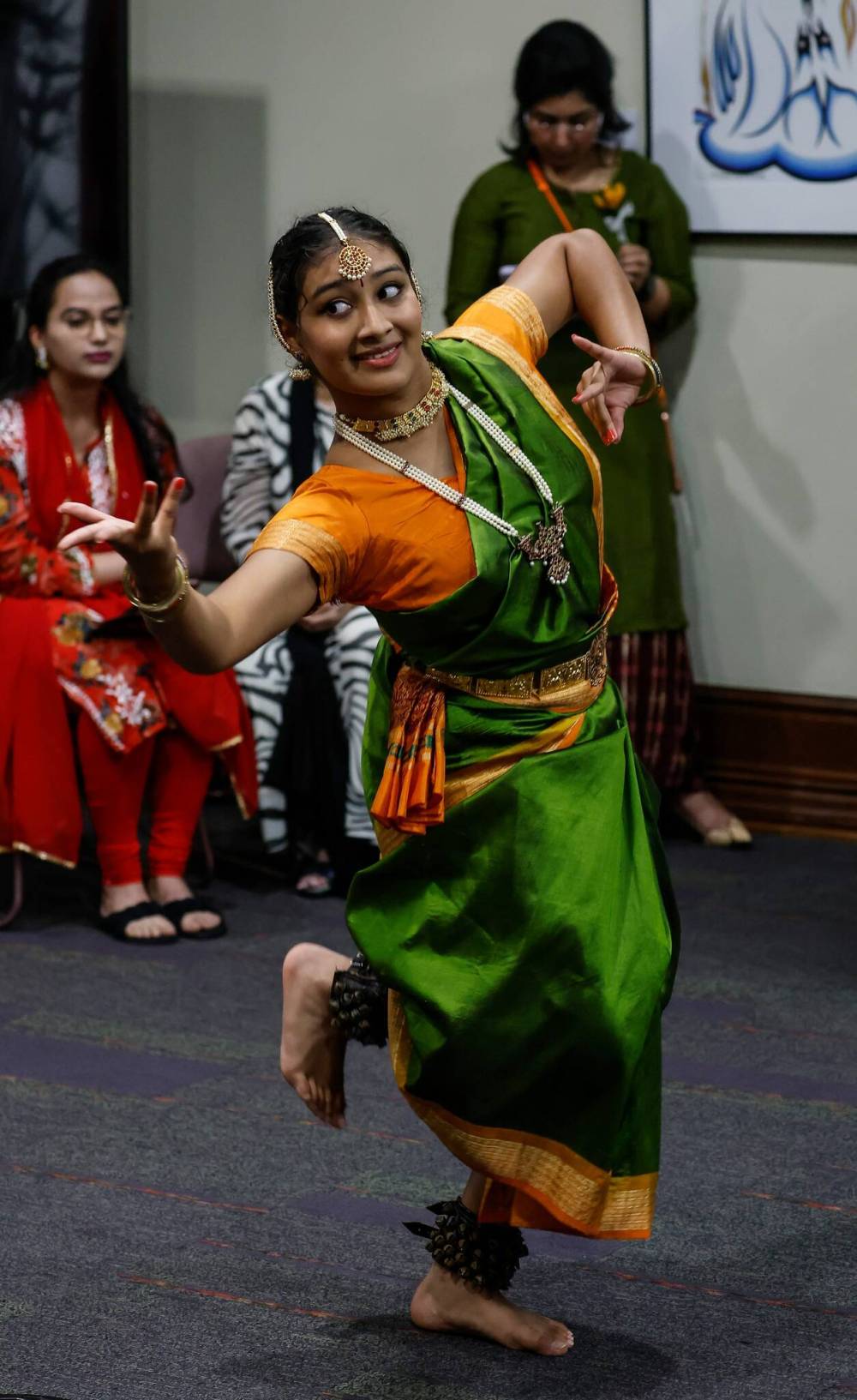
A dancer performs at the book launch South Asian Pioneers at the Manitoba Legislature.
JOHN WOODS / FREE PRESS

A dancer performs at the book launch South Asian Pioneers at the Manitoba Legislature.

The book features more than 85 narrative-style profiles. It is not an exhaustive list, Bhinder says, but recognizes those who not only contributed to the province’s educational, economic, cultural and social landscapes, but also, through their leadership, built Manitoba’s South Asian communities into what exists today. The organizations were more than hubs for the community to stay connected through their arts, culture and heritage. They also built a broader awareness with the vision of a lasting legacy.

Rebello and Bhinder hope the perspectives can help the broader community gain better understanding of the South Asian diaspora.

The project helped Bhinder realize “how these stories can be lost if they are not intentionally documented … and that history is not only created by governments or institutions. It is also created by ordinary people who quietly build these communities …You will see in this book there is not just one sector that has been documented. People are from so many different sectors…There are a lot of different areas where people have been trailblazing.”

While some of those profiled in the book have since died or moved away, they shared a common bond of perseverance and a passion to make Manitoba better, Bhinder says.

Some of the pioneers in the book are:

● Ganga Dakshinamurti: Library professional, including educator at Red River College library technician program and information literacy and library services at University of Manitoba Libraries; co-founder and company co-ordinator of Manohar Performing Arts of Canada.

● Krishnamurti Dakshinamurti: Scientist in physiology and pharmacology, educator and mentor at University of Manitoba, founder of Mahatma Gandhi Centre of Canada, established Dakshinamurti Academy of Hindu Studies at Hindu Society of Manitoba, Order of Manitoba recipient.

● Naranjan S. Dhalla: cardiovascular researcher, educator and mentor at University of Manitoba; Director of the Institute of Cardiovascular Sciences at the St. Boniface Hospital Research Centre, Winnipeg Citizens Hall of Fame Bust in Assiniboine Park, Contributor to community and cultural organizations, Order of Canada and Order of Manitoba recipient.

● Dr. Chander K. Gupta: Physician in obstetrics and gynecology, educator and advocate in women’s health care, Contributor to community organizations, Order of Manitoba recipient.

● Dr. Daya Gupta: Ophthalmologist/chief surgeon at the Gupta Eye Centre and medical director of the Ultravision Eye Laser Centre; contributor to philanthropic endeavours in support of research, education and community organizations.

A mandala design, which includes intricate patterns expanding outwards from a central point, is featured on the cover and captures the essence of the book — with Manitoba’s South Asian early pioneers serving as the nucleus from which future generations can move forward. Both Rebello and Bhinder hope the stories will inspire the next generations of the South Asian community to continue contributing to the province and share their journeys through future publications.

“When I look at the cover design and see the mandala … I see all the people at one time when we began together,” Rebello says. “I see us as advocates nurturing the other groups that will come, the other waves. You all will go and do better, bigger and greater things in Manitoba.”

For more information, contact ISDMT at indiasch@mymts.net

Romona Goomansingh is an educator, freelance writer and author in Winnipeg.

Report Error Submit a Tip

More Stories

Desperate Poilievre wants Canadians to believe the sky is falling when it’s just cloudy outside

Tom Brodbeck 5 minute read Preview

Desperate Poilievre wants Canadians to believe the sky is falling when it’s just cloudy outside

Tom Brodbeck 5 minute read Yesterday at 12:47 PM CDT

Pierre Poilievre has a problem.

Canadians just don’t seem to be paying much attention to him anymore.

So, naturally, the Conservative Opposition leader has decided to turn up the volume.

At a recent party caucus retreat in Penticton, B.C., Poilievre delivered the familiar message: Canada is in trouble, Canadians are hurting and the Liberal government is making everything worse.

Read
Yesterday at 12:47 PM CDT

Siloam Mission, WFPS discussing on-site paramedic to reduce staggering number of emergency calls

Scott Billeck 4 minute read Preview

Siloam Mission, WFPS discussing on-site paramedic to reduce staggering number of emergency calls

Scott Billeck 4 minute read Yesterday at 2:00 AM CDT

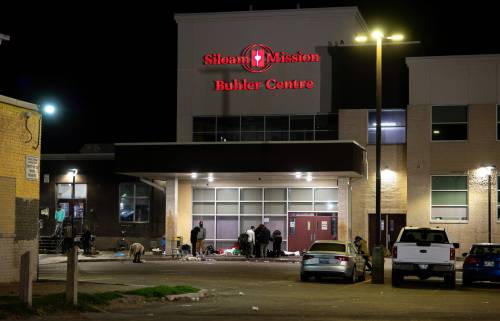
Winnipeg’s fire-paramedic service and its largest homeless-serving organization are discussing what it would look like to station at least one paramedic at Siloam Mission, as emergency calls to the downtown facility surge.

The ongoing discussions come as Winnipeg Fire Paramedic Service crews were dispatched 1,771 times during the first eight months of the year to the two adjacent Siloam properties at 303 Stanley St. and 300 Princess St.

WFPS said most of the calls were related to overdoses or other consequences of substance use, with the total nearly double the 854 calls recorded over the same period last year. By comparison, there were 831 calls during the same span in 2024, and 591 in 2023.

“The number of emergency calls isn’t sustainable for us as a service, but it’s certainly not sustainable for them as an agency trying to provide services,” WFPS chief Ryan Sneath told the Free Press. “And they recognize that they’re impacting emergency services, not them specifically, but the site in a significant way.”

Read
Yesterday at 2:00 AM CDT

United Way, other charities fight for dollars as donor base shrinks

Scott Billeck 8 minute read Preview

United Way, other charities fight for dollars as donor base shrinks

Scott Billeck 8 minute read Yesterday at 2:00 AM CDT

Winnipeg’s charitable sector is being squeezed from both sides: demand for help is growing while the pool of donors to meet that need is shrinking.

The imbalance is increasingly being carried by a relatively small group of deep-pocketed donors. Last year, 600 people — about three per cent of United Way Winnipeg’s individual donors — accounted for roughly $8 million, or 55 per cent of individual donations.

The fundraising pitch isn’t getting any easier.

Homelessness and public drug use have become increasingly visible, household budgets remain strained and the problems charities are trying to address can seem so entrenched that donors may reasonably wonder what difference another contribution can make.

Read
Yesterday at 2:00 AM CDT

Kinew delivered what most of us wanted; now we’ll have to deal with the consequences

Dan Lett 5 minute read Preview

Kinew delivered what most of us wanted; now we’ll have to deal with the consequences

Dan Lett 5 minute read Updated: Yesterday at 8:43 AM CDT

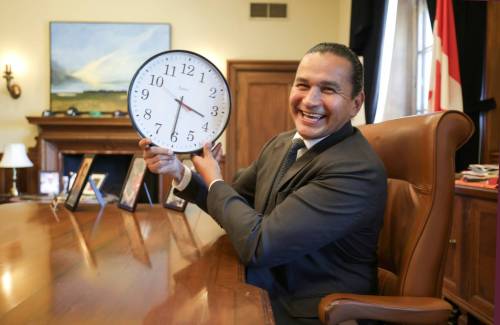
Premier Wab Kinew has decided to adopt permanent daylight savings time, which means a permanent end to the spring forward, fall back tradition of adjusting our clocks. And absolutely no one is surprised.

Read
Updated: Yesterday at 8:43 AM CDT

A quick look at where provinces and territories stand on time changes

The Canadian Press 2 minute read Preview

A quick look at where provinces and territories stand on time changes

The Canadian Press 2 minute read Updated: Yesterday at 6:28 AM CDT

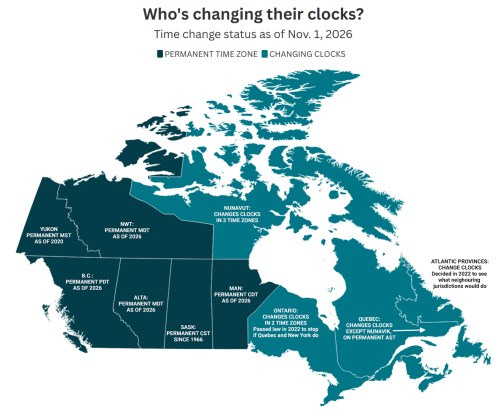
WINNIPEG - Manitoba's government said Thursday the province will be sticking with daylight time year-round, making it the latest jurisdiction to move away from twice-annual time changes. Here's a look at where things stand across Canada:

British Columbia said in March that it was moving to permanent Pacific daylight time. The change also means that parts of northeastern B.C., which have been on mountain standard time year round, are now in alignment with the rest of the province.

Alberta also switched to permanent daylight time this year in what it calls Alberta time. The change means it now has the same time as Saskatchewan year round.

Saskatchewan has been on permanent central standard time since 1966.

Read
Updated: Yesterday at 6:28 AM CDT

Family account spiced with magic realism, geopolitical intrigue and a ghost story

Reviewed by Zilla Jones 4 minute read Preview

Family account spiced with magic realism, geopolitical intrigue and a ghost story

Reviewed by Zilla Jones 4 minute read 2:01 AM CDT

Tom Lin’s second novel Babylon, South Dakota moves beyond a historical account of an immigrant family’s struggle, delightfully blending and bending genres.

Lin is a Chinese-born novelist whose family emigrated to the U.S. when he was four years old. His debut novel, The Thousand Crimes of Ming Tsu, won the 2022 Andrew Carnegie Medal for Excellence in Fiction, making him the youngest ever recipient of that award. He earned a PhD in English from the University of California Davis and is currently an assistant professor of English and creative writing at the University of Iowa.

Babylon, South Dakota takes place in an unspecified time period that can be understood to be during the Mao era — likely the 1950s or ’60s. A young Chinese couple, the Hsuis, immigrate to the rural community that gives the book its title. They take the names Saul and Mei and settle on a 160-acre homestead left to them by a distant relative.

Saul’s dream is to breed and sell chrysanthemums from seeds he brought from China, while Mei wants to raise livestock. They speak no English, know nothing of life in the United States, are unprepared for the harshness of winter and the isolation of the farm and bring nothing with them except some gold, which Mei hides around the house for emergencies. Their only link to the outside world is a discarded and marginally functioning TV set, which Saul rescues and rigs up.

Read
2:01 AM CDT